 Lawrenceville Slab Leak Detectors
Slab Leak Under Garage Floor in Lawrenceville GA
A slab leak under a garage floor in Lawrenceville, GA, shows as a damp patch, a warm spot, or water pooling near the door — but a leaking water heater looks the same. Homes in ZIPs 30045 and 30046 near Sugarloaf should run the meter test, then call for detection.
What this looks like in a Lawrenceville home
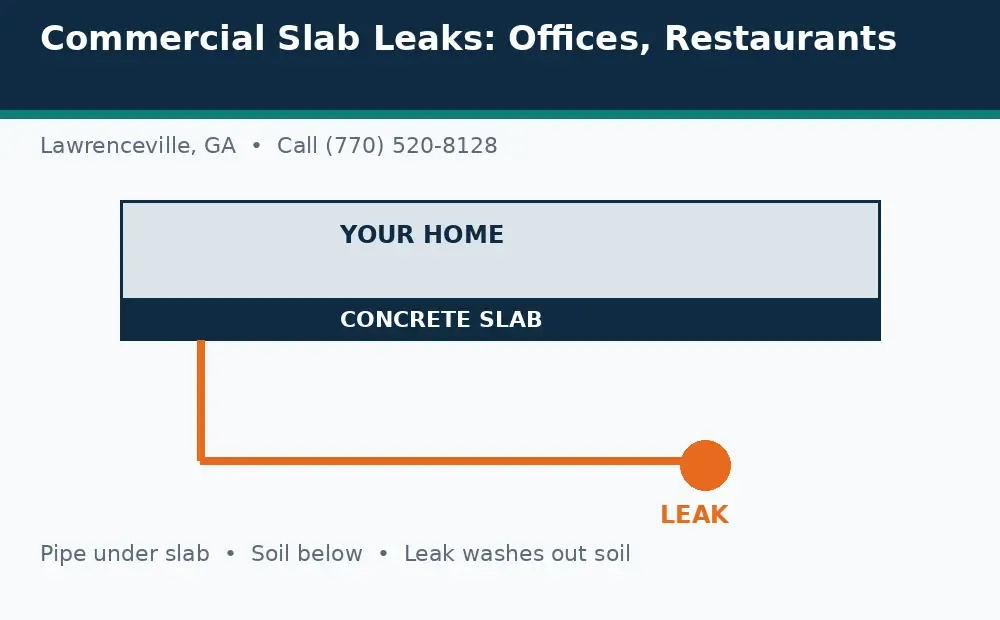
The images on this page are illustrative diagrams, not photos of a specific job at a specific address, and they are not presented as this business's own work. Call us at (770) 520-8128 if you are unsure what you are seeing.
The short answer: the garage floor is a slab too — and it hides the same leak
Homeowners rarely think of the garage floor as part of the house, but it is a concrete slab over the same soil, carrying the same pipes, as the floor inside. The pipes that feed your kitchen and bathrooms pass under the garage on their way through the house, and in many Lawrenceville homes the service line enters near the garage wall and the water heater sits in the garage itself. That makes the garage floor a common place for a slab leak to show up — and a common place for it to be misread, because a garage floor gets wet for many ordinary reasons. A damp patch, a warm spot, or water pooling near the door can be a slab leak, a water heater fault, rain, condensation, or a drain problem, and each needs a different fix. This guide works through them in order, because the pattern — not the puddle — is what identifies the cause.
The garage slab has a harder life than the slab inside the house. It carries vehicle traffic, it swings through wider temperature changes than a heated living room, and it often sits at a slightly different level from the house slab, with a seam between the two pours that water can follow. The Georgia red clay soil guide explains the shrink-swell cycle under every Lawrenceville slab, and the garage is no exception: the clay moves, the pipes move with it, and the joints and bends take the strain. The signs guide lists the clues in full.
Signs of a slab leak under a garage floor
The signs are the same ones that matter inside the house, with a garage twist: bare concrete shows them differently from carpet or tile. A damp or dark patch on the garage floor that returns after drying is the most common sign — a patch that keeps coming back has a continuing source below it. A warm patch on the floor points at a hot-water line, and on bare concrete it is easier to feel than under carpet; the warm spot guide explains why heat is the one symptom that locates itself. Water pooling near the door or along the wall base deserves attention rather than a mop. Cracks in the garage floor can be a sign too — the cracks guide explains which cracks matter and which are ordinary shrinkage — and a musty smell at the joint where the slab meets the wall, covered in the musty smell and warped floors guide, means moisture has been arriving there for a while.
The two signs that carry the most weight are the ones you cannot see on the floor at all: a water bill that jumps without a change in use, and the sound of running water with every tap off. The high water bill guide covers the rule-outs, and the running-water sound guide explains what to listen for. Either one, together with a damp or warm patch, is worth a meter test the same day.
Rule out the water heater first
Before assuming a slab leak, rule out the water heater — in many Lawrenceville homes it sits in the garage, and it is the most common look-alike for a garage-floor leak. A water heater can put water on the garage floor in several ways: the tank itself can fail and leak from its base, the drain pan underneath can overflow or its drain can block, the temperature-and-pressure relief valve can discharge, and a fitting at the top of the heater can weep. The water heater running constantly guide covers the heater as a hot-water-leak clue, and the mimics guide covers the fixtures that most often impersonate a slab leak.
Telling the two apart is mostly a matter of looking closely. Water from a heater fault sits near the heater — around its base, in or under the drain pan, or below the relief-valve discharge pipe — while slab-leak water can appear anywhere on the floor, including far from the heater. A heater that cycles constantly points at the hot side — the hot-water versus cold-water symptoms guide explains the difference. The meter test settles it from the other direction: turn everything off and watch the meter. A slab leak on a pressurised supply line moves the meter; a heater tank leak usually does not move it much once the tank has drained to the leak's level, because the tank only refills as water escapes. If the water is at the heater and the meter is still, the heater is the likelier culprit — if the heater itself is leaking, call and describe it rather than opening it up.
Other look-alikes: rain, condensation, and drains
Three more causes put water on a garage floor without any pipe failing under the slab. Rain is the first: wind-driven rain under the door, a door seal that has shrunk, or a driveway that falls toward the garage will push water in during a storm, and it dries between storms. If the water only appears after rain and only near the door, the yard leak guide covers water outside the home. Condensation is the second: on humid days, warm air meeting a cool concrete slab leaves a thin film of moisture across the floor, which dries as the slab warms and never moves the meter. The third is a drain or sewer line under the garage slab. A drain line is not pressurised, so a break there never registers at the meter, and it usually tracks with water use and may smell — the sewer versus supply guide explains why it needs a camera and a different test.
The timing log is the cheapest diagnostic tool you own. For two or three days, note when the water appears: constantly, after showers or laundry, after rain, or only on humid mornings. A patch that never dries points at a pressurised line. A patch that appears after rain points outside the plumbing. A patch that appears after a shower or laundry points at a drain. Photograph the patch each time, with the time noted.
Confirm it: the meter test and detection
Once the look-alikes are ruled out, the meter test is the confirmation step. Turn off every tap and appliance, then watch the meter dial for 15 to 30 minutes. If it moves, water is escaping from a pressurised line, and a slab leak is the leading suspect. The water meter leak test guide walks through the check step by step, and the meter test post explains how to read the result. If it does not move, a supply leak is off the table and the investigation turns to drains, the heater, condensation, or rain. Either result is useful: a meter test that finds nothing still rules out the supply side and points the investigation in the right direction.
Detection then finds the break before any concrete is opened. Acoustic listening follows the sound of escaping water through the slab, thermal imaging maps warm areas for hot-water leaks, and pressure testing of isolated lines separates the hot side from the cold side. The detection methods guide explains how they combine, and the acoustic and thermal detection guide covers the two main tools. The bare garage floor can make listening easier than a carpeted room, but detection still starts with the meter and pressure tests, not a guess about where the sound is loudest. The published planning range for detection is $300-$600, a planning range only, with a written price following inspection.
Repair options for a garage-floor slab leak
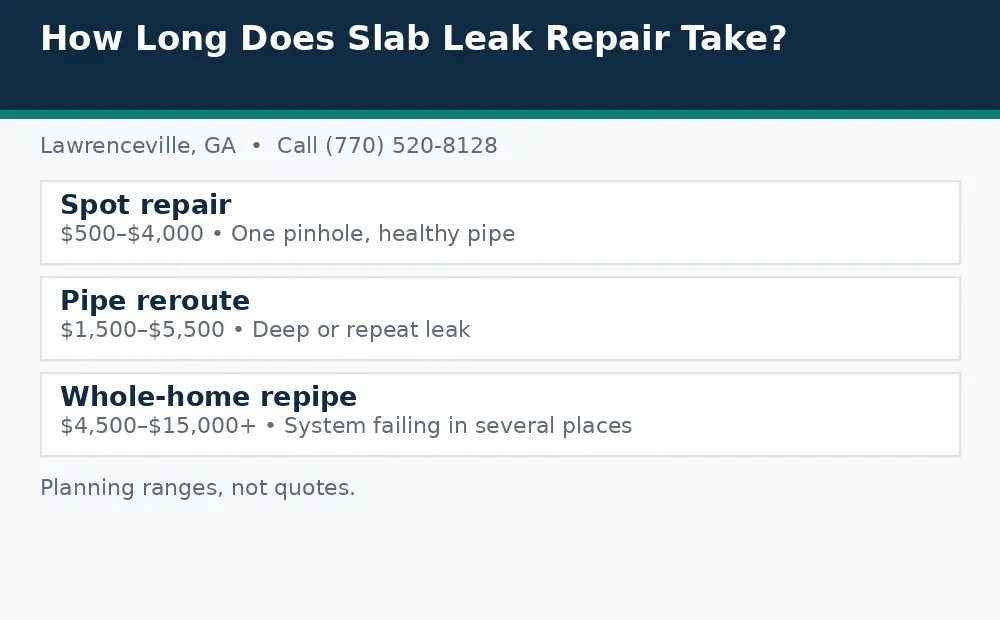
Repair depends on where the break is and what condition the pipe is in. A single leak in otherwise healthy pipe is usually a spot repair — a small, targeted opening in the garage floor, the pipe fixed, and the concrete put back. Garage spot repairs are often simpler than indoor ones, because there is no finished flooring to protect. A line that has failed before, or pipe worn along its length, may suit a reroute — a new line run through a wall or ceiling that bypasses the bad under-slab section — or a lining, where a new pipe is formed inside the old one without breaking the slab. Repeated failures point toward a whole-home repipe. The spot repair versus reroute versus repipe guide compares the routes, the fix without breaking the floor guide covers the options that avoid opening the slab, and the repair cost guide carries the published planning ranges: spot repair $500-$4,000, lining $800-$3,000, reroute $1,500-$5,500, repipe $4,500-$15,000+. Those are planning ranges only — never a quote, and never a price for your home until it has been inspected.
Whatever route is chosen, the garage floor needs putting back properly: concrete patching and floor restoration are part of the job, and the concrete and floor restoration service page covers what that step includes. And do not cut the floor open at the wet patch before detection — the break is often rooms away from where the water surfaces, as the wet spot guide explains, and a cut in the wrong place is a bill for a hole that needs restoring while the leak keeps running.
What to tell us when you call
When you call, tell us where the water appears on the garage floor, when it appears — constantly, after rain, after showers, or only in the morning — whether the floor feels warm there, what the meter did with everything off, and whether the water heater sits in the garage. Mention your ZIP code. That short list lets us plan detection around the cause, not just the puddle.
Call (770) 520-8128 and describe your situation in plain words. We will talk through detection first, then a repair plan that fits your home.
Call Us Today
Fast local slab leak detection and repair in Lawrenceville, GA, ZIPs 30043–30046.
Call Now to Speak to a SpecialistFrequently asked questions
How do I know if the water on my garage floor is a slab leak?
Run the meter test first: turn off every tap and appliance, then watch the meter dial for 15 to 30 minutes. If it moves, water is escaping from a pressurised line and a slab leak is the leading suspect. Then log the timing — constantly, after showers or laundry, after rain, or only on humid mornings. A patch that never dries points at a supply line; one that only appears after rain points outside the plumbing.
Could it be my water heater instead?
In many Lawrenceville homes the water heater sits in the garage, and it is the most common look-alike for a garage-floor leak. A failing tank leaks from its base, a drain pan can overflow, the relief valve can discharge, and a fitting at the top can weep. Heater water sits near the heater, while slab-leak water can appear anywhere on the floor. If the water is at the heater and the meter is still, the heater is the likelier culprit.
Can a slab leak under the garage floor damage my house?
Yes. Water escaping under the garage slab does not stay under the garage: it spreads through the soil and fill, follows joints and the seam between the garage and house slabs, and can reach the walls and flooring inside the home. Over time it can wash soil from under the slab, dampen baseboards and drywall, and leave a musty smell. A returning damp patch is worth a meter test promptly, not at the next convenient moment.
Does the meter test work for a garage slab leak?
Yes, for a supply-line leak. Turn off every tap and appliance, including the ice maker and any irrigation, and watch the meter dial for 15 to 30 minutes — if it moves, water is being lost from a pressurised line. A drain or sewer line under the garage slab is not pressurised, so a break there never moves the meter; it usually tracks with water use and may smell, and it needs a camera inspection rather than a meter reading.
Will repair mean breaking up my garage floor?
Not always. A single leak in otherwise healthy pipe is usually a spot repair — a small opening in the floor, the pipe fixed, and the concrete put back. Rerouting the line or lining it can avoid opening the slab at all where they fit. Detection comes first either way, because the break is not under the wet patch, and a cut in the wrong place is a bill for a hole that needs restoring while the leak keeps running.