 Lawrenceville Slab Leak Detectors
High Water Bill: Is a Slab Leak the Cause?
A high water bill in Lawrenceville can mean a slab leak, but also a running toilet, a meter misread, or an irrigation fault. Homeowners in Downtown Lawrenceville and Collins Hill, ZIPs 30046 and 30043, should compare the bill with the period last year, run a test, and rule out mimics.
Key takeaways
- Compare with the same period last year, not last month — seasonal use swings hide leaks in monthly comparison.
- A running toilet is the most common bill-jump mimic; isolate it before anything else.
- The meter test with everything off is the decisive check: movement means real loss, stillness means look elsewhere.
- If the meter moves with every mimic ruled out, a slab leak is back on the table and detection is next.
What this looks like in a Lawrenceville home
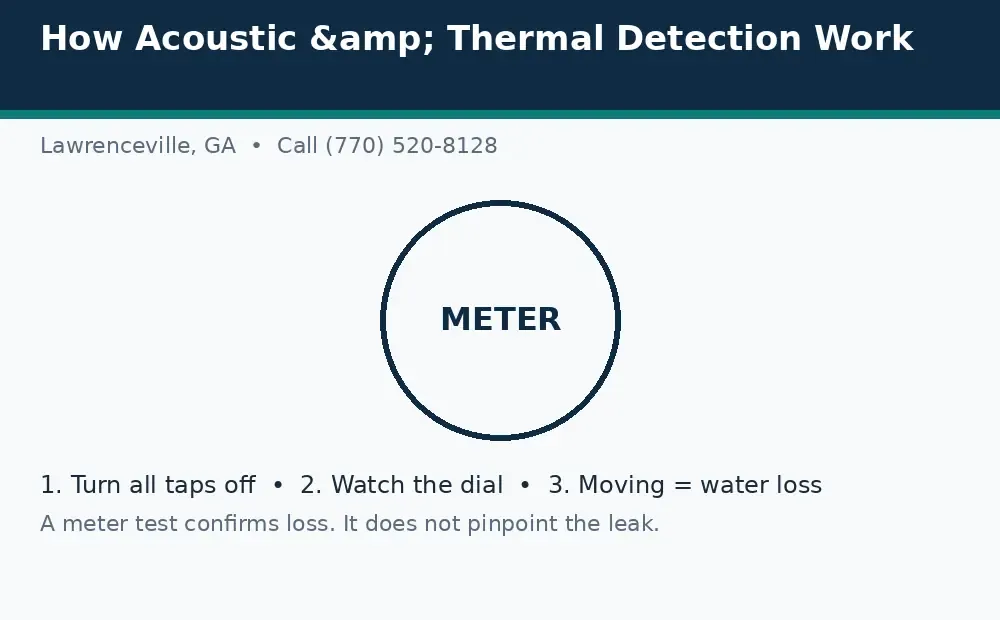
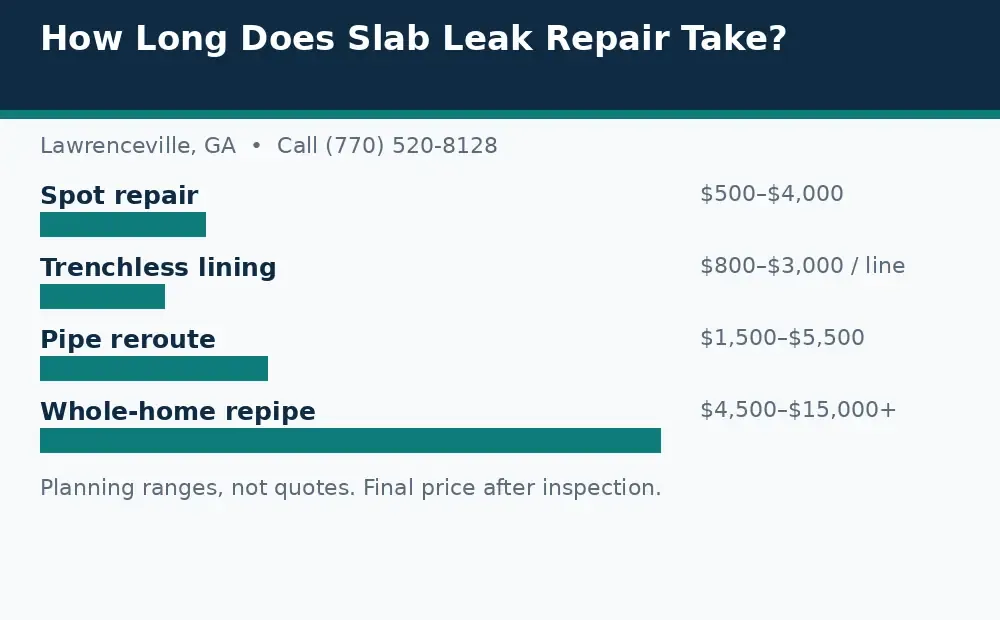
The working photo on this page is an illustrative working photo, not a photo of a specific job at a specific address. The diagrams are schematics, not to scale, made to explain the signs, process, options, or costs on this page in plain words. Call us at (770) 520-8128 if you are unsure what you are seeing.
How do I read a high bill properly?
Start with the bill's own numbers, not its total. Find the usage figure — gallons or cubic feet for the period — and compare it with the same period last year, not with last month. Summer watering, guests, a filled pool, or a new appliance all move monthly usage legitimately, and a month-on-month jump can be entirely innocent. A year-on-year jump with no matching change in household or habits is a different animal: it says the house used more water than it did a year ago under similar conditions, and that difference needs an explanation.
Next, check the bill for the boring explanations before the alarming ones. An estimated reading corrected later can produce a single-period spike that reverses next period; a billing-period length change can inflate one bill without any extra daily use. If the usage figure itself is genuinely higher and stays higher, the question becomes where the extra water went, and that question is answered by the meter, not by staring at the bill. Keep the bills in order as you go — the pattern across periods is evidence, while any single bill is only a hint. If the pattern points at loss, the hidden water cost calculator can turn your own bill rate and an observed loss rate into a monthly figure, using your rate from your bill, never an invented one.
What mimics a slab leak on the water bill?
The running toilet leads the list, for the same reason it leads the mimics page: it loses water continuously, raises the bill, and leaves no damp patch, because the water goes down the drain. After the toilet, check the outdoor suspects — an irrigation zone stuck open, a hose bib dripping, a hose left running — and the indoor ones — a dripping tap is usually too small to explain a large jump on its own, but a failed fill valve or a continuously running appliance line can contribute. Seasonal suspects belong on the list too: a new irrigation schedule, a garden project, or guests staying for weeks can all raise usage without any leak at all.
The rule-out method is isolation, one suspect at a time, watching the meter after each. Shut a toilet's supply and see whether the meter stops; shut the irrigation main and see whether the loss stops; close every bib and tap and see what remains. The mimics guide in this batch walks each suspect in detail, and the discipline is the same throughout: a mimic is confirmed when isolating it stops the loss, not when it merely looks suspicious. If every suspect is isolated and the meter still moves, the bill jump is not a mimic — it is a real loss, and the slab returns to the top of the list.
How does the meter test settle a high bill question?
The meter test is the check that converts a bill argument into a measurement. Everything in the house off — taps, appliances, irrigation, ice makers — then read the dial, wait, and read again. A dial that does not move says the house is not losing water right now, whatever the bill said: the jump was usage, estimation, a past event now resolved, or a mimic that has since stopped. A dial that moves says water is leaving the system now, and the size of the movement hints at the scale — a slow creep versus a substantial flow — without proving where it goes.
Two cautions keep the test honest. First, 'everything off' must genuinely mean everything, including the appliances people forget: ice makers, humidifiers, irrigation controllers on a timer, and a toilet that refills silently. Second, a still meter does not prove there never was a leak — an intermittent or drain-side leak may not move a supply meter at all — so a still meter after a genuine bill jump deserves a second test on another day and a look at the drain-side signs. If the meter moves persistently, the next step is slab leak detection, and the bill pattern plus the meter readings become the first evidence the technician works from.
When does a high bill mean a slab leak specifically?
A bill jump becomes a slab-leak case when three things line up: the jump persists against the same period last year, the meter moves with everything genuinely off, and the mimics have been isolated without stopping the loss. Add a corroborating sign — a warm floor, a damp patch, a sound of running water, low pressure — and the case strengthens further, because each additional sign narrows the location story. No single element proves a slab leak on its own; the combination is what justifies a detection call rather than another month of watching.
The converse also matters: a bill jump without a moving meter, without any corroborating sign, and with a plausible usage explanation is usually not a slab leak, and treating it as one wastes a detection visit. That is why this post insists on the sequence — bill pattern, meter test, mimic isolation, then detection — rather than jumping from a scary total to a slab conclusion. For homes in Downtown Lawrenceville and ZIP 30043, the sequence is identical; what varies is the house's usage pattern, which is why the year-on-year comparison, not a neighbour's bill, is the right baseline.
What should I do about a high bill today?
Today, do three things in order. First, pull the last several bills and compare usage with the same periods last year, noting the first period that breaks the pattern. Second, run the meter test with everything genuinely off, and write both readings down with the time. Third, isolate the toilet supplies and the irrigation main, one at a time, watching the meter after each. If the meter stops at any isolation, you have found the cause and the fix belongs to that fixture or system, not to the slab.
If the meter keeps moving with everything isolated, call for detection and report the bundle: the bill pattern, the meter readings, the mimics ruled out, and any corroborating sign. That bundle is also the start of any insurance file, following the documentation habits in the insurance claim process guide. Do not wait for another billing period to confirm what the meter already told you — a month of additional loss is the price of hesitation, and the meter test you already ran is confirmation enough to act on.
High bill decision table
| What you find | What it usually means | Next step |
|---|---|---|
| Jump vs last month only | Seasonal or one-off use | Compare vs same period last year |
| Jump vs same period last year | Real extra usage or loss | Meter test |
| Meter still, mimics present | Usage or a stopped mimic | Fix the mimic; re-test later |
| Meter moves, isolation stops it | Mimic found | Repair that fixture or system |
| Meter moves, all isolated | Real hidden loss | Detection call with your bundle |
The bill starts the question; the meter answers it. Never skip from a scary total straight to a slab conclusion.
Compare Usage vs same period last year — the trend, not the month.
Test Meter with everything genuinely off, readings written down.
Isolate Toilets, then irrigation, then bibs — one at a time, watching the meter.
Decide Loss stops: fix the mimic. Loss persists: detection with your evidence bundle.
What to tell us when you call
When you call, tell us what you noticed, when it started, and where in the house it shows. Mention your ZIP code, whether the water meter moves with everything off, and whether the sign is on a hot-water or cold-water line if you know. That short list helps the technician bring the right equipment and plan the visit. You do not need to know the cause before you call — that is what detection is for.
Call (770) 520-8128 and describe what you are seeing in plain words. We will talk through the next step and arrange a detection visit.
Call Us Today
Fast local slab leak detection and repair in Lawrenceville, GA, ZIPs 30043–30046.
Call Us: (770) 520-8128Frequently asked questions
How much can a slab leak raise a water bill?
It varies with leak size and duration, and no figure is offered here for a specific home. Use your own bill rate and an observed loss rate in the hidden water cost calculator to estimate your own case, rather than borrowing someone else's number.
My bill jumped once and then went back to normal. Was that a leak?
Possibly an estimated reading corrected, a one-off usage event, or a mimic that stopped. Keep the bill, compare the next period, and run a meter test if the jump repeats.
Can a running toilet really raise a bill as much as a slab leak?
Yes. A toilet losing water continuously can raise a bill substantially without any damp patch, which is why it is always isolated first in a bill investigation.
The meter does not move but my bill is high. What now?
Check usage explanations and estimated readings first, then re-test the meter on another day. Drain-side leaks and intermittent leaks may not move a supply meter.
Should I call the water utility about a high bill?
If the meter itself looks faulty or the bill shows an estimated reading you dispute, yes — ask the utility about the reading. If the meter confirms real loss on your side, the next call is for detection.