 Lawrenceville Slab Leak Detectors
Slab Leak Mimics: Is It Really a Slab Leak?
Not every sign that looks like a slab leak is one. A running toilet, HVAC condensate, an irrigation break, or a dripping hose bib can mimic one in Lawrenceville. Homeowners in Downtown Lawrenceville and Sugarloaf, ZIPs 30046 and 30045, should rule out mimics first, then run a meter test.
Key takeaways
- A running toilet is the single most common mimic — it moves the meter and raises the bill exactly like a slab leak.
- HVAC condensate, irrigation breaks, and hose bibs each leave their own clues: location, timing, and whether the loss stops when they are isolated.
- The meter test separates mimics from real loss: if the meter stops when a suspect is isolated, you found the mimic.
- If the meter keeps moving with every suspect ruled out, that is when detection earns its keep.
What this looks like in a Lawrenceville home
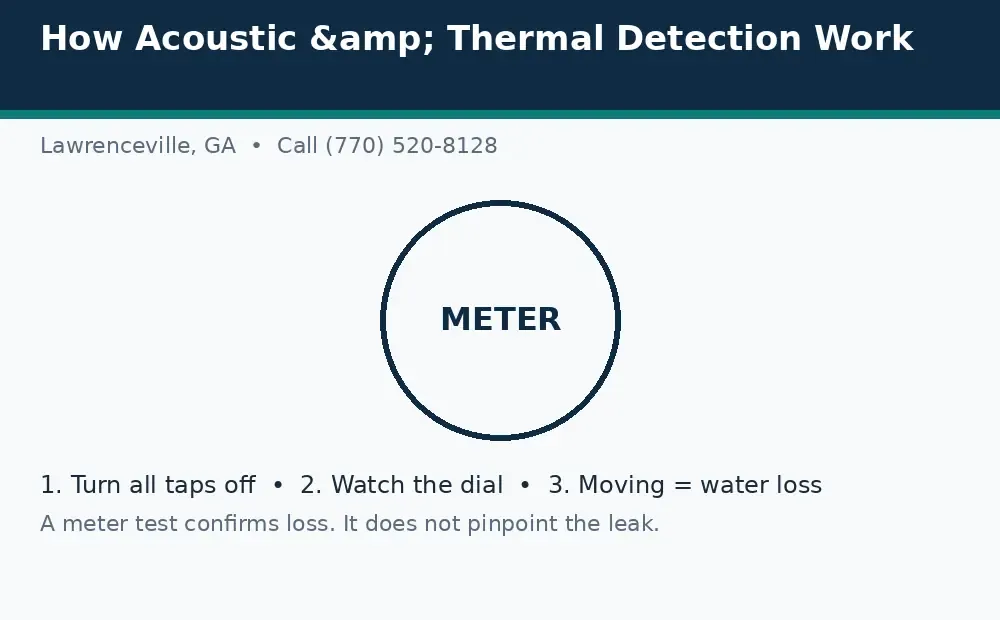
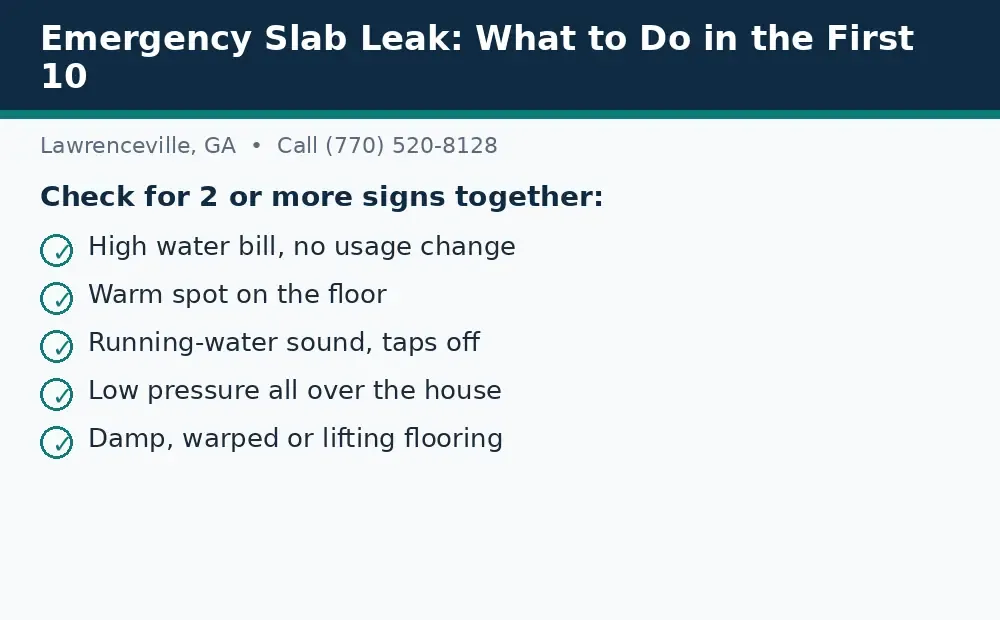
The working photo on this page is an illustrative working photo, not a photo of a specific job at a specific address. The diagrams are schematics, not to scale, made to explain the signs, process, options, or costs on this page in plain words. Call us at (770) 520-8128 if you are unsure what you are seeing.
Why do mimics matter so much?
A slab leak diagnosis starts with signs, and signs are not specific. A bill jump, a damp patch, a sound of running water, and a musty smell each have several causes, and the slab is only one of them. The practical cost of skipping the mimic check is real: a detection visit booked for a toilet problem wastes the homeowner's time and money, while a genuine slab leak misread as a toilet problem keeps washing soil from under the slab while the homeowner fiddles with a flapper. The mimic check exists to spend ten minutes ruling out the cheap causes before anyone pays for the serious investigation.
The method is simple and honest: isolate suspects one at a time and watch the meter. A mimic, by definition, stops losing water when it is isolated — turn the toilet's supply off and the meter stops, shut the irrigation main and the loss stops, close a hose bib and the sound stops. A slab leak does none of those things, because the failed pipe keeps losing water regardless of which fixture you isolate. That contrast is the whole diagnostic logic, and it is why the water meter test sits at the centre of this page: it is the instrument that tells you whether you are chasing a mimic or a real loss.
How does a running toilet mimic a slab leak?
A toilet that runs — water continuously passing from the tank to the bowl, often because a flapper no longer seals or a fill valve no longer shuts off — loses water around the clock, exactly like a pressurised pipe leak. The bill jumps, the meter moves with everything apparently off, and the house shows no damp patch, because the water goes down the drain rather than into the floor. Homeowners often miss it because the sound is quiet or intermittent, and because nobody watches a toilet that looks idle.
The homeowner check is straightforward and safe: listen at each toilet in a quiet house, look for water movement or rippling in the bowl when the toilet has not been flushed, and check whether the tank refills on its own. As a self-check only — not a procedure this site claims as a service — a dye or food-colouring test in the tank can show whether tank water is reaching the bowl without a flush; if colour appears in the bowl, the flapper is the suspect. If isolating a toilet's supply stops the meter, you have found the mimic, and the fix is a toilet repair, not detection. If the meter keeps moving with every toilet isolated, the mimic is ruled out and slab leak detection becomes the right next step.
What about HVAC condensate, irrigation, and hose bibs?
An HVAC condensate problem mimics a slab leak through damp, not through the meter. Condensate water that drains wrongly can dampen a wall base, a closet floor, or a ceiling below an air handler, and the damp patch looks for all the world like a plumbing leak. The clues are location and timing: damp that appears when the system runs hard, near the air handler or its drain route, and a meter that stays still while the damp grows. A condensate issue does not move the water meter, because it is water the system already removed from the air, not supply water escaping a pipe.
An irrigation break mimics through the yard and the meter together: a cracked lateral or a stuck zone valve loses supply water outdoors, raises the bill, and moves the meter, while the house itself shows nothing. The clue is isolation — shut the irrigation main and watch the meter stop — and location, since the wet patch sits over the irrigation route rather than the slab. A dripping hose bib or an outdoor tap left open mimics the same way on a smaller scale, and it is the first thing to check precisely because it is so easy to miss: walk the outside of the house, look at every bib and tap, and confirm each is fully closed. Homes in Collins Hill and New Hope with irrigation systems should run the isolation check before assuming a slab problem, and the symptom checker helps separate these clues before you call.
What mimics come from inside the walls, not the slab?
Wall and appliance leaks are the mimics that most closely resemble slab leaks, because they dampen floors and walls from above rather than below. A washing machine hose, a dishwasher connection, a refrigerator water line, or a bathroom supply line can all leak slowly into a wall cavity and show as a damp baseboard, a warped floorboard, or a musty smell in exactly the room where a slab leak would also show. The distinguishing clues are height and spread: wall leaks often dampen the wall itself above the floor line, show near a specific appliance or fixture, and worsen when that appliance runs.
Drainage and foundation seepage form another mimic family: water entering from outside through a wall or floor joint during heavy rain looks like a plumbing leak but follows weather, not the meter. If the damp appears only after rain and the meter stays still, the cause is water getting in, not water getting out of a pipe. The honest rule across all these mimics is the same: a slab leak is a diagnosis of exclusion plus positive location evidence. Rule out the fixtures, the appliances, and the weather pattern first, and what remains — a meter that moves with everything isolated, a sign that persists regardless of weather or appliance use — is what detection is for. The signs guide covers the signs themselves; this page covers why each sign needs a second suspect.
What is the right order: mimic check, meter test, or detection?
The order that wastes the least time and money is: quick visual checks first, meter test second, isolation third, detection last. Walk the house and yard for the obvious — running toilets, dripping bibs, appliance connections, irrigation valves — because those cost nothing to find. Then run the meter test with everything off to establish whether water is actually being lost. Then isolate suspects one at a time, watching the meter after each isolation, until either the loss stops (mimic found) or every suspect is cleared and the loss persists (slab leak likely). Only then does detection make sense, because detection answers 'where under the slab', and that question only matters once 'is it under the slab at all' is answered.
If you reach detection with a ruled-out list in hand, say so when you call: which suspects you isolated, what the meter did each time, and how long the signs have been present. That list shortens the visit and sharpens it, because the technician starts from evidence rather than from scratch. And if a mimic check finds nothing and the meter still moves, do not keep repeating the checks hoping for a different answer — that persistence is itself the finding, and it is the point at which the detection visit guide in this batch tells you what happens next and how to prepare for it.
Mimic rule-out table
| Suspect | Clue | Isolation test | If the meter stops |
|---|---|---|---|
| Running toilet | Bill jump, no damp patch | Shut toilet supply off | Toilet repair, not detection |
| HVAC condensate | Damp near air handler, runs with system | Meter stays still | Condensate drain issue |
| Irrigation break | Wet yard strip, bill jump | Shut irrigation main | Irrigation repair |
| Hose bib / outdoor tap | Drip outside, small loss | Close bib fully | Replace washer or bib |
| Appliance / wall line | Damp near appliance, worsens in use | Isolate appliance supply | Appliance line repair |
| Rain seepage | Damp only after rain | Meter stays still | Drainage / sealing issue |
| Slab leak | Meter moves, all suspects cleared | Nothing stops it | Detection, then repair |
A mimic is confirmed by isolation, not by appearance. If no isolation stops the loss, the loss is real and detection is next.
Look Toilets, bibs, appliances, irrigation valves — the free checks first.
Test Meter with everything off — is water actually being lost?
Isolate One suspect at a time, watching the meter after each.
Decide Loss stops: fix the mimic. Loss persists: book detection with your ruled-out list.
What to tell us when you call
When you call, tell us what you noticed, when it started, and where in the house it shows. Mention your ZIP code, whether the water meter moves with everything off, and whether the sign is on a hot-water or cold-water line if you know. That short list helps the technician bring the right equipment and plan the visit. You do not need to know the cause before you call — that is what detection is for.
Call (770) 520-8128 and describe what you are seeing in plain words. We will talk through the next step and arrange a detection visit.
Call Us Today
Fast local slab leak detection and repair in Lawrenceville, GA, ZIPs 30043–30046.
Call Us: (770) 520-8128Frequently asked questions
Can a running toilet really look like a slab leak?
Yes. It loses water continuously, raises the bill, and moves the meter, all without a damp patch — the same footprint as a slow slab leak. Isolating the toilet's supply is the test that separates them.
What is the toilet dye test?
As a homeowner self-check only, colour added to the tank that appears in the bowl without a flush shows the flapper is letting tank water through. It is a check you do yourself; it is not a service this site claims.
Does a slab leak move the meter but a condensate problem does not?
Correct. Condensate is water removed from the air by the system, not supply water escaping a pipe, so it damps without moving the meter. A supply leak moves the meter.
My yard is wet but the house is dry — slab leak or irrigation?
Isolate the irrigation main and watch the meter. If the loss stops, the irrigation system is the suspect. If it persists with irrigation off and everything else off, a supply-side leak including a slab leak is back on the table.
I ruled out everything and the meter still moves. Now what?
That persistence is the finding. Call for detection with your ruled-out list, the meter readings, and how long the signs have been present.