 Lawrenceville Slab Leak Detectors
Musty Smell, Damp Spots, and Warped Floors: Early Slab Leak Signs
A musty smell, a damp spot that never dries, or warping flooring in a Lawrenceville home can be early signs of a slab leak. Homeowners in Downtown Lawrenceville and Sugarloaf, ZIPs 30046 and 30045, should check the meter and rule out spills, condensate, and rain seepage first.
Key takeaways
- Damp that returns after drying, in the same place, is more telling than a one-off wet patch after a spill.
- Musty smell without visible damp still counts — smell often arrives before a stain does.
- Warping, cupping, and loosening tiles point at prolonged damp from below, not a single surface spill.
- Check the meter first: damp plus a moving meter is a slab-leak case; damp with a still meter points elsewhere.
What this looks like in a Lawrenceville home
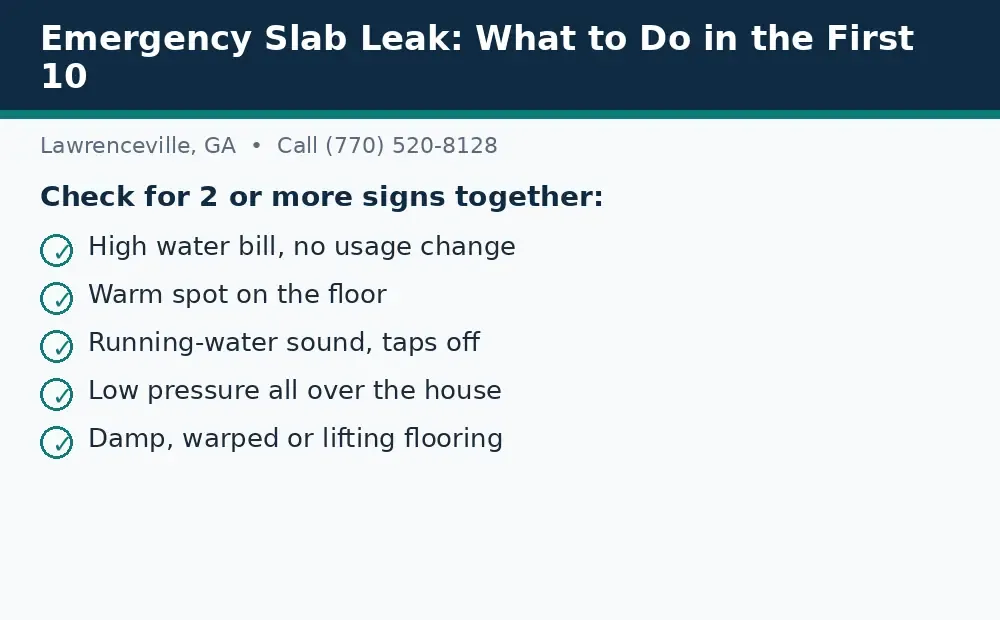
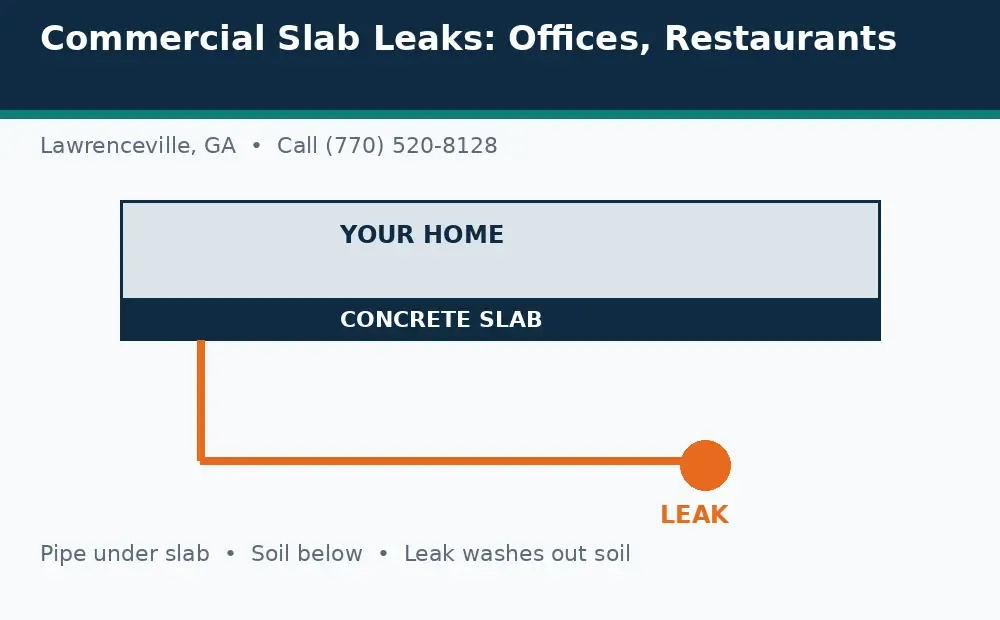
The working photo on this page is an illustrative working photo, not a photo of a specific job at a specific address. The diagrams are schematics, not to scale, made to explain the signs, process, options, or costs on this page in plain words. Call us at (770) 520-8128 if you are unsure what you are seeing.
Why does a slab leak smell before it shows?
Water escaping under a slab does not immediately stain a floor. It first wets the concrete, then the underlayment and the back of the flooring, then the wall base — and the smell of that damp, enclosed space often reaches a nose before any mark reaches an eye. Mustiness is the smell of damp materials and the microbial growth damp encourages, in a place with little airflow: under flooring, behind baseboards, inside a wall cavity. A homeowner who notices a musty room with no visible water is not imagining things; they are noticing the earliest stage of a damp problem, and the question is only whether the damp comes from below, from a fixture, or from outside.
That is why smell deserves the same seriousness as a stain, and the same discipline: note which room, when it started, whether it strengthens after rain or stays constant regardless of weather, and whether any other sign accompanies it — a bill change, a warm patch, a sound. A smell that follows rain points at seepage; a smell that stays constant through dry weather, especially with a moving meter, points at supply water. The mould and water damage guide covers what prolonged damp can lead to, but this post stays at the earlier question: is the damp real, where is it, and what is feeding it?
What do damp spots, warping, and loose tiles each tell you?
Each flooring symptom tells a slightly different story about duration and source. A damp spot that dries and returns in the same place suggests a continuing source beneath it, because a one-off spill dries and stays dry. Warping or cupping in wood or laminate suggests prolonged damp from below, since surface spills rarely warp boards evenly across a room — they spot, while under-slab damp spreads. Tiles that loosen or grout that darkens and crumbles in one area suggest water working at the adhesive and grout from beneath over time, again a pattern rather than an event.
Location sharpens the story further. Damp in a bathroom or kitchen could be a fixture; damp in a living room or hallway far from any fixture, over a known pipe route, is harder to explain away. Damp along a wall base suggests water wicking up from the slab edge, while damp in the middle of a room suggests water rising through the slab itself. None of these patterns proves a slab leak — fixtures, condensate, and rain seepage all remain on the table — but a pattern that fits 'from below, persistent, spreading slowly' is exactly what earns a meter test, and the meter test is what separates a slab story from a fixture story. The floor restoration service page explains what restoration involves once the source is fixed, which is the step after diagnosis, not a substitute for it.
How do I check damp properly without making it worse?
Check with your senses and a meter test, not with demolition. Press a dry tissue or paper towel to the spot and note whether it picks up moisture; check whether the area feels cooler or warmer than surrounding floor; look at baseboards for swelling, paint bubbling, or a tide line. Photograph the area with a date, including a wider shot showing the room and the nearest fixture, so the pattern is visible later. Do not pull up flooring or baseboards to look underneath — that destroys evidence, spreads any microbial growth, and turns a diagnostic question into a restoration job before the source is known.
Then run the meter test with everything off, and rule out the room's own suspects: a refrigerator water line, a washing machine hose, an air-conditioning drain, a bathroom fixture. If the damp persists with those ruled out and the meter moves, the slab case strengthens considerably, and detection in Lawrenceville becomes the next step with your dated photos in hand. If the meter stays still, look harder at weather and fixtures: damp that appears only after rain, or only when a particular appliance runs, is telling you its source by its timing. Homes in Sugarloaf and Downtown Lawrenceville follow the same checks; flooring type changes what damp looks like, not what causes it.
When is damp an emergency, and when is it a prompt check?
Damp becomes urgent when it is spreading fast, when water is visibly pooling, when it reaches electrics, or when it arrives with a pressure collapse or a spinning meter — any of those justify an emergency call the same day, following the first steps on the emergency page. Damp that is stable, localised, and unaccompanied by other signs justifies a prompt check within days: meter test, mimic rule-outs, dated photos, and a detection call if the meter moves. The difference is not about worry — both deserve attention — but about sequencing: a spreading, pooling problem needs water stopped first, while a stable damp patch needs diagnosis first.
What damp should never get is months of watching. Prolonged damp is the condition in which flooring damage, baseboard damage, and microbial growth all progress, and each of those turns a pipe repair into a larger restoration job. A damp patch that has been present for weeks while a homeowner waited to be sure is a patch that has been working on the floor for weeks. The cost of an early meter test is nothing; the cost of late restoration is the flooring, the baseboards, and the drying time. If you have been watching a patch, today is the day to test it — and the symptom checker lets you record damp alongside your other signs so the pattern is visible before you call.
What happens after the source is found?
Once detection locates the source, the damp story splits into two jobs: fix the pipe, then deal with what the water did. The pipe fix follows the usual menu — spot repair, reroute, lining, or repipe — chosen by the leak and the pipe's condition, with a written price after inspection. The damp job follows separately: drying the affected area thoroughly, assessing flooring and baseboards for what can stay and what must go, and restoring the finish. Drying is not a hairdryer afternoon; it is a process covered in the cleanup and drying guide in this batch, and it must complete before new flooring goes down, or the new floor inherits the old damp.
Two disciplines protect that second job. First, document before cleanup: dated photos of the damp, the warped boards, and the wall bases, kept with the detection report and the bills, because restoration scope and any insurance file both depend on that record. Second, do not cover damp with rugs, new flooring, or sealant in the meantime — covering hides the sign, traps the moisture, and turns a drying job into a hidden one. A damp patch that is properly dried, properly documented, and properly restored leaves no legacy; a damp patch that is covered and forgotten becomes the next homeowner's mystery, or the next room's problem.
Damp symptom decoder
| Symptom | What it suggests | First check |
|---|---|---|
| Musty smell, no visible damp | Hidden damp under flooring or behind baseboards | Note room and timing; meter test |
| Damp spot that returns after drying | Continuing source beneath | Meter test; photograph dated |
| Warped or cupped boards | Prolonged damp from below | Meter test; note extent and rooms |
| Loose tiles, dark grout | Water working at adhesive from beneath | Meter test; check nearby fixtures |
| Damp only after rain | Seepage, not supply leak | Drainage and sealing check |
| Damp near an appliance | Fixture or appliance line | Isolate that appliance's supply |
Patterns, not single symptoms, make the case. A returning damp patch plus a moving meter is a slab-leak case; either alone is only a clue.
Notice Smell, damp, warping, or loosening — note room, date, and timing.
Photograph Dated wide and close shots before anything is dried or covered.
Test Meter with everything off; rule out the room's fixtures.
Decide Meter moves: detection. Meter still: weather and fixture investigation.
What to tell us when you call
When you call, tell us what you noticed, when it started, and where in the house it shows. Mention your ZIP code, whether the water meter moves with everything off, and whether the sign is on a hot-water or cold-water line if you know. That short list helps the technician bring the right equipment and plan the visit. You do not need to know the cause before you call — that is what detection is for.
Call (770) 520-8128 and describe what you are seeing in plain words. We will talk through the next step and arrange a detection visit.
Call Us Today
Fast local slab leak detection and repair in Lawrenceville, GA, ZIPs 30043–30046.
Call Us: (770) 520-8128Frequently asked questions
Does a musty smell always mean a slab leak?
No. Mustiness means hidden damp, which can come from a fixture, condensate, rain seepage, or a slab leak. The meter test and the smell's timing — constant versus rain-following — narrow which one.
Should I pull up warped flooring to look underneath?
No. Pulling flooring destroys evidence and can spread microbial growth. Photograph, test the meter, rule out fixtures, and let detection locate the source before anything is opened.
My floor is damp but the meter does not move. What now?
Look at weather timing and nearby fixtures. Damp only after rain suggests seepage; damp tied to an appliance suggests that appliance's line. Re-test the meter on another day if the damp persists.
How urgent is a damp patch with no other signs?
Prompt, not emergency, unless it spreads fast, pools, or reaches electrics. Run the meter test within days, photograph it dated, and call for detection if the meter moves — do not watch it for months.
Will new flooring fix a damp patch?
No. New flooring over an unfixed source inherits the damp. Fix the pipe, dry thoroughly, then restore the finish — in that order.