 Lawrenceville Slab Leak Detectors
Can a Slab Leak Be Fixed Without Breaking the Floor?
Yes, sometimes. A Lawrenceville slab leak can often be fixed without opening the floor by rerouting the pipe or lining it. Homes in Downtown Lawrenceville and Collins Hill, ZIPs 30046 and 30043, need detection first, because the right option depends on the pipe, its position, and the camera result.
Key takeaways
- Rerouting moves the pipe's route around the slab — no floor opening over the leak itself.
- Lining coats the inside of a pipe, but only fits pipes that are still round and stable enough to hold a liner.
- Tunneling digs beneath the slab from outside; it is a method a technician may use, not a service this site lists.
- Detection always comes first: the fix that avoids breaking the floor still needs a precise location.
What this looks like in a Lawrenceville home
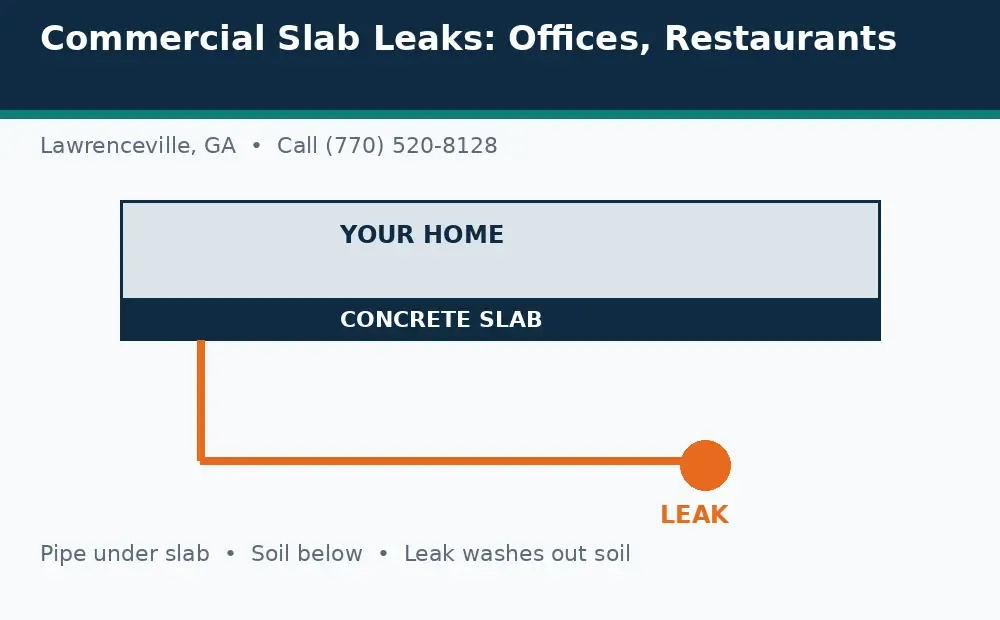
The working photo on this page is an illustrative working photo, not a photo of a specific job at a specific address. The diagrams are schematics, not to scale, made to explain the signs, process, options, or costs on this page in plain words. Call us at (770) 520-8128 if you are unsure what you are seeing.
Why does fixing a slab leak usually mean opening the floor?
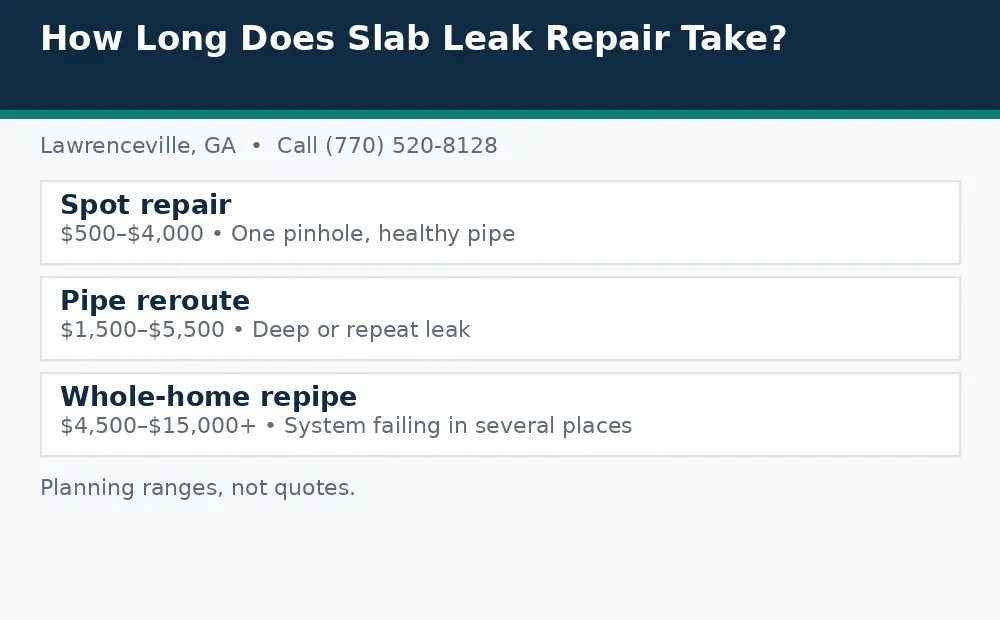
The short answer is access. The leaking pipe sits under concrete, and the traditional way to reach a single bad section is to open the floor above it, repair that section, and restore the concrete and flooring. That is what slab leak spot repair means, and for a single, precisely located leak it is often the most direct fix. The fear most homeowners have is not the repair itself but the unknown: how much floor comes up, what happens to the tile or hardwood, and whether the house ends up looking patched. Those are fair questions, and they are exactly why the no-break options below exist — but they are options for certain leaks, not a promise for every leak.
The key point is that the floor question gets answered by detection, not by preference. A technician who has pinpointed the leak, identified whether it is on a hot-water, cold-water, or drain line, and checked the pipe's condition can say which access method fits. A homeowner who skips detection and asks for a no-break fix is asking someone to choose a route blind. So the honest order is always the same: find it precisely, then choose the least disruptive fix that actually fits that leak, that pipe, and that house.
How does rerouting avoid breaking the floor?
Rerouting leaves the leaking section where it is and gives the water a new route that does not run under the slab. The new pipe typically runs through walls, ceilings, or an attic space, or along an accessible route, and the old section is capped off so it carries no more water. Because the new route is accessible, future problems on that run are easier to reach too. Rerouting suits a leak in a run that keeps failing, a line whose path under the slab is awkward, or a home where opening the floor would mean destroying expensive or irreplaceable flooring.
Rerouting is not free of disruption — it still involves opening walls or ceilings in places, patching, and painting — but for many homeowners that trade is far easier to live with than a floor opening, especially in a kitchen or living room. The planning range published on this site for rerouting is $1,500 to $5,500, labelled as a planning range, not a quote, because the length of the new run, the number of fixtures it serves, and the access route all change the work. A written price comes after inspection, once the technician has seen the house and the route. If you want to compare that with the other routes, the spot repair vs reroute vs repipe guide lays the three side by side.
When does pipe lining fit, and when does it not?
Lining, also called trenchless pipe lining, works from inside the pipe. A liner is placed into the existing pipe and cured in place, creating a new inner surface that carries the water while the old pipe stays buried. When it fits, it is the least disruptive option of all: no floor opening, no new route through the house, and the fixtures stay roughly where they are. The catch is eligibility. Lining needs a pipe that is still round and stable enough to hold the liner — a pipe that has collapsed, shifted badly out of line, or bellied (sagged) so water pools in it generally cannot be lined, and only a camera inspection can settle that question.
That is why any honest lining conversation starts with a camera, not with a promise. If the camera shows a sound, round pipe with a crack or a leaking joint, lining is on the table. If it shows a collapsed or badly offset section, lining is off the table and the conversation moves to rerouting, spot repair, or repiping. The planning range for lining on this site is $800 to $3,000, again a planning range, not a quote, and no lifespan or warranty figure is offered here because none has been supplied for this site. If lining eligibility is your main question, the trenchless pipe lining service page explains the method and the camera-first step in more detail.
What is tunneling, and why is it not listed as a service here?
Tunneling means digging a small tunnel beneath the slab from outside the house, reaching the leaking section from below rather than from above. The floor inside stays intact, and the work happens in the tunnel and at the access point outside. It is a real method that technicians use for certain leaks, particularly where the leak sits under a room whose floor would be very costly to open and restore. It is also slower, messier work than it sounds: digging by hand under a slab, working in a confined space, and then backfilling and restoring the access area all take time and care.
This site does not list tunneling as a service, and this post does not claim otherwise. It is described here because homeowners researching no-break fixes will meet the term everywhere, and an honest guide should explain it rather than pretend it does not exist. Whether tunneling fits a particular Lawrenceville home depends on the leak's position, the soil, and access outside the house — questions only an on-site assessment can answer. If a technician you speak to proposes tunneling, ask how the tunnel route is chosen, what happens to the soil that comes out, and how the access area is restored, alongside the same written-price-after-inspection expectation that applies to every option on this site. For homes in Downtown Lawrenceville and ZIP 30044, access outside the house can vary a lot from lot to lot, which is another reason the method cannot be promised from a web page.
How do I choose between reroute, lining, spot repair, and repipe?
Start from the leak, not from the method. One precisely located leak in an otherwise sound pipe points toward spot repair or lining, depending on the camera result. A run that has leaked before, or a pipe material that is failing in several places, points toward rerouting that run or, if the whole system is aging, toward whole-home repiping. A drain-side leak points toward camera-led options on the drain side, which follow different rules from pressurised supply lines. The technician's job at detection is to give you that picture — which pipe, which line, what condition — so the choice is a decision, not a guess.
Then weigh the disruption honestly against the durability question. The least disruptive fix for today's leak is not always the best value if the same run leaks again next year; the most thorough fix is not always sensible for a single leak in a young pipe. Ask for the reasoning in plain words: why this method, what it leaves in place, what could still fail, and what the restoration involves. A written price after inspection should come with that reasoning, not instead of it. And if you are still deciding, the slab leak repair cost estimator lets you walk through the published planning ranges for each route side by side before you call.
No-break options at a glance
| Option | Floor opened? | Best when | Planning range* |
|---|---|---|---|
| Spot repair | Yes, above the leak | One precise leak, sound pipe | $500–$4,000 |
| Reroute | No, over the leak | Failing run, costly flooring | $1,500–$5,500 |
| Lining | No | Round, stable pipe (camera confirms) | $800–$3,000 |
| Whole-home repipe | Usually no slab opening | System-wide aging, repeat leaks | $4,500–$15,000+ |
| Tunneling | No, from outside | Method a technician may use; not listed here | Ask after assessment |
*Planning ranges only, not quotes. The technician gives a written price after inspection. Detection is $300–$600 on the same basis.
Detect first Pinpoint the leak and identify the line before any fix is chosen.
Check the pipe Camera inspection decides whether lining is even possible.
Compare disruption Floor opening vs wall/ceiling work vs a tunnel — weigh what each means for your home.
Get it in writing Method, reasoning, restoration, and price in writing after inspection, before work starts.
What to tell us when you call
When you call, tell us what you noticed, when it started, and where in the house it shows. Mention your ZIP code, whether the water meter moves with everything off, and whether the sign is on a hot-water or cold-water line if you know. That short list helps the technician bring the right equipment and plan the visit. You do not need to know the cause before you call — that is what detection is for.
Call (770) 520-8128 and describe what you are seeing in plain words. We will talk through the next step and arrange a detection visit.
Call Us Today
Fast local slab leak detection and repair in Lawrenceville, GA, ZIPs 30043–30046.
Call Us: (770) 520-8128Frequently asked questions
Can every slab leak be fixed without breaking the floor?
No. Rerouting and lining avoid opening the floor over the leak, but they fit certain leaks and certain pipes. Spot repair opens the floor above a single leak, and some leaks leave no sensible no-break option.
Is rerouting better than spot repair?
Neither is always better. Rerouting suits a failing run or costly flooring; spot repair suits one precise leak in a sound pipe. Detection results and the pipe's condition decide, not preference alone.
Does lining work on any pipe?
No. The pipe must still be round and stable enough to hold a liner. Collapsed, badly offset, or bellied pipe generally cannot be lined, and a camera inspection decides.
What is tunneling under a slab?
Digging a small tunnel beneath the slab from outside to reach the leak from below, leaving the inside floor intact. It is a method a technician may use; this site does not list it as a service.
Do I still need detection if I want a no-break fix?
Yes, more so. A no-break fix chosen without a precise location and a camera check risks fixing the wrong thing. Detection comes first, whatever the fix.