 Lawrenceville Slab Leak Detectors
Cracks in Walls, Floors, or Foundation: Slab Leak Sign or Not?
Cracks in walls, floors, or foundations can point to a slab leak, but most have other causes — settlement, temperature movement, or shrinkage. Lawrenceville homeowners in Downtown and Collins Hill, ZIPs 30046 and 30043, should look for growing cracks, or cracks arriving with a bill jump or damp.
Key takeaways
- Hairline cracks are common and usually harmless; growing, widening, or stair-step cracks deserve attention.
- A crack plus a water sign (bill, damp, sound, pressure) is a slab-leak case; a crack alone is usually a settlement or shrinkage story.
- Photograph and date cracks, and measure their width — change over time matters more than any single crack.
- Never fill and forget a growing crack: filling hides the monitoring evidence without addressing any cause.
What this looks like in a Lawrenceville home
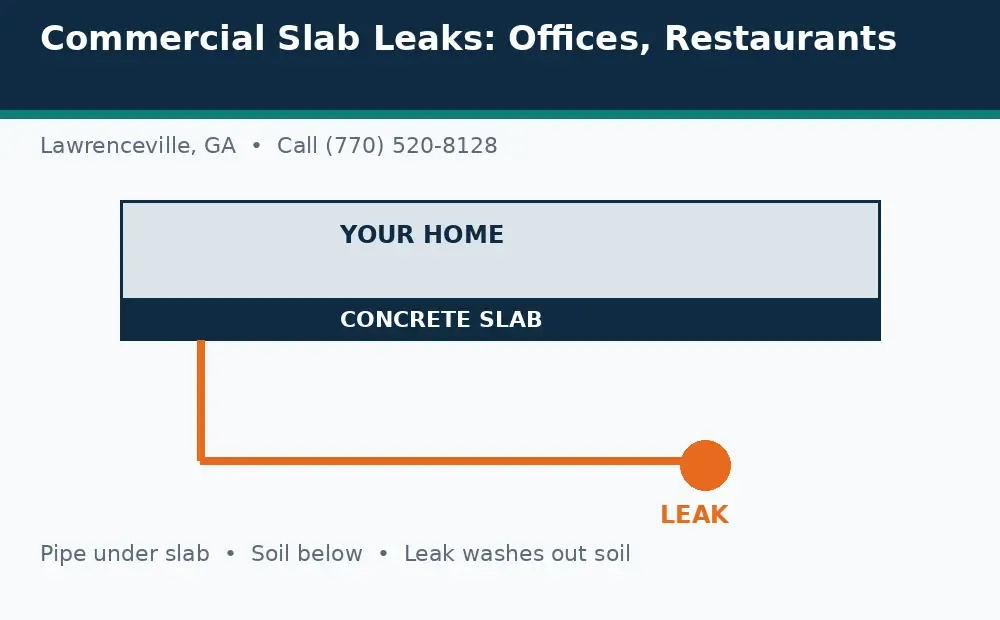
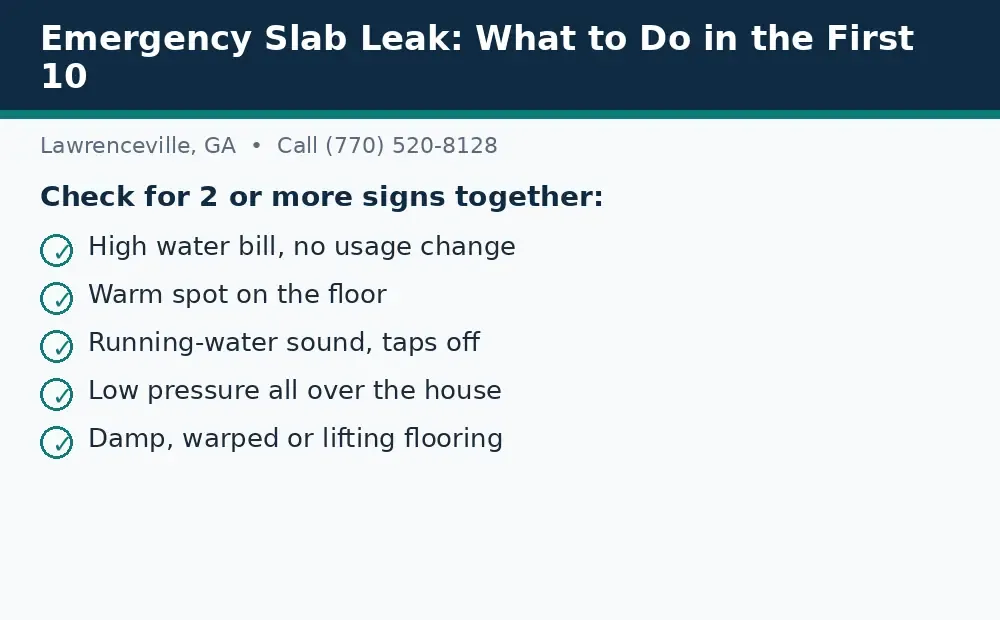
The working photo on this page is an illustrative working photo, not a photo of a specific job at a specific address. The diagrams are schematics, not to scale, made to explain the signs, process, options, or costs on this page in plain words. Call us at (770) 520-8128 if you are unsure what you are seeing.
Why do houses crack at all?
Houses move, and concrete and plaster show movement as cracks. Fresh concrete shrinks as it cures, producing fine hairline cracks that are a normal part of a building's first years. Seasonal temperature change expands and contracts materials at different rates, opening and closing fine lines. Soil under and around a house swells and shrinks with moisture, lifting and settling the slab by small amounts that show as cracks in walls and floors. All of that is ordinary, and most cracks a homeowner notices belong to one of those ordinary stories rather than to a leak.
A slab leak enters the crack story through soil washout: water escaping under the slab carries fine soil away, changing support under the concrete, and the slab responds by settling or cracking where support changed. That mechanism is real, but it is only one of several, and it leaves a signature — cracks that grow or widen over weeks, cracks that arrive together with water signs, cracks near the area where water signs show. A crack without any water sign, stable over months, is unlikely to be a leak story at all. The slab leak vs foundation problem guide draws that distinction in full, and this post stays on the narrower question: when does a crack belong on the leak checklist?
Which cracks deserve a closer look?
Pay attention to change, not to existence. A hairline crack that has looked the same for a year is a different matter from a crack that was hairline last month and is visibly wider now, from a crack that extends across a wall or floor in a stair-step pattern following mortar joints, or from a crack that appears alongside a door or window that has started sticking. Width matters too: a crack you can fit a coin edge into, or one that admits light or draught, deserves more attention than a surface line in paint. Location matters as well: cracks near plumbing routes, near rooms showing damp or warmth, or radiating from a point where water signs cluster all strengthen the leak hypothesis.
Measure rather than eyeball. Mark the crack's ends with pencil and a date, photograph it with a coin or ruler for scale, and re-photograph it monthly from the same position. That record turns a worry into data: a crack that does not change over three months is reassuring in a way no single glance can be, while a crack that widens month on month is evidence that something is still moving — and 'something still moving' plus a water sign is a detection case. Do not fill a crack you are monitoring: filler hides the very change you are trying to observe, and it can mask a growing problem until the movement becomes much larger.
When does a crack plus a water sign mean a slab leak?
The combination is the test. A crack plus a bill jump, a crack plus a damp patch, a crack plus a warm floor, or a crack plus low pressure — any of those pairings moves the crack from the settlement column to the leak checklist, because two independent systems (structure and water) are now telling the same story at the same time and place. The meter test then decides whether that story holds: a moving meter with everything off confirms real water loss, and the crack's location relative to the pipe route helps detection narrow the search. Without the meter result, the pairing is still only a suspicion, however worrying it feels.
Conversely, a crack with a still meter, no damp, no bill change, and no sound is most likely a structural or shrinkage matter, and the right next step is monitoring and, if it grows, a structural opinion — not slab detection. That distinction protects homeowners twice: it prevents a detection visit for a settlement crack, and it prevents a settlement explanation from delaying a real leak. If you are unsure which column your crack falls in, run the water meter test and use the symptom checker to record the crack alongside your water signs before you call; the pattern, presented together, is what a technician needs.
What should I do about a crack today?
Today, do three things: photograph and date it with a scale reference, check the meter with everything off, and look for any water sign in the same area — damp, warmth, sound, or a bill change. If the meter moves or a water sign is present, call for detection in Lawrenceville and report the crack as part of the bundle, not as the headline: 'crack widening over two months in the hallway, plus a bill jump and a moving meter' is a far more useful report than 'crack in the wall'. If the meter is still and no water sign exists, start the monthly monitoring routine and note the date you started; a stable crack over months is its own answer.
What not to do matters too. Do not fill, paint over, or cover a crack you have not yet characterised — you would destroy the monitoring evidence. Do not assume a crack means foundation failure and panic, and do not assume it means nothing and ignore it: both errors come from judging a crack alone, and the remedy for both is the same — measure it, test the meter, and let change over time plus water evidence decide. For homes in Collins Hill and Downtown Lawrenceville, where slab construction and soil conditions are shared across ZIPs 30043–30046, that routine is identical; what varies is the house's own history, which only your dated record captures.
What happens if a crack is linked to a leak?
If detection confirms a leak near the crack, the repair follows the usual order: fix the pipe first, using the method the leak and the pipe dictate, with a written price after inspection, and only then address the crack and any restoration. Fixing a crack before fixing the leak that caused it is wasted work, because the movement continues while the water keeps escaping. After the pipe is fixed, the crack's future is monitored again: a crack that stops growing once the water stops is consistent with a leak cause, while a crack that keeps growing after the leak is fixed points at an additional structural question that deserves its own opinion.
Restoration of the crack itself — filling, patching, repainting — belongs to the restoration step, agreed alongside the pipe repair rather than assumed. Ask what the restoration includes and whether the crack will be monitored after repair, because a patched crack that reopens is information, not a failure of the patch. And keep the dated photo record through the whole sequence: before, during, and after repair. That record is what turns a frightening crack into a managed problem with a beginning, a cause, a fix, and an end — and it is also the file any future buyer, insurer, or technician will want to see, following the same documentation habits as the insurance claim process guide.
Crack triage table
| Crack pattern | Water sign present? | Reading | Next step |
|---|---|---|---|
| Hairline, stable for months | No | Likely shrinkage or settlement | Monitor monthly |
| Hairline, stable | Yes (bill, damp, sound) | Leak possible elsewhere; crack may be unrelated | Meter test, then detection |
| Growing or widening | No | Movement ongoing; cause unclear | Monitor closely; structural opinion if it continues |
| Growing or widening | Yes | Leak-linked movement likely | Detection call with crack record |
| Stair-step, doors sticking | Either | Structural movement, needs attention | Detection if water signs exist; structural opinion regardless |
A crack alone is a monitoring question. A crack plus a water sign is a detection question. Never fill a growing crack before characterising it.
Mark Pencil marks at the crack ends, dated, photographed with a scale reference.
Test Meter with everything off — movement plus a crack is a case.
Monitor Same-position photo monthly; change over time is the evidence.
Decide Stable: keep monitoring. Growing plus water signs: detection call.
What to tell us when you call
When you call, tell us what you noticed, when it started, and where in the house it shows. Mention your ZIP code, whether the water meter moves with everything off, and whether the sign is on a hot-water or cold-water line if you know. That short list helps the technician bring the right equipment and plan the visit. You do not need to know the cause before you call — that is what detection is for.
Call (770) 520-8128 and describe what you are seeing in plain words. We will talk through the next step and arrange a detection visit.
Call Us Today
Fast local slab leak detection and repair in Lawrenceville, GA, ZIPs 30043–30046.
Call Us: (770) 520-8128Frequently asked questions
Do all foundation cracks mean a slab leak?
No. Most cracks come from shrinkage, temperature movement, or settlement. A crack becomes a leak question when it grows or arrives with a water sign such as a bill jump, damp, or low pressure.
Should I fill a crack before calling?
No, not a crack you are still characterising. Filler hides the change you are monitoring. Photograph and date it first, test the meter, and let the pattern decide.
How do I measure a crack's growth?
Mark both ends with pencil and a date, photograph it with a coin or ruler for scale, and re-photograph monthly from the same position. Widening over months is the signal, not any single measurement.
Can a slab leak cause stair-step cracks?
It can contribute where soil washout changes support, but stair-step cracking also has structural causes. A crack pattern plus water signs justifies detection; the pattern alone justifies monitoring and, if it grows, a structural opinion.
Will fixing the leak fix the crack?
Fixing the leak stops the water-driven movement, but the crack itself still needs restoration as a separate step, agreed alongside the repair. A crack that keeps growing after the leak is fixed needs its own structural assessment.