 Lawrenceville Slab Leak Detectors
Georgia Red Clay Soil and Slab Leaks: What Homeowners Should Know
Georgia red clay soil matters for Lawrenceville slab leaks because clay swells when wet and shrinks when dry, and that seasonal movement stresses buried pipes and the slab. Homeowners in Downtown Lawrenceville and Collins Hill, ZIPs 30046 and 30043, should watch for cracks and water signs arriving with ground movement.
Key takeaways
- Red clay swells when wet and shrinks when dry — that cycle moves soil, and moving soil stresses pipes.
- Seasonal cracking that opens and closes with wet and dry spells points at soil movement, not necessarily at a leak.
- A leak plus soil movement together is worse than either alone: water adds to the swelling that stressed the pipe.
- No Lawrenceville-specific soil, home-age, or water-chemistry statistics are claimed here — the mechanism is general, the house evidence is specific.
What this looks like in a Lawrenceville home
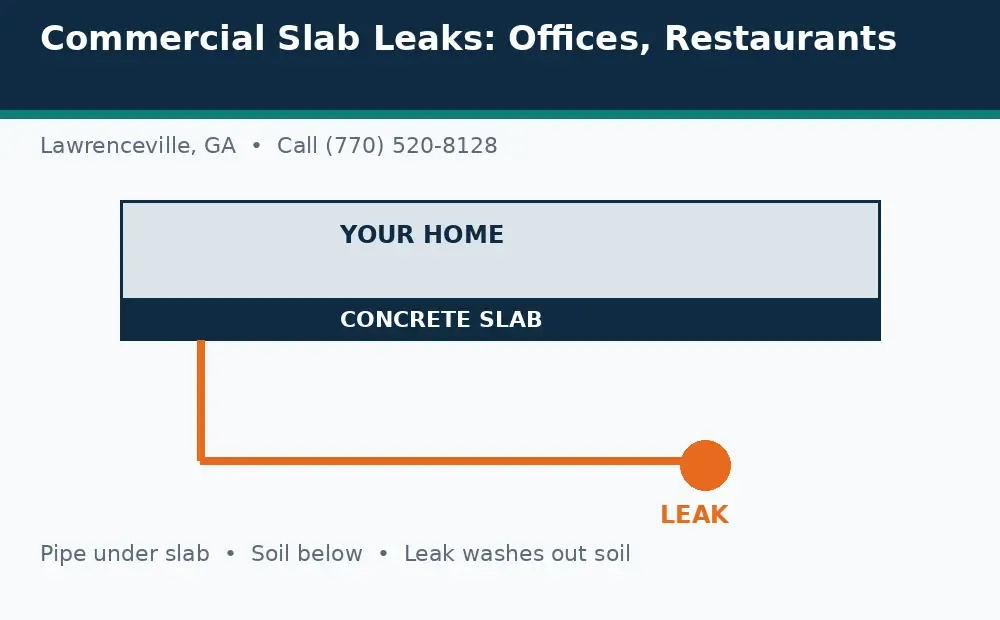
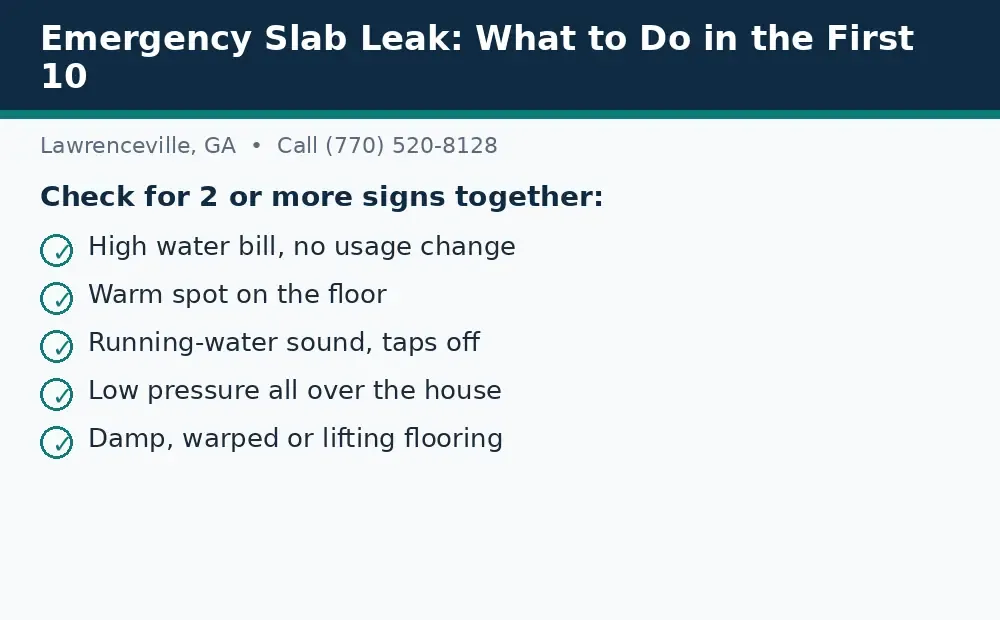
The working photo on this page is an illustrative working photo, not a photo of a specific job at a specific address. The diagrams are schematics, not to scale, made to explain the signs, process, options, or costs on this page in plain words. Call us at (770) 520-8128 if you are unsure what you are seeing.
What is red clay, and why does it move?
Red clay is the iron-rich, fine-grained soil common across much of Georgia, including the Lawrenceville area. Its defining trait for homeowners is not its colour but its behaviour with water: clay particles absorb water and swell, and release water and shrink as they dry. That swell-shrink cycle repeats with the seasons — wet periods swell the soil, dry periods shrink it — and the ground under and around a house therefore moves by small amounts, repeatedly, over years. A concrete slab sitting on moving soil moves with it, and buried pipes move too, until a joint or a thinned section absorbs more movement than it can tolerate.
The movement involved is usually small in any single cycle — fractions of an inch rather than inches — but it is repeated, and repetition is what matters. A pipe joint that flexes slightly with every seasonal cycle, year after year, accumulates stress at exactly the points where corrosion or age has already weakened it. That is why clay soil belongs on a slab leak cause list alongside pipe age and pressure: not as a single dramatic event, but as a background stress that makes other weaknesses fail sooner. This post claims no Lawrenceville-specific soil measurements, home-age statistics, or water-chemistry figures, because none have been verified for this site — the mechanism described is the general behaviour of clay soils, and any specific claim about a particular lot needs that lot's own evidence.
How does clay movement show up in a house?
Clay movement shows up first as seasonal change: cracks that open wider in dry spells and narrow in wet ones, doors and windows that stick after a long dry period and free up after rain, floors that feel slightly uneven in one season and level in another, and gaps that appear and disappear around trim. That seasonality is the signature — a crack that breathes with the weather is telling a soil story, while a crack that only grows, regardless of weather, is telling a different story, possibly including a leak. Photographing and dating cracks through wet and dry periods is therefore the single most useful homeowner habit for separating soil movement from leak damage, and the cracks guide in this batch explains that monitoring routine in full.
Drainage shapes how strongly a home feels clay movement. Soil that stays evenly moist moves less than soil that swings between soaked and parched, which is why consistent drainage — gutters clear, downspouts discharging away from the slab, grading that moves water away rather than pooling it — matters more for clay homes than for homes on stable soils. A downspout that dumps beside the foundation creates a wet pocket in otherwise dry soil, and that pocket swells while its surroundings shrink, concentrating movement exactly where it hurts most. Conversely, a long dry spell that shrinks soil away from the slab edge can open a gap that later wet weather fills unevenly. Even moisture, maintained by drainage, is the goal — not dryness at any cost, and not wetness either.
When does clay movement plus a leak become a combined problem?
A leak and clay movement amplify each other in both directions. Movement stresses a pipe until it leaks; the leaking water then wets the surrounding clay, which swells further, which moves the soil more, which stresses the pipe and the slab further. That feedback loop is why a leak in clay soil deserves prompt attention even when it looks small: the water is not merely escaping, it is actively changing the ground conditions around the failure. It is also why a leak's signs in a clay-soil home can include structural clues — growing cracks, sticking doors — alongside the usual water clues, and why both sets of clues should be reported together at a detection visit.
Separating the contributions matters for the fix. If movement alone, without a leak, is cracking walls, the answer is a structural and drainage conversation, not a pipe repair. If a leak alone, without movement, is losing water, the answer is detection and pipe repair. If both are present — a moving meter plus growing seasonal cracks — the answer is both conversations, in order: stop the water first by finding and fixing the leak, then address drainage and monitor whether the movement settles once the extra water is gone. The detection service answers the water question, and the crack record you kept through the seasons answers the movement question. Bring both to the visit, because a technician who sees only one half of a combined problem can only solve half of it.
What can a homeowner do about clay soil around the house?
The homeowner's clay tools are drainage, observation, and consistency. Keep gutters and downspouts clear and discharging away from the slab, not beside it. Keep grading sloped away from the house, and correct any area where water pools against the foundation after rain. Avoid the two extremes that stress clay most: prolonged soaking of one area (a leaking outdoor tap, an overwatered bed against the wall) and prolonged drying of one area (bare soil baking against the slab edge in a dry spell, where mulch or ground cover would moderate it). Water the landscape evenly where watering happens, rather than flooding one bed and ignoring the rest — even moisture is kinder to clay than feast and famine.
Observation is the second tool, and it costs nothing: dated photographs of cracks, doors, and floor areas through wet and dry periods, kept with bills and meter notes. That record distinguishes a stable seasonal pattern, which is monitored, from a growing pattern, which is investigated — and it distinguishes both from a leak pattern, which is tested by meter. If a pattern grows regardless of weather, or if water signs arrive alongside movement, call for detection in Lawrenceville with the record in hand. For homes in Downtown Lawrenceville and Collins Hill, the clay conversation is shared across ZIPs 30043–30046, but every lot's drainage and history differ, which is why the record, not a general claim, decides each case.
What should I not assume about clay and my home?
Do not assume clay soil means your home will leak, and do not assume a leak means clay is to blame. Many homes on clay soils run for decades without a slab leak, because pipe condition, installation, pressure, and drainage matter as much as soil type. Equally, many slab leaks happen on non-clay soils for entirely different reasons. Clay is one stressor among several, and its presence raises the value of drainage care and crack monitoring without condemning the house — just as its absence would not excuse ignoring a bill jump or a damp patch.
Also do not import other cities' or other states' soil statistics to your lot. Figures quoted for a different city's clay, a different housing era, or a different water system are not Lawrenceville data, and this post deliberately offers none. What you can rely on is your own lot's evidence: your crack record through seasons, your drainage pattern, your meter results, and your detection findings. Those four, kept together, answer the clay question for your home better than any general statistic could, and they are exactly what to bring when you use the symptom checker or call for a visit.
Clay cycle and pipe stress
| Seasonal state | Soil behaviour | Effect on slab and pipes |
|---|---|---|
| Wet period | Clay absorbs water and swells | Upward pressure; joints and slab lift slightly |
| Dry period | Clay releases water and shrinks | Support falls away; slab settles slightly |
| Repeated cycles | Swell and shrink, year after year | Accumulated stress at weak joints and thin sections |
| Leak added | Escaping water wets clay locally | Extra swelling near the leak; feedback loop |
| Even moisture | Less swing between states | Less movement; drainage is the control |
Clay movement is a cycle, not an event. Even moisture, maintained by drainage, is the homeowner's main control.
Watch Cracks, doors, and floors through wet and dry periods, dated and photographed.
Drain Gutters clear, downspouts away from the slab, grading away from the house.
Even out Avoid soaking one area and parching another; even moisture moves less.
Test Water signs plus movement: meter test first, then detection with your record.
What to tell us when you call
When you call, tell us what you noticed, when it started, and where in the house it shows. Mention your ZIP code, whether the water meter moves with everything off, and whether the sign is on a hot-water or cold-water line if you know. That short list helps the technician bring the right equipment and plan the visit. You do not need to know the cause before you call — that is what detection is for.
Call (770) 520-8128 and describe what you are seeing in plain words. We will talk through the next step and arrange a detection visit.
Call Us Today
Fast local slab leak detection and repair in Lawrenceville, GA, ZIPs 30043–30046.
Call Us: (770) 520-8128Frequently asked questions
Does every home on red clay get slab leaks?
No. Clay is one stressor among several, alongside pipe age, pressure, and drainage. Many clay-soil homes run for decades without a slab leak; clay raises the value of drainage care and monitoring, it does not condemn a house.
How can I tell clay movement from leak damage?
Seasonality is the clue: cracks and sticking doors that breathe with wet and dry spells point at soil movement, while a moving meter, bill jump, or damp points at water loss. Both together need both investigations, water first.
Should I water my foundation in a dry spell?
Even moisture is kinder to clay than extremes, but foundation watering is a judgement for your lot's drainage and soil, not a blanket prescription from this page. Avoid soaking one area while others parch, and keep drainage working.
Can clay soil statistics from another city apply to my home?
No. Soil, housing era, and water-system figures from elsewhere are not Lawrenceville data. Rely on your own lot's crack record, drainage pattern, meter results, and detection findings.
Does fixing a leak stop clay movement?
No. Fixing a leak stops the extra water feeding local swelling, but seasonal clay movement continues and still needs drainage care and monitoring. The leak fix removes one amplifier, not the cycle.