 Lawrenceville Slab Leak Detectors
Hot-Water vs Cold-Water Slab Leak Symptoms Compared
Hot-water and cold-water slab leaks in Lawrenceville share signs — bill jumps, meter movement, damp — but warmth points at hot water, while cold-water leaks hide behind signs. Homeowners in Downtown Lawrenceville and Sugarloaf, ZIPs 30046 and 30045, should compare warmth and bills, let pressure testing confirm which side leaks.
Key takeaways
- Warmth is the hot-water signature: a warm floor patch with no other explanation points at the hot line.
- Cold-water leaks lack the warmth clue, so bill and meter evidence carry more weight for them.
- Gas or electric bill jumps alongside water bill jumps strengthen a hot-water case specifically.
- Only pressure testing settles hot versus cold — symptoms suggest, tests confirm.
What this looks like in a Lawrenceville home
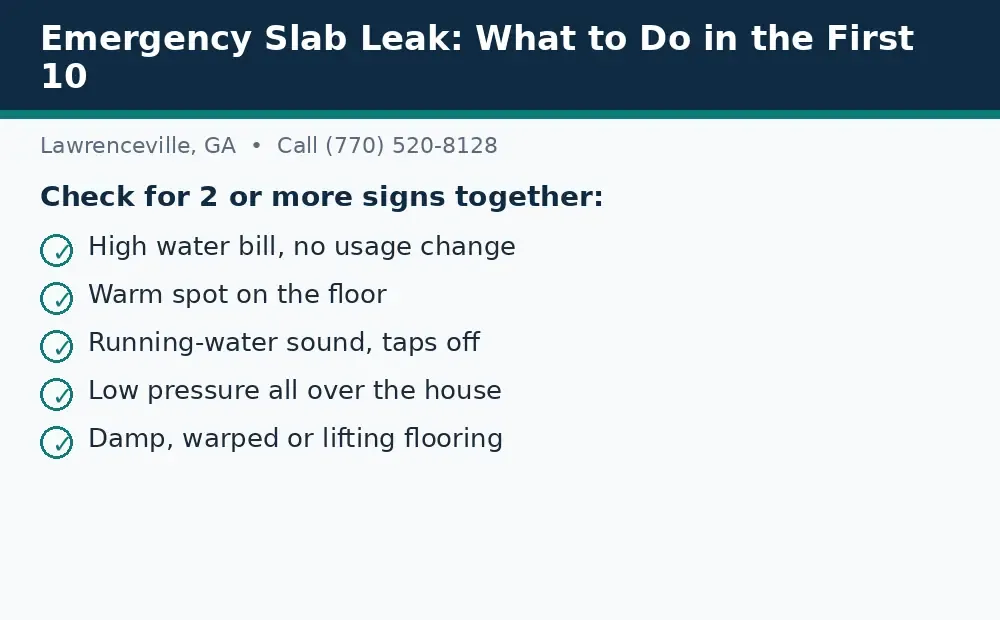
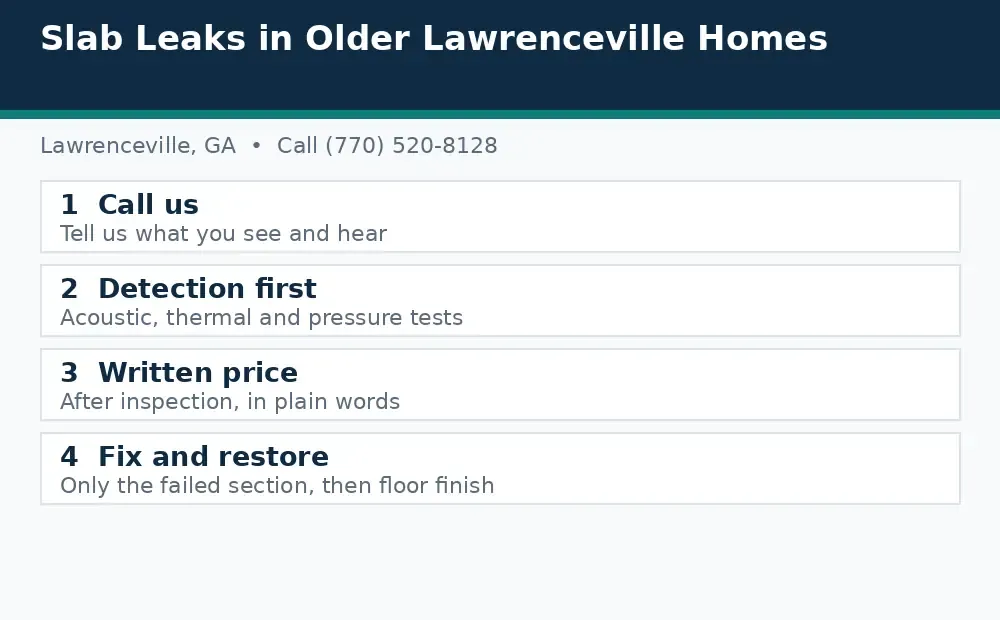
The working photo on this page is an illustrative working photo, not a photo of a specific job at a specific address. The diagrams are schematics, not to scale, made to explain the signs, process, options, or costs on this page in plain words. Call us at (770) 520-8128 if you are unsure what you are seeing.
What signs do hot and cold leaks share?
Most slab leak signs do not care which line leaks. A bill jump, a meter that moves with everything off, low pressure, damp flooring, a sound of running water, and musty smell can all accompany either side, because both sides lose pressurised water under the same slab. A homeowner who notices only the shared signs cannot tell hot from cold by those signs alone, and should not try — the shared signs justify a meter test and a detection call, and the side question is answered by testing, not by symptom-guessing. That shared foundation is important, because it prevents the common error of dismissing a leak for lacking a side-specific clue: a cold-water leak without warmth is still a leak, and a hot-water leak without a bill jump yet is still a leak.
The shared signs also explain why the signs guide treats signs as a cluster rather than as a fingerprint. Two or more shared signs together justify action regardless of side, and the side-specific clues below then refine — never replace — that justification. If you have shared signs, run the meter test first; the side comparison that follows is about directing detection efficiently, not about deciding whether detection is needed at all.
What points specifically at a hot-water leak?
Warmth is the hot-water signature, and it is unusually specific. A patch of floor that feels warm to bare feet while surrounding floor feels normal, persisting regardless of heating, sunlight, or time of day, points at escaping hot water warming the slab above the leak. The patch usually sits over a hot-water run — hallways, bathrooms, kitchens — and it often arrives with a heater that runs constantly, because the heater keeps reheating replacement water, and with a gas or electric bill climbing alongside the water bill. That three-part cluster — warmth, cycling heater, dual bill jump — is the strongest symptom case any slab leak offers, and it is detailed in full on the water heater guide in this batch.
Hot-water leaks also show tap behaviour clues: hot taps that run cooler than usual at distant fixtures, because the leak steals flow and heat along the way, or hot water that takes longer to arrive. Those clues are weaker alone — distance, pipe length, and heater settings all affect hot-water delivery — but alongside warmth and heater cycling they corroborate the hot side. Thermal imaging fits hot-water detection precisely because it reads the warmth pattern, which is why a hot-side suspicion leads detection toward imaging first, as explained on the thermal imaging page.
What points specifically at a cold-water leak?
Cold-water leaks offer no warmth clue, so their case is built from absence and from bill and meter evidence. The signs are the shared ones — bill jump, meter movement, damp, sound, pressure drop — without warmth, without heater cycling, and without a gas or electric jump. That absence is itself informative: a homeowner with a moving meter, a bill jump, and no warm patch and a normally cycling heater is more likely facing a cold-water leak than a hot-water one, though 'more likely' is not proof, and a hot leak under a thickly covered floor can hide its warmth too.
Cold-water leaks also tend to be noticed later than hot-water leaks of the same size, precisely because they lack the warm patch that draws attention. A cold pinhole may run as a creeping bill for a long time before damp appears, which is why bill comparison with the same period last year matters more for cold leaks than for any other kind. Acoustic listening fits cold-water detection well, because the escaping pressurised water sounds the same regardless of temperature, and the acoustic page explains that method. If your signs are all shared signs with no warmth, do not wait for warmth to appear — it will not, and the meter test you run today is the check that matters.
How does testing settle hot versus cold?
Pressure testing settles it by isolating each side. The hot-water side and the cold-water side are tested separately, and the side that loses pressure is the side that leaks. That result is definitive in a way no symptom cluster can be, and it directs everything after: thermal imaging for a confirmed hot side, acoustic listening for either pressurised side, camera work only if a drain suspicion remains alongside. A symptom-based guess that turns out wrong costs a misdirected search; a pressure result costs a test and saves that search.
Two cautions keep the testing honest. First, a home can have both a hot-side and a cold-side issue, though that is uncommon — a pressure result that implicates one side does not automatically clear the other if signs persist after repair. Second, a drain-side leak can coexist with supply signs or mimic them, and drain testing follows different rules, covered on the sewer detection page. The testing order therefore runs: meter confirms loss, pressure picks the side, locating method matches the side, and any remaining signs after repair trigger re-testing rather than assumption. For homes in Downtown Lawrenceville and Sugarloaf, that order is identical; floor covering and heater type change how symptoms show, not how testing settles them.
Does the side change the repair?
Sometimes, and the differences are practical rather than dramatic. A hot-water leak's repair must consider the heater's involvement — whether the heater contributed, whether it needs attention after continuous running, and whether the new route serves hot-water demand properly. A cold-water leak's repair is usually a cleaner pipe question, without the heater dimension. Rerouting a hot-water run may involve different insulation and route considerations than rerouting a cold-water run, and the restoration conversation may differ where warmth has affected flooring adhesives or finishes over time.
What does not change is the decision framework: detection first, written price after inspection, method chosen by leak position, pipe condition, and run history, with the planning ranges on this site as the frame — detection $300–$600, spot $500–$4,000, lining $800–$3,000, reroute $1,500–$5,500, repipe $4,500–$15,000+, all planning ranges, not quotes. Side determines the search and shades the repair; it does not create a separate price list or a separate process. If you are comparing sides because you are deciding whether to call, stop comparing and test: the symptom checker records your side clues, the meter test confirms loss, and pressure testing settles the side — in that order, without delay.
One last habit makes the whole comparison work: write down which fixtures you tested, what you heard or felt, and what the meter did, in that order, before you call. A technician can then skip straight to confirming the side, instead of re-running your checks from scratch, and your own notes stay useful if a second opinion is ever needed.
Hot vs cold: side-by-side
| Clue | Hot-water leak | Cold-water leak |
|---|---|---|
| Warm floor patch | Signature sign, often present | Absent — no warmth to show |
| Heater cycling | Constant running common | Normal cycling |
| Gas/electric bill | Often jumps with water bill | Usually unchanged |
| Water bill / meter | Jump + movement | Jump + movement |
| Damp, sound, pressure | May all appear | May all appear |
| Best locating method | Thermal imaging first | Acoustic listening |
| Settling test | Pressure testing, side by side — symptoms suggest, tests confirm | |
Shared signs justify action regardless of side. Side-specific clues direct detection; they never replace testing.
What to tell us when you call
When you call, tell us what you noticed, when it started, and where in the house it shows. Mention your ZIP code, whether the water meter moves with everything off, and whether the sign is on a hot-water or cold-water line if you know. That short list helps the technician bring the right equipment and plan the visit. You do not need to know the cause before you call — that is what detection is for.
Call (770) 520-8128 and describe what you are seeing in plain words. We will talk through the next step and arrange a detection visit.
Call Us Today
Fast local slab leak detection and repair in Lawrenceville, GA, ZIPs 30043–30046.
Call Us: (770) 520-8128Frequently asked questions
Can a cold-water leak cause a warm floor?
No. Warmth comes from escaping hot water. A warm patch points at the hot line; a cold-water leak shows the shared signs without warmth.
My heater runs constantly but there is no warm patch. Hot leak or not?
Possibly, if floor covering hides the warmth, or possibly a heater issue. Run the meter test, then let pressure testing settle the side — do not guess from one clue.
Do hot and cold leaks cost different amounts to repair?
No separate price list exists. Repair cost follows method, position, and pipe condition, with the same published planning ranges for either side. Heater attention after a hot leak is a separate consideration.
Can both hot and cold lines leak at once?
Uncommon but possible. A pressure result implicating one side does not automatically clear the other if signs persist after repair — re-test rather than assume.
Which side should I suspect if I only have a bill jump?
Neither yet. A bill jump alone is a shared sign. Run the meter test, check for warmth and heater behaviour, and let pressure testing pick the side.