 Lawrenceville Slab Leak Detectors
Yard Leak: Wet Spots, Lush Grass, and Pooling Explained
A yard leak in Lawrenceville — a wet spot that never dries — can come from a main line break, a slab leak, or an irrigation fault. Homeowners in Collins Hill and Gwinnett Place, ZIPs 30043 and 30044, should check the meter and isolate irrigation first.
Key takeaways
- A wet patch that stays wet days after rain, in the same place, is a leak clue; a patch that dries with the weather is usually drainage.
- Lush grass in a strip or patch means extra water is reaching that soil consistently — follow the strip, it often traces the pipe route.
- Irrigation is the first suspect to isolate: shut its main and watch the meter.
- Never dig to find a yard leak yourself — location work first, one dig at the right place.
What this looks like in a Lawrenceville home
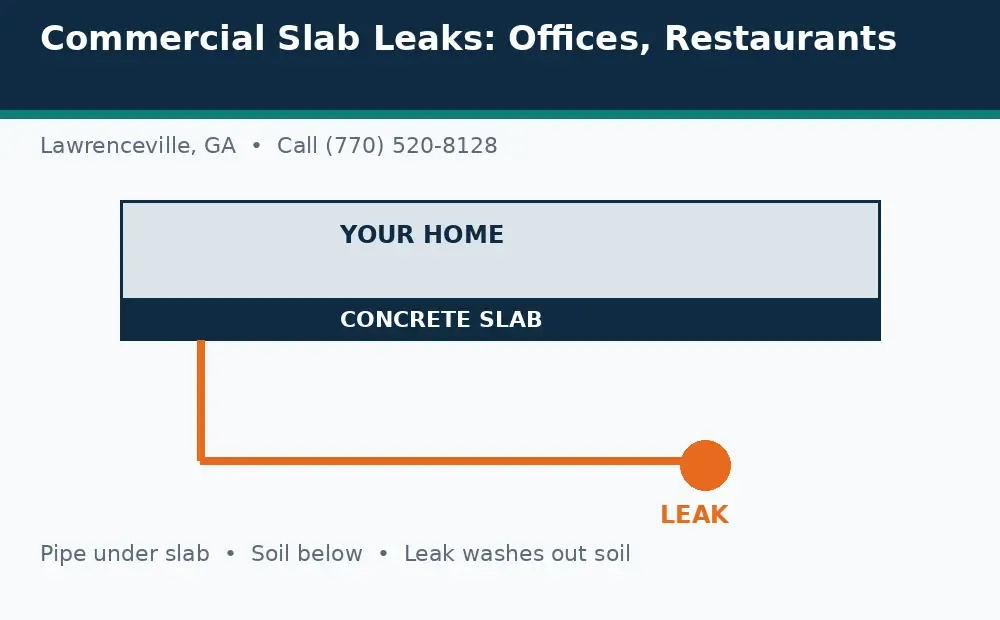
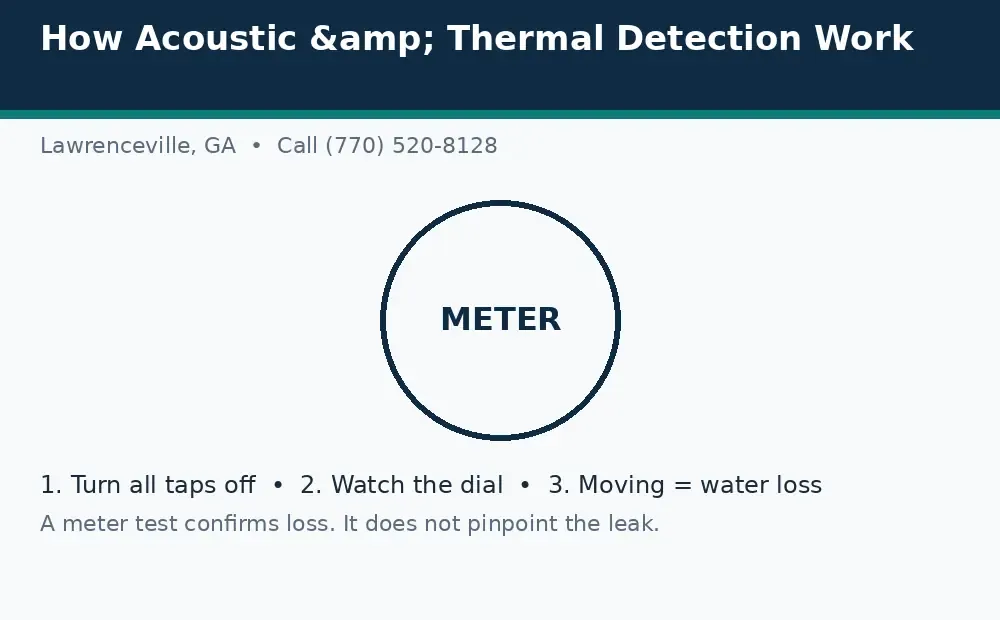
The working photo on this page is an illustrative working photo, not a photo of a specific job at a specific address. The diagrams are schematics, not to scale, made to explain the signs, process, options, or costs on this page in plain words. Call us at (770) 520-8128 if you are unsure what you are seeing.
What does a yard leak actually look like?
A yard leak rarely announces itself as a geyser. More often it is a patch of ground that stays soft or wet when the rest of the yard has dried, a strip of grass that grows visibly greener and taller than its neighbours, a small area that sinks slightly, or water pooling in a low spot where pooling never happened before. The grass clue deserves emphasis, because it is the most counterintuitive: a homeowner who notices one lush strip and assumes the lawn is simply thriving there is looking at extra water feeding that strip, week after week, and the strip's shape often follows the buried pipe's route in a way no fertiliser pattern would.
Timing separates a leak from weather. A patch that appears after heavy rain and dries with the yard is drainage doing its job. A patch that stays wet through dry weather, or that returns in exactly the same place after every dry spell, is fed by something constant — and the constant candidates are a supply leak, an irrigation fault, or a drainage failure that traps water. Note the patch's shape, size, and exact position, photograph it dated, and note whether it changes with rain or ignores it. That dated record is the starting point for everything that follows, and it is far more useful than a description given from memory weeks later.
Is it the main line, the slab, or the irrigation?
Three systems can wet a yard, and they are separated by tests, not by appearance. Irrigation is tested by isolation: shut the irrigation main, wait, and watch both the patch and the meter. If the patch stops growing and the meter stops, the irrigation system is the answer, and the repair belongs to that system. The main supply line is tested by the meter with everything off: a moving meter with irrigation off and the house off points at the supply side, and the patch's position relative to the meter-to-house route then suggests whether the break sits in the yard section or continues under the slab.
A slab leak reaches the yard less directly but still visibly: water escaping under the slab can travel along the slab edge and surface beside the house, or wash soil that settles and shows as a soft or sinking strip near the foundation. The distinguishing feature is the house signs that accompany it — a bill jump, low pressure, damp inside, or a warm patch — which a pure yard-section break may not produce, or produces differently. The main water line break guide in this batch covers the supply-side story in full, and the mimics guide covers the irrigation isolation in detail. What matters here is the order: isolate irrigation first, test the meter second, and let those two results decide whether the yard patch is a yard job, a slab job, or neither.
How is a yard leak located without tearing up the lawn?
Location follows the same narrowing logic as indoor detection, adapted to open ground. Pressure testing separates the system into sections and shows which section loses pressure. Acoustic listening follows the sound of escaping water through soil — harder outdoors, where ambient noise competes, but still the primary tool for a pressurised break. Line tracing maps the buried route, so a lush strip can be compared with the actual pipe path rather than guessed at. Only when those steps agree does digging start, at one place, and a yard repair done that way leaves one restored patch, not a trench across the lawn.
What not to do is dig on suspicion. A homeowner who digs where the grass is greenest may find the pipe — or may find nothing, because water surfaces downhill from its source, or may cut a different utility, or may widen a break that was previously a slow loss. Exploratory digging also destroys the surface evidence — the patch shape, the grass pattern — that location work reads. If the patch sits over a driveway or patio rather than lawn, the same rule holds with more force: detection and tracing decide the dig point, and the no-break fix guide becomes relevant where rerouting can avoid excavation altogether. For homes in Collins Hill and Gwinnett Place, lot and driveway layouts vary, but the sequence — isolate, test, trace, dig once — does not.
What does a yard leak repair and restoration involve?
For a yard-section break, the repair is usually direct: expose the failed length at the located point, replace it, pressure-test the new section, and backfill. Restoration means returning the dig area to grade, reseeding or re-sodding, and confirming drainage still moves water away from the house rather than into the repair area. Ask before work starts what restoration includes — grade, topsoil, seed or sod, and any patio or path reinstatement — because a repair that leaves a sunken, muddy patch has finished the pipe job and left the yard job undone. Photograph the area before work so the restored result can be compared.
For a break that continues under the slab, the repair conversation becomes a slab conversation, with the same menu — spot repair, reroute, lining where it fits, repipe where the system dictates — and the same written-price-after-inspection discipline. The planning ranges on this site apply as the frame: detection $300–$600, spot $500–$4,000, reroute $1,500–$5,500, repipe $4,500–$15,000+, all planning ranges, not quotes. While the repair is planned, keep the supply off or isolated if advised, keep the meter notes and dated photos together, and follow the documentation habits in the insurance claim process guide if a claim follows — yard damage photographs are claim evidence too.
Can yard leaks be prevented or caught earlier?
The same routine that catches indoor leaks catches yard leaks, with one addition: a yard walk. Compare each bill with the same period last year, run a yearly meter test, and walk the yard after dry spells looking for patches that stay wet, grass strips that outgrow their neighbours, or soft ground. Know where the supply line enters the property and where the irrigation main sits, and make sure anyone digging on the property — for any project — has lines marked first. A shovel through a supply or irrigation line is one of the most avoidable yard leaks there is.
If a previous yard repair exists on the property, note its position and watch that run: a replaced section beside an aging remainder is the same pattern as an indoor repeat leak, and it deserves the same judgement about the rest of the run. And if a lush strip appears and you are unsure whether it is a leak or simply a healthy lawn, the test costs nothing: isolate the irrigation, run the meter test, and watch the strip over a dry week. A healthy lawn dries evenly with the weather; a fed strip does not. That distinction, observed rather than assumed, is what turns a lawn observation into a decision — and the service area checker confirms the property sits inside the covered ZIPs 30043–30046 before you call.
Yard symptom decoder
| Yard sign | Most likely source | First test |
|---|---|---|
| Wet patch, dry weather, same place | Supply or irrigation leak | Isolate irrigation, then meter test |
| Lush strip following a line | Buried pipe route leaking | Compare strip with traced pipe route |
| Pooling in a low spot after rain | Drainage, not a leak | Watch through a dry spell |
| Soft or sinking ground | Soil washout from a leak | Meter test; do not dig |
| Wet patch near the slab edge | Slab leak surfacing at the edge | Meter test + house signs check |
Shape and timing are the evidence: a strip that follows a pipe route, and wetness that ignores dry weather, both point at a leak rather than drainage.
Photograph Dated wide and close shots of the patch, strip, or pooling.
Isolate Irrigation main off — if the patch and meter settle, irrigation is the answer.
Test Meter with everything off; movement means supply-side loss.
Locate Pressure test, listening, and tracing — then one dig at the right place.
What to tell us when you call
When you call, tell us what you noticed, when it started, and where in the house it shows. Mention your ZIP code, whether the water meter moves with everything off, and whether the sign is on a hot-water or cold-water line if you know. That short list helps the technician bring the right equipment and plan the visit. You do not need to know the cause before you call — that is what detection is for.
Call (770) 520-8128 and describe what you are seeing in plain words. We will talk through the next step and arrange a detection visit.
Call Us Today
Fast local slab leak detection and repair in Lawrenceville, GA, ZIPs 30043–30046.
Call Us: (770) 520-8128Frequently asked questions
Is a lush patch of grass always a leak?
No. Fertiliser, shade patterns, and a low spot can all green one area. A lush strip that follows a line, stays wet through dry weather, and pairs with a moving meter is a leak clue; a lush patch that dries evenly with the yard usually is not.
Should I dig where the grass is greenest?
No. Water surfaces downhill from its source, so the greenest point may not be the break. Location work first, then one dig at the traced point.
Can a slab leak cause a yard wet patch?
Yes. Water escaping under the slab can travel to the slab edge and surface beside the house, or wash soil that shows as soft ground near the foundation. House signs plus a meter result confirm whether the slab is involved.
How do I tell a yard leak from a drainage problem?
Watch through dry weather. Drainage wetness follows rain and dries with the yard; leak wetness persists through dry spells in the same place, and usually moves the meter.
Who restores the lawn after a yard repair?
Ask before work starts. Restoration — grade, topsoil, seed or sod — should be agreed in writing alongside the pipe repair, with before photographs for comparison.