 Lawrenceville Slab Leak Detectors
Main Water Line Break: Signs, Location, and Repair
A main water line break in Lawrenceville shows as pooling water, a soggy or unusually green yard patch, a pressure drop, or a meter that spins with everything off. Homeowners in Gwinnett Place and Collins Hill, ZIPs 30044 and 30043, should shut the supply if safe and call for detection.
Key takeaways
- The main line runs from the street or meter into the house — a break there can flood the yard without any indoor sign at first.
- Pooling, soggy ground, and lush grass patches are yard symptoms; pressure loss and a spinning meter are house symptoms.
- Water travels underground, so the wet patch is not proof of the break's location — detection still comes first.
- Shut the supply off if safe, photograph the area, and call before digging anywhere yourself.
What this looks like in a Lawrenceville home
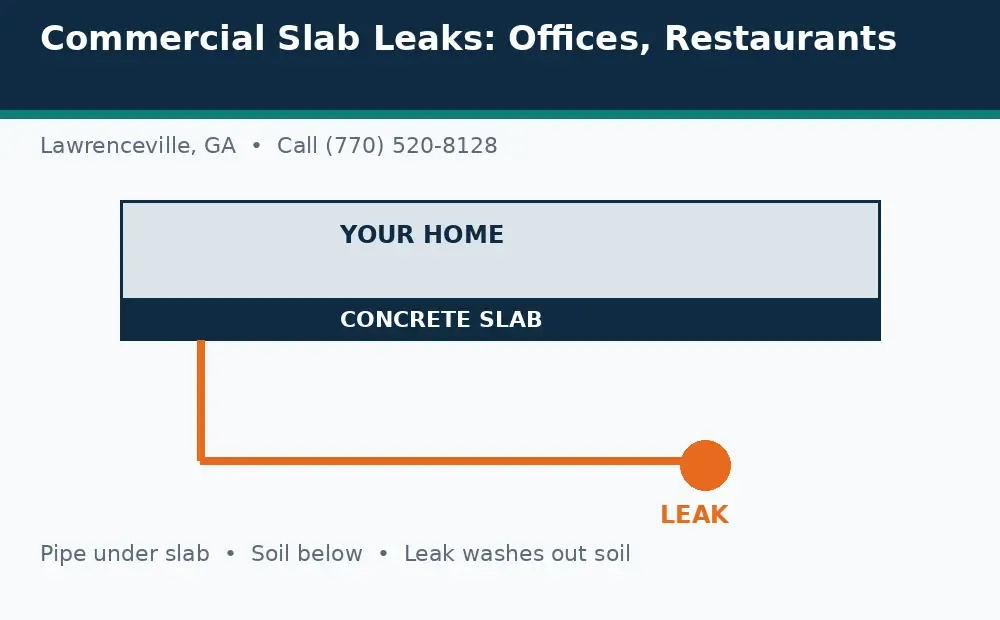
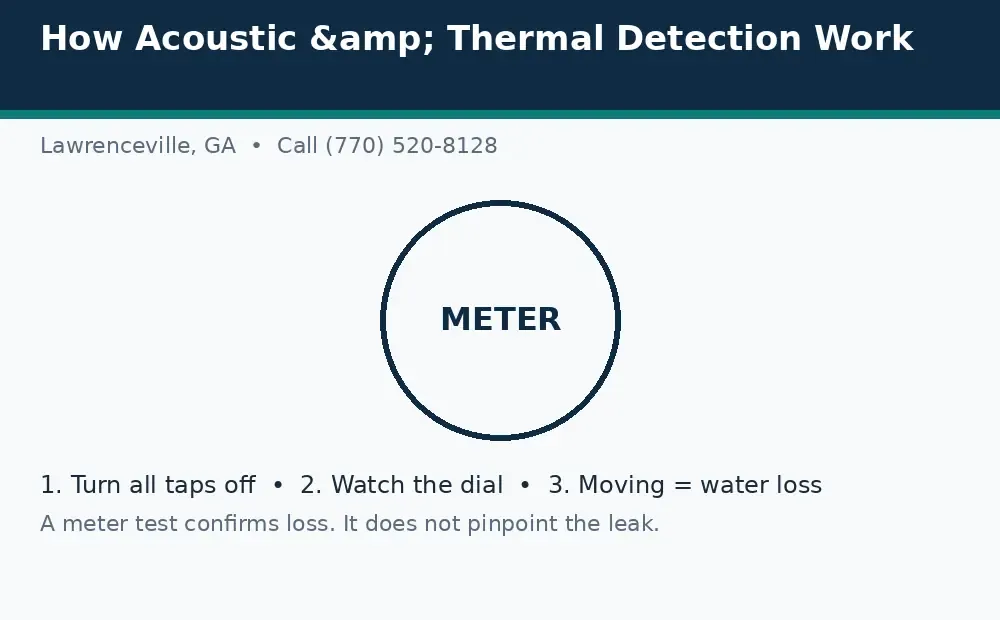
The working photo on this page is an illustrative working photo, not a photo of a specific job at a specific address. The diagrams are schematics, not to scale, made to explain the signs, process, options, or costs on this page in plain words. Call us at (770) 520-8128 if you are unsure what you are seeing.
What is the main water line, and where does it break?
The main water line is the supply pipe that carries water from the street or meter into your home. Unlike the smaller pipes that branch to individual fixtures, it carries the whole house's supply, so a break in it loses water fast and shows up across the house at once. Breaks happen where the line is weakest: at a joint, where corrosion has thinned the pipe, where ground movement has stressed a section, or where a root or a digging accident has damaged it. The line is buried, so the break itself is invisible — what you see is what the escaping water does at the surface.
That invisibility is why a main line break is so often misread at first. A homeowner who finds a soggy patch in the yard may assume a drainage problem; a homeowner whose pressure drops everywhere may suspect the utility. Both can be a main line break, and both deserve the same first check: the water meter with everything in the house off. If the meter moves, water is leaving the system somewhere between the meter and the house, and the main line is the prime suspect. From there, slab leak detection in Lawrenceville covers the same location work, because the tools — pressure testing, listening, and tracing — are the same whether the failed section ends up under the slab or under the yard.
What are the signs of a main water line break?
Yard signs come first for many breaks: a patch of ground that stays wet days after rain, a soft or sinking area, grass that grows greener and faster in one strip, or water pooling where it never pooled before. House signs follow or arrive together: pressure that drops at every tap at once, air sputtering from taps, discoloured water after the flow returns, or a water bill that jumps sharply. Any one of these alone has other explanations — a wet patch can be drainage, a pressure drop can be utility work — but two or more together, especially with a moving meter, point firmly at a supply-side break.
The meter test is the check that turns suspicion into a decision. Turn every tap and appliance off, read the meter, wait, and read it again. A dial that moves with nothing running means water is going somewhere it should not, and the amount of movement hints at the size of the loss without proving the location. Do not dig to find the break yourself: buried lines, other utilities, and the risk of widening the damage make exploratory digging a bad idea, and a wrong hole costs time while water keeps escaping. Note instead where water first appeared, when pressure changed, and what the meter showed, and give that note to the technician — it is the starting point for location work, and it pairs naturally with the water meter leak test guide on this site.
How is a main line break located without digging up the yard?
Location starts with narrowing, not digging. Pressure testing separates the system into sections and shows which section loses pressure, which tells the technician whether the break sits on the main run, a branch, or inside the house. Acoustic listening then follows the sound of escaping water through the ground and the pipe, and line tracing maps the pipe's route so the listening points mean something. Only when those steps agree on a location does digging start, and then it starts at one place, not along the whole route. That sequence — narrow, listen, trace, then dig once — is what keeps a main line repair from becoming a yard-wide excavation.
Where the break sits changes the fix. A break in the yard section is usually reached directly, repaired or replaced over the failed length, and backfilled. A break that continues under the slab becomes a slab problem, and the options shift to the same menu as other slab failures: spot repair, rerouting, or repiping, chosen by the pipe's condition and the leak's position. The planning ranges on this site — detection $300–$600, spot repair $500–$4,000, reroute $1,500–$5,500, repipe $4,500–$15,000+, all planning ranges, not quotes — apply as the starting frame, with a written price after inspection once the location and the failed length are known. Homes in Gwinnett Place and ZIP 30045 follow the same process; lot layout changes the digging, not the diagnosis.
What does the repair involve, and what happens to the yard?
For a yard-section break, the repair is usually direct: expose the failed length, cut it out, replace it, test the new section under pressure, and backfill. The yard disruption is localised to the dig site, and restoration means returning that area to grade, reseeding or re-sodding as needed, and checking that drainage still moves water away from the house. Ask before work starts what the restoration includes and what it does not, because a repair that leaves a sunken, muddy patch has only half-finished the job. Photograph the area before work starts so the restored result can be compared with the original.
For a break that runs under the slab or under a driveway, the conversation changes, and the options from the fix without breaking the floor guide become relevant: rerouting around the slab can avoid both a floor opening and a driveway excavation. Whatever the route, the same discipline applies — detection first, written price after inspection, and restoration agreed in advance. While the repair is planned, keep the supply off or isolated if the technician advises it, and keep the meter note and photos together; they become part of the record if an insurance question arises later, following the same documentation habits as the insurance claim process guide.
Can a main water line break be prevented?
No routine guarantees a buried line will never fail, but the same habits that catch slow slab leaks also catch main line trouble early. Compare each water bill with the same period last year, run a yearly meter test, and walk the yard after heavy rain looking for patches that stay wet or grass that grows oddly fast in one strip. Know where the line enters the house and where the shut-off sits, and make sure everyone in the household knows too — in a break, the first ten minutes matter more than any later repair choice.
Before any digging on your property, for any reason, have underground lines marked. A shovel through a supply line is one of the most avoidable breaks there is, and it is also one of the most expensive in water loss and repair. If your home's supply line is aging, or if a previous break was repaired on one section while the rest of the run is the same age and material, ask the technician whether the rest of the run deserves watching, rerouting, or replacement as a planned job rather than as the next emergency. A planned replacement is chosen on your schedule; a break chooses its own.
Main line break: symptom map
| Where you notice it | What you see | What it suggests |
|---|---|---|
| Yard | Wet patch, soft ground, lush strip, pooling | Break in the buried yard section |
| Every tap | Pressure drop, sputtering, discoloured water | Supply-side loss affecting the whole house |
| Water meter | Dial moves with everything off | Water leaving the system; size hints at severity |
| Water bill | Sharp jump vs same period last year | Loss running unnoticed for a billing period |
| Inside, near slab | Damp floor, warm patch | Break may continue under the slab |
No single symptom proves a main line break. Two or more together, plus a moving meter, justify a detection call the same day.
Meter Everything off, read, wait, read again. Movement means loss.
Note Where water appeared, when pressure changed, what the meter showed.
Call Report a suspected main line break, water status, and unsafe areas.
Locate Pressure test, listening, and tracing before any digging.
Restore Agree the yard restoration in advance, and photograph before work.
What to tell us when you call
When you call, tell us what you noticed, when it started, and where in the house it shows. Mention your ZIP code, whether the water meter moves with everything off, and whether the sign is on a hot-water or cold-water line if you know. That short list helps the technician bring the right equipment and plan the visit. You do not need to know the cause before you call — that is what detection is for.
Call (770) 520-8128 and describe what you are seeing in plain words. We will talk through the next step and arrange a detection visit.
Call Us Today
Fast local slab leak detection and repair in Lawrenceville, GA, ZIPs 30043–30046.
Call Us: (770) 520-8128Frequently asked questions
Is a main water line break the same as a slab leak?
Not exactly. A main line break is a failure in the supply line from the street into the house; a slab leak is a leak in a pipe under the slab. A break can be in the yard section, under the slab, or both, and detection tells you which.
Should I dig to find the break myself?
No. Buried lines and other utilities make exploratory digging risky, and a wrong hole wastes time while water keeps escaping. Location work comes first, then one dig at the right place.
How do I know the break is not a utility problem?
A utility issue usually affects neighbours too and shows no meter movement with your taps off. A moving meter with everything off points at your side of the system.
Will my yard be dug up along the whole line?
No, if location work is done first. Pressure testing, listening, and tracing narrow the break to one area, so digging starts at one place, not along the route.
What if the break runs under my driveway?
Detection still comes first, and rerouting around the slab or driveway may avoid excavation there. The options depend on the leak's position and the pipe's condition.