 Lawrenceville Slab Leak Detectors
Sound of Running Water When Every Tap Is Off
Hearing running water in a Lawrenceville home when every tap is off usually means water is moving somewhere it should not. Homeowners in Downtown Lawrenceville and Collins Hill, ZIPs 30046 and 30043, should quiet the house, locate the sound, and check the meter.
Key takeaways
- Quiet the house first: televisions, washing machines, and HVAC noise all mask or mimic running-water sounds.
- Locate the sound by room and by floor — a sound loudest at one floor area points differently from one heard everywhere.
- Check the meter: a sound plus a moving meter means real loss; a sound with a still meter needs another explanation.
- A sound alone never proves a slab leak — it earns a meter test, and the meter test earns detection.
What this looks like in a Lawrenceville home
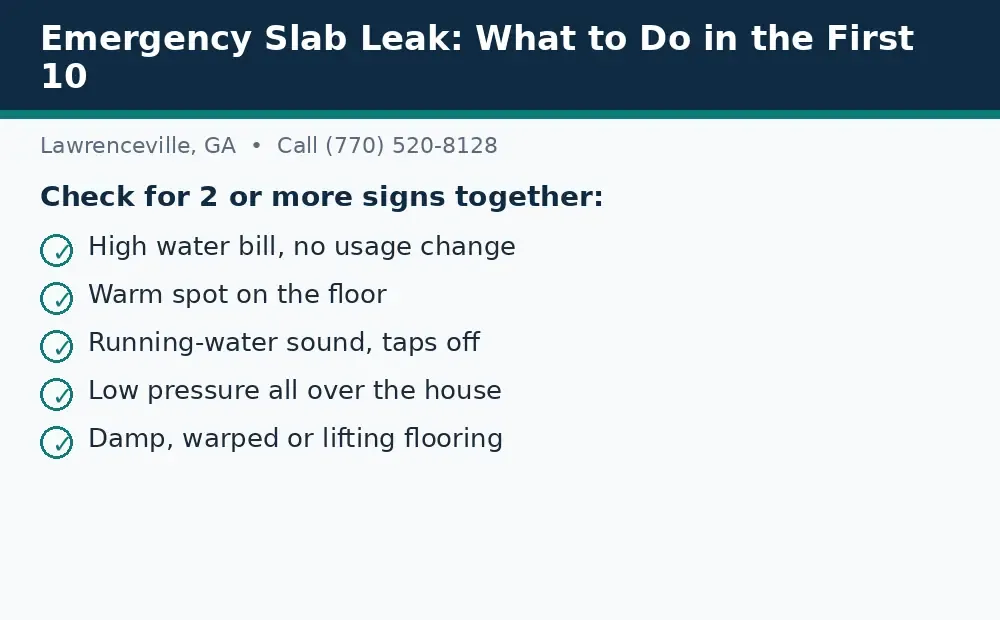
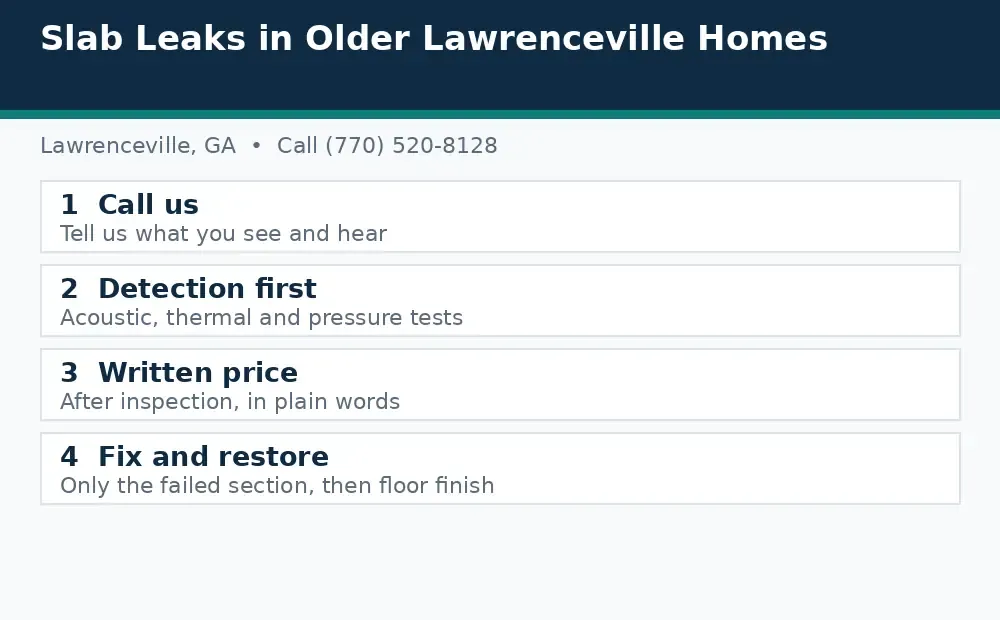
The working photo on this page is an illustrative working photo, not a photo of a specific job at a specific address. The diagrams are schematics, not to scale, made to explain the signs, process, options, or costs on this page in plain words. Call us at (770) 520-8128 if you are unsure what you are seeing.
What does a slab leak actually sound like?
A slab leak under pressure makes a sound that is often described as hissing, rushing, or a faint continuous flow — not a drip, not a gurgle, and not the clunk of a pipe expanding. The sound comes from pressurised water escaping through a hole or crack and moving through soil or along the pipe, and concrete muffles it, so what reaches your ear is usually quieter and less localised than you expect. Many homeowners first notice it at night, when the house is still, or in a bathroom or utility room where the floor carries the sound well. If you have to press your ear to the floor to hear it, that does not make it imaginary — quiet is normal for a leak under concrete.
The sound's character gives clues, but only clues. A steady hiss that never changes suggests a constant pressurised loss; a sound that comes and goes with fixture use suggests a fixture or appliance rather than a slab line; a sound that follows rain suggests drainage rather than supply. None of those distinctions proves anything on its own, which is why this post treats sound as a trigger for the meter test rather than as a diagnosis. The acoustic detection service exists precisely because trained listening with sensitive equipment hears what an unaided ear can only suspect — but the homeowner's first job is simpler: notice the sound, locate it as well as you can, and check the meter.
How do I locate the sound properly?
Wait for a quiet house. Turn off the television, pause the washing machine and dishwasher, and let the HVAC settle, because every one of those can produce or mask a water-like sound. Then walk slowly from room to room, pausing in each, and note where the sound is loudest and whether it is heard through the floor, through a wall, or near a fixture. Crouch and listen at floor level in the loudest room — slab sounds travel through the floor, so floor-level listening is more informative than standing listening. Note the room, the floor area, and whether the sound is continuous or intermittent, and do it at two different times of day if you can, because a sound that appears only when someone showers is a different story from one that never stops.
Also listen outside the suspect room: at the water heater, near the meter, and at the main shut-off. A sound heard everywhere with no loudest point suggests a main or shared line; a sound with a clear loudest floor area suggests a localised leak worth marking for the technician. Write the notes down rather than trusting memory — 'loudest in the hallway outside the guest bathroom, continuous, heard at night and at midday' is a useful report, while 'somewhere downstairs' is not. That note, plus the meter result, is what you hand to detection, and it mirrors the preparation advice in the detection visit guide in this batch.
What else sounds like running water?
Several ordinary things produce water-like sounds, and each deserves ruling out before the slab is blamed. A toilet refilling silently after a slow flapper leak produces a faint, intermittent flow sound near a bathroom. A water heater refilling or expanding can hiss or groan near the heater. An ice maker, a humidifier, or a water softener cycling can all sound like distant running water. Pipes expanding and contracting with temperature change tick and knock, usually in bursts rather than continuously. And in attached housing, a neighbour's plumbing can transmit sound through shared walls or slabs in ways that genuinely sound as if they come from your own floor.
The distinguishing test for each is isolation and timing. Does the sound stop when a toilet's supply is shut? Does it follow the water heater's cycle? Does it appear only when an appliance runs? Does it persist through the night with everything in your house off? A sound that survives every isolation and every quiet period, in your own home, with your own meter moving, is the one that points at the slab. A sound that stops with an isolation was never the slab at all. The mimics guide in this batch walks those isolations in full, and the symptom checker lets you record the sound alongside your other signs before you call.
What does the meter test add to a sound report?
The meter test turns a subjective sound into an objective fact: is water actually being lost right now? Everything off, read the dial, wait, read again. A moving dial plus a continuous sound is a strong pair — it says water is escaping under pressure somewhere, and the sound says roughly where to start listening with equipment. A still dial plus a sound says something else entirely: the sound may be a neighbour's pipe, an appliance, expansion noise, or a drain-side issue that does not move a supply meter, and each of those leads somewhere other than slab detection.
Run the test during a period when the sound is present, if you can, because an intermittent loss tested during a quiet interval will read as no loss and mislead you. If the sound is continuous, any quiet period works. If the meter moves, note how much and over how long — the rate hints at the loss size without proving the location — and call for detection in Lawrenceville with the sound location, the meter readings, and the isolations you tried. If the meter stays still despite a persistent sound, note that too and call to discuss it: a still meter does not end the investigation, it redirects it, and a technician can advise whether acoustic work, a drain check, or a neighbour-side question is the right next step.
When should a running-water sound trigger an urgent call?
Urgency follows the combination, not the sound alone. A continuous sound plus a spinning meter, a sound plus pooling water or a sudden pressure drop, or a sound plus water near electrics all justify an emergency call the same day, following the first steps on the emergency repair page: shut the supply if safe, keep clear of wet electrics, and call with a plain account. A faint, intermittent sound with a still meter and no other sign justifies a prompt check — meter test, isolations, and a second listen on another day — rather than a midnight emergency, but it does not justify ignoring it.
The mistake to avoid in both directions is waiting for certainty. A sound that persists for weeks while a homeowner waits to be sure is a leak running for weeks, whether or not it ever becomes dramatic. Conversely, a sound investigated the day it is noticed costs a meter test and a few isolations, and either finds a simple cause or produces the evidence bundle detection needs. For homes in Downtown Lawrenceville and ZIP 30046, the advice is the same as everywhere in Lawrenceville's ZIPs 30043–30046: quiet the house, locate the sound, test the meter, isolate the simple causes, and let the results — not the worry — decide the call.
Sound investigation flow
| Step | What to do | What the result means |
|---|---|---|
| Quiet the house | TV, laundry, HVAC off or settled | Removes masking and mimic sounds |
| Locate | Room by room, floor level, note loudest area | Localised vs everywhere changes the story |
| Isolate | Toilets, appliances, irrigation, one at a time | Sound stops: mimic found |
| Meter test | Everything off, read, wait, read again | Moves: real loss. Still: redirect investigation |
| Decide | Sound + moving meter = detection call | Sound alone = keep testing, do not assume |
Sound is a trigger, not a diagnosis. The meter test is what promotes it from suspicion to evidence.
Quiet Still house, no laundry, no television — listen room by room.
Locate Floor level in the loudest room; note continuous vs intermittent.
Isolate One suspect at a time; a sound that stops was never the slab.
Test Meter during a period the sound is present, readings written down.
What to tell us when you call
When you call, tell us what you noticed, when it started, and where in the house it shows. Mention your ZIP code, whether the water meter moves with everything off, and whether the sign is on a hot-water or cold-water line if you know. That short list helps the technician bring the right equipment and plan the visit. You do not need to know the cause before you call — that is what detection is for.
Call (770) 520-8128 and describe what you are seeing in plain words. We will talk through the next step and arrange a detection visit.
Call Us Today
Fast local slab leak detection and repair in Lawrenceville, GA, ZIPs 30043–30046.
Call Us: (770) 520-8128Frequently asked questions
I hear running water but the meter does not move. Is it a slab leak?
Probably not a pressurised supply leak. It may be an appliance, expansion noise, a neighbour's pipe, or a drain-side issue. Note when it occurs and what stops it, and discuss the pattern with a technician rather than assuming the slab.
Why do I only hear it at night?
Night is when the house is quietest, so a faint continuous sound becomes audible. Night-time audibility does not mean the leak started at night — it means the house finally got quiet enough to hear it.
Can acoustic detection hear what I cannot?
Yes. Acoustic equipment is far more sensitive than the unaided ear and can follow a pressurised leak's sound through concrete to a marked location. Your job is to report where you hear it; the equipment does the precise locating.
Does a loud sound mean a large leak?
Not necessarily. Sound loudness depends on pressure, pipe material, floor covering, and room acoustics as well as leak size. The meter reading sizes the loss; the sound locates the search.
Should I record the sound for the technician?
A phone recording can help, especially if the sound is intermittent, but a written note of location, timing, and continuity matters more. Bring both if you have them.