 Lawrenceville Slab Leak Detectors
Can a Slab Leak Attract Termites in Lawrenceville, GA?
A slab leak in Lawrenceville, GA does not create termites, but the moisture it leaves under the slab can attract eastern subterranean termites. In ZIPs 30043 and 30044, near Collins Hill, Georgia red clay holds that moisture against the slab, and the leak has to be found and fixed first.
What this looks like in a Lawrenceville home
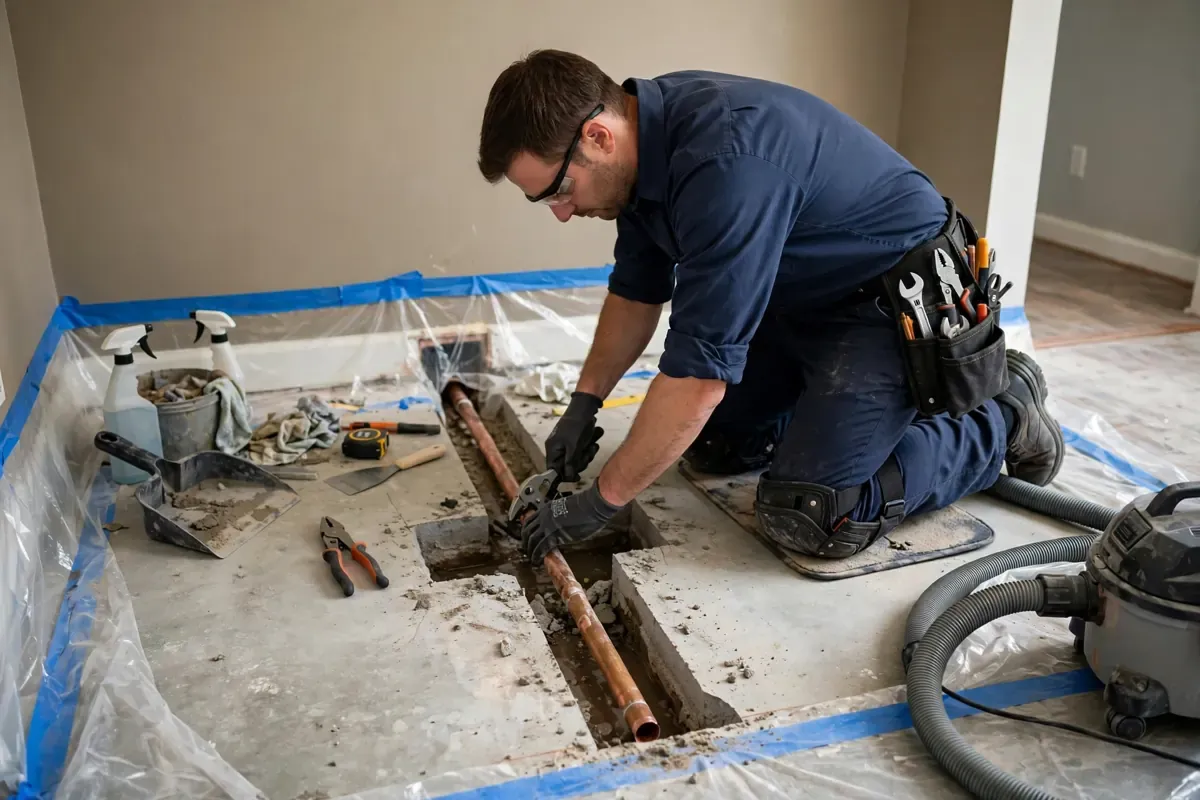
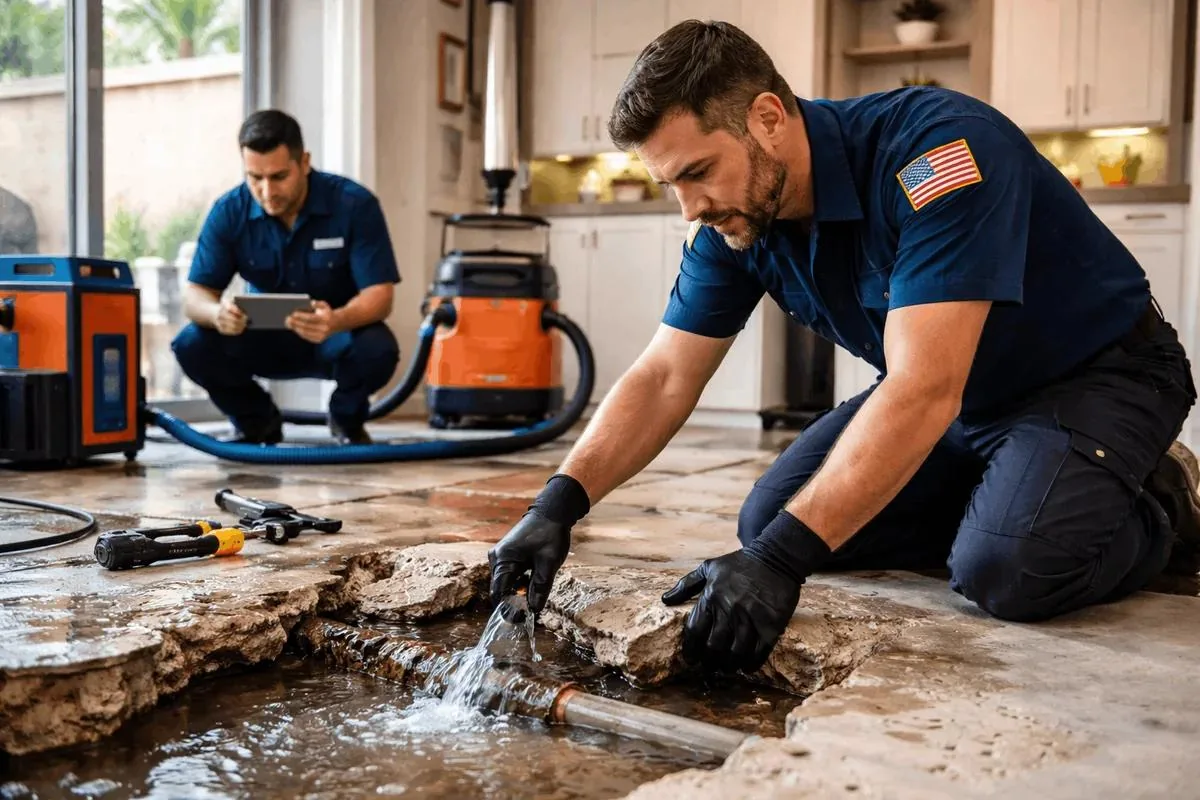
The images on this page are generic illustrations — a pipe-under-slab diagram and a spot-repair photo — not photos of this business's own work or of a specific home. Call us at (770) 520-8128 if you are unsure what you are seeing.
The short answer: the leak does not create termites — it invites them
A slab leak does not create termites. Termites are already in the soil around Georgia homes; what a slab leak gives them is the one thing they need most — constant moisture — and a route straight to it. A plumbing leak under a slab keeps the soil wet right where the pipe passes through the concrete, which is exactly the route termites like. Georgia pest companies describe the state as sitting in the most termite-active region in the country, and short winters keep termites active nearly all year, so the moisture a leak leaves behind is not a rare condition here — it is an open invitation in a place where termites are already looking. Fix the leak and the attraction drops. Leave the leak running and the invitation stays open, month after month, while the damp wood above the slab softens. The what is a slab leak guide explains how a leak under the slab starts, and the Georgia red clay guide explains why the soil under a Lawrenceville home holds that moisture instead of draining it away. Detection still comes first when something is wrong — the water meter leak test guide walks through the check that confirms water is actually being lost.
How termites get past concrete
Concrete is not a barrier to a subterranean termite; it is a surface to get around. University extension guidance notes that eastern subterranean termites can enter through cracks as narrow as about 1/32 of an inch, and they use expansion joints and the gaps around pipe penetrations the same way — every place where a pipe passes through the slab is a place where the concrete is already interrupted. The leak makes that entry point worse in two ways at once: the wet soil sits right at the crack or joint, so the termites do not have to travel far to find it, and the moisture softens the wood above, so the first wood they reach is already the kind they exploit. The foundation damage guide covers what a leak does to the soil and the slab itself, and the how long a slab leak goes undetected guide covers how long a leak can run before anyone notices — which is also how long the invitation can stay open.
Once inside, subterranean termites build mud tubes — thin tunnels of soil running up a foundation wall or a slab edge — to travel between the damp soil and the wood above while staying out of the open air. The tubes are the clearest sign they are there, and they often appear exactly where the moisture is: near a pipe entry, along a damp slab edge, or behind a baseboard over a wet patch. A leak does not guarantee termites will come — a house can have a leak for years and never see one — but a leak removes the two things that normally keep them away: dry soil and dry wood. That is the whole mechanism, and it is why a leak that looks like a plumbing problem is also, over time, a pest problem.
Why Lawrenceville homes are at risk
Three things stack up in Lawrenceville. The first is the soil: Georgia red clay holds moisture rather than draining it, so a leak under a slab keeps the soil wet for far longer than the same leak would in sandy ground — the red clay guide linked above covers this in detail, and the what causes slab leaks guide covers the pipe failures that start the leak. The second is the termite pressure itself: Georgia pest companies describe the state as sitting in the most termite-active region in the country, with short winters that keep termites active nearly all year instead of forcing them into a long dormant season. The third is the way Lawrenceville homes are built: slab-on-grade construction puts the wood framing close to the soil, with the slab as the only layer between them — and the slab is already pierced by the pipes that run through it.
None of this means every Lawrenceville home with a slab leak will get termites. It means the margin for error is thinner here than in a drier climate: a leak that runs for months in red clay, under a slab, in a state where termites are active nearly all year, is a leak that has had every chance to attract them. The risk grows with time, which is the same reason a leak should be found quickly for its own sake — the longer it runs, the more water is lost, the more the soil is washed out, and the more the wood above softens. Finding the leak early is the single step that cuts both risks at once.
Overlapping warning signs: leak signs and termite signs
A slab leak and a termite problem share one early sign — dampness — and then they diverge, which is how you tell them apart. The leak's signs are the ones this site covers in depth: a warm spot on the floor over a hot-water line, the sound of running water when every tap is off, a water bill that has jumped for no reason, and a musty smell with damp or warped floors. Those signs point to water escaping under the slab, and they are the reason to get detection done.
The termite signs are different, and they belong to a termite inspector, not a plumber: mud tubes running up a foundation wall or slab edge, discarded wings near windows or doors, wood that sounds hollow when tapped, blistered paint or buckling near the slab, and small piles of what looks like sawdust near wood. The overlap is the danger zone: damp wood from a leak is the wood termites exploit first, so a warm, damp patch on the floor with mud tubes nearby is two problems at once, not one problem with two explanations. If you see termite signs, do not wait for the leak repair to finish before calling a termite inspector — and if you see leak signs, do not wait for a termite inspection before calling for detection. The two problems are found by different professionals, and each one gets worse while the other is being handled.
What to do, in what order
Start with the leak, because the leak is the cause you can fix. Do the meter test: turn off every tap and appliance and watch the meter — if it moves, water is escaping. The meter test post explains how to read the result, and the slab leak symptom checker walks through the signs one by one. Then get detection done: acoustic listening and thermal imaging pinpoint the leaking pipe without opening the floor, and the detection methods guide maps each method to the question it answers. Only once the leak is located is a repair priced — spot repair, reroute, trenchless lining, or whole-home repipe, compared in the spot repair versus reroute versus repipe guide.
Then, separately, get a termite inspection. Leak repair is not termite treatment, and termite treatment is not leak repair: fixing the pipe stops the moisture, but it does not remove termites that are already in the wood, and treating termites does not stop the water that attracted them. A termite inspection is a separate professional step, done by a licensed pest professional, and it is the only way to know whether the moisture has already been found. Keep both reports — the detection report that says which pipe leaked, and the inspection report that says what the termites did — because each one is the evidence the other professional needs. The published planning ranges on this site for the leak side are detection $300-$600, spot repair $500-$4,000, lining $800-$3,000, reroute $1,500-$5,500, and whole-home repipe $4,500-$15,000 or more — planning ranges only, with a written price following inspection. The repair cost guide carries all five ranges together.
After the repair: drying, restoration, and watching for recurrence
Fixing the pipe ends the leak; it does not dry the house. The soil under the slab, the concrete, and any damp wood all need time to dry, and the water damage cleanup and drying guide covers what that looks like. If the repair opened the floor, the concrete and floor restoration service page covers putting the surface back. Do not rush the drying to get the floor back down: wood that is still damp is still attractive to termites, and a floor laid over damp concrete traps the moisture underneath it.
Then watch for recurrence. A repair that holds is the end of the story; a leak that comes back re-creates the same moisture invitation, in the same place, for the same reason. Check the meter the same way you checked it before — a meter that moves with nothing running means water is escaping again — and walk the house for the same signs: warm patches, musty smells, damp floors. If the termite inspector found activity, follow their schedule for re-inspection rather than assuming the leak repair settled it. The leak and the termites are two separate problems with one shared cause, and both stay solved only while the slab stays dry.
What to tell us when you call
When you call, tell us what you have seen — a warm spot, a high bill, a spinning meter, or mud tubes near the slab — and whether a termite inspector has already been involved, plus your ZIP code. That short list tells us whether we are looking for a leak, and what the detection report will need to show.
Call (770) 520-8128 and describe your situation in plain words. We will talk through detection first, then a repair plan that fits your home.
Call Us Today
Fast local slab leak detection and repair in Lawrenceville, GA, ZIPs 30043–30046.
Call Now to Speak to a SpecialistFrequently asked questions
Can a slab leak attract termites?
Yes, in the sense that matters: a slab leak does not create termites, but the constant moisture it leaves under the slab attracts eastern subterranean termites, which are already in the soil around Georgia homes. A plumbing leak under a slab keeps the soil wet right where the pipe passes through the concrete, which is exactly the route termites like. Fix the leak and the attraction drops; leave it running and the invitation stays open.
How do termites get through a concrete slab?
They go around it, not through it. University extension guidance notes that eastern subterranean termites can enter through cracks as narrow as about 1/32 of an inch, and they use expansion joints and the gaps around pipe penetrations the same way — every place where a pipe passes through the slab is a place where the concrete is already interrupted. The leak's wet soil sits right at that entry point, and the moisture softens the wood above.
Are Lawrenceville homes more at risk from termites?
Georgia pest companies describe the state as sitting in the most termite-active region in the country, with short winters that keep termites active nearly all year. Lawrenceville adds Georgia red clay, which holds moisture rather than draining it, so a leak under a slab keeps the soil wet far longer than the same leak would in sandy ground. Slab-on-grade construction also puts the wood framing close to the soil, with the slab as the only layer between them.
What are the signs of termites vs a slab leak?
A slab leak shows as a warm spot on the floor, the sound of running water with every tap off, a water bill that has jumped, and a musty smell with damp floors. Termites show as mud tubes up a foundation wall or slab edge, discarded wings near windows, wood that sounds hollow when tapped, and blistered paint near the slab. Damp wood from a leak is the wood termites exploit first, so both signs mean two problems, not one.
Should I fix the leak or call a termite inspector first?
Fix the leak first, because it is the cause you can stop — detection finds the pipe, then the repair that fits. Then, separately, get a termite inspection: leak repair is not termite treatment, and termite treatment is not leak repair. Fixing the pipe stops the moisture but does not remove termites already in the wood, and treating termites does not stop the water that attracted them. Keep both reports.