 Lawrenceville Slab Leak Detectors
Water Damage Cleanup and Drying After a Slab Leak
Water damage cleanup after a slab leak in Lawrenceville means documenting first, stopping the source, removing water, drying thoroughly, and only then restoring flooring. Homeowners in Downtown Lawrenceville and Collins Hill, ZIPs 30046 and 30043, should photograph everything before cleanup and never cover damp flooring before it is dry.
Key takeaways
- Document before cleanup: dated photos and the detection report are the record restoration and any claim depend on.
- The source comes first — cleanup without a fixed pipe just gets wet again.
- Drying is a process, not an afternoon: it completes before new flooring, never after.
- This is a guide only. Cleanup and drying steps here do not present restoration as a service this site offers beyond its listed floor restoration work.
What this looks like in a Lawrenceville home
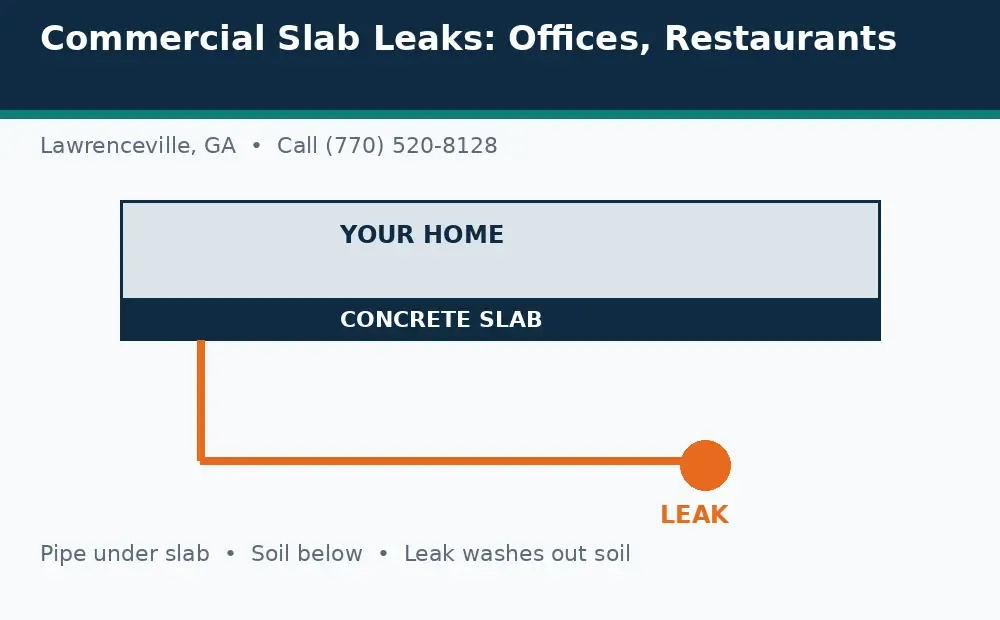
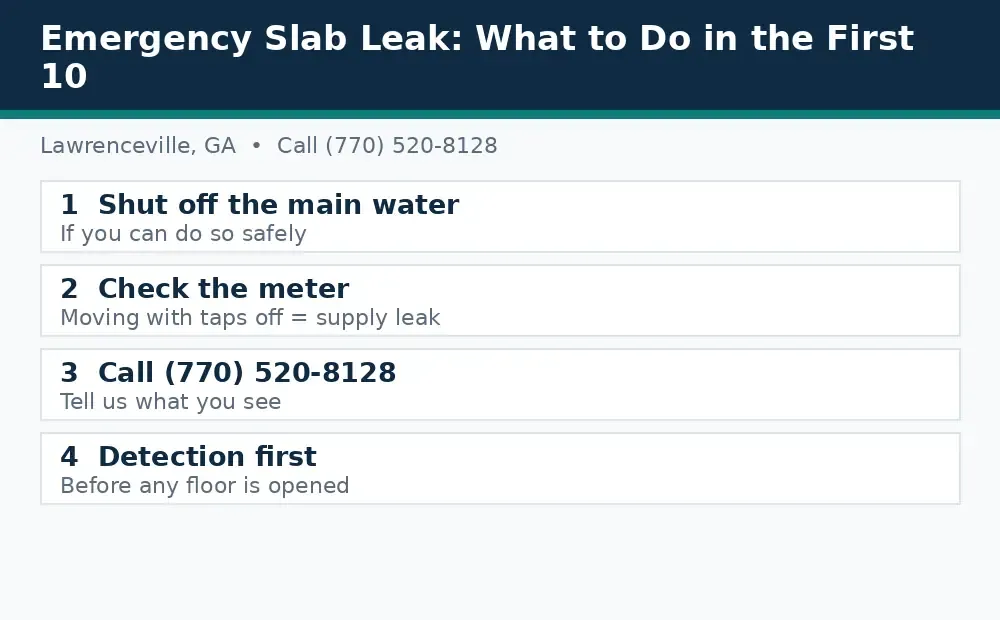
The working photo on this page is an illustrative working photo, not a photo of a specific job at a specific address. The diagrams are schematics, not to scale, made to explain the signs, process, options, or costs on this page in plain words. Call us at (770) 520-8128 if you are unsure what you are seeing.
Why does the order — document, fix, dry, restore — matter so much?
Cleanup feels urgent, and in one sense it is: standing water damages more the longer it sits. But the most expensive cleanup mistake is doing the steps in the wrong order. Cleaning up before documenting removes the evidence that restoration scope and any insurance file depend on. Drying before fixing the source wastes the drying, because the pipe keeps feeding the damp. Restoring flooring before drying completes traps moisture under the new finish, where it continues damaging from below while looking fixed from above. The order on this page — document, fix the source, remove water, dry, restore — exists because each step protects the next one, and skipping ahead costs more than the time it appears to save.
Start therefore with photographs, dated, wide and close: the wet area, the flooring, the wall bases, any standing water, and the rooms around the affected area. Keep those photos with the detection report and the bills, in the same folder habits described on the insurance claim process guide. Only then move to water removal and drying, and only after the pipe is fixed or isolated. If the leak is still active, the cleanup conversation is premature — stop the water first, following the emergency steps, and let cleanup follow the fix.
How is standing water removed safely?
Standing water removal starts with safety, not equipment. Keep clear of water near electrics, do not touch wet outlets, panels, or appliances, and wear waterproof footwear and gloves — floodwater in a home can carry contaminants from drains, soil, and building materials, and skin contact should be minimised. Small amounts can be mopped, squeegeed, or wet-vacuumed by a homeowner where it is safe to do so; larger amounts, contaminated water, or water that has reached wall cavities usually belong to professional water-damage services, and this guide does not present itself as a substitute for them. Know the boundary: a mop and a wet vacuum handle a room's surface water, not a saturated wall system.
As water comes up, keep the record going: photograph each stage, note what was removed and when, and keep any damaged material that an insurer or restorer may need to see, bagged and labelled, rather than discarding everything immediately. Move furniture and rugs out of the wet area to a dry place, lift curtains, and open a path for air — but do not start pulling up flooring or cutting walls to 'let it dry' without a plan, because indiscriminate opening spreads damage and destroys the record of what was wet and how far it spread. The removal step ends when no standing water remains and the affected area is ready for drying — not when it merely looks drier.
What does thorough drying actually involve?
Drying means bringing moisture content in the slab, flooring, and wall bases back down, not merely making surfaces feel dry to the touch. Surface dryness is misleading: concrete and wood hold moisture deep, and a surface that feels dry can still be wet underneath, which is why new flooring laid over a merely surface-dry slab so often fails. Thorough drying uses air movement and dehumidification over time, with moisture readings taken at intervals to show the trend — falling readings toward normal, not a single 'dry' declaration. No drying timeline is promised here, because drying time varies with the amount of water, the materials, the area, and the airflow available, and any figure offered without those specifics would be invented.
Different materials dry differently, and that difference shapes decisions. Tile over concrete often survives better than wood or laminate over the same wet slab, because tile tolerates damp that warps wood; carpet padding, once saturated, usually cannot be dried back to a sound, odour-free state and is normally removed rather than dried in place. Wall bases and lower wall sections need checking where water wicked upward, not just the floor itself. If drying is being done professionally, ask what is being measured, how often, and what target the readings aim for — those questions, answered with numbers from your own home, are what make drying a process rather than a hope. The floor restoration page covers the restoration work that follows drying on this site's listed services.
What happens to flooring, baseboards, and walls?
Each material gets its own verdict after drying, and the verdict should follow measurement, not appearance alone. Flooring that has warped, cupped, loosened, or delaminated generally does not return to its original state by drying, however thorough — warped boards stay warped, loosened tiles stay loosened at the adhesive, and the restoration question becomes replacement of the affected area rather than rescue of it. Baseboards that have swollen or separated usually need replacement over the affected length, because swollen fibreboard does not shrink back true. Wall sections need checking for wicking height: paint bubbling, soft plaster, or a tide line all mark how far water travelled, and that mark sets the scope of wall work.
Matching is the restoration question homeowners most often underestimate. Tile from a discontinued range, hardwood with years of patina, and carpet from a dyed lot all resist exact matching, and a restoration that replaces only the damaged area can leave a visible patch even when the work is sound. Discuss matching before restoration starts: whether the affected area alone is replaced, whether a larger area is refinished for uniformity, and what the finish will actually look like. Get that discussion in writing alongside the pipe repair's written price, because restoration scope agreed afterwards is scope negotiated from weakness. Homes in Downtown Lawrenceville and Collins Hill face the same matching questions; flooring age, not neighbourhood, decides them.
How do I prevent the next damp problem after cleanup?
Prevention after cleanup is monitoring, not optimism. Keep the drying readings if they were taken, and keep the before-and-after photographs with the detection report and the invoices — that file is what proves the job was completed and what a future technician, buyer, or insurer will want. Resume the routine that catches leaks early: bill comparison with the same period last year, yearly meter tests, and glances at the restored area for returning damp, smell, or warping. A restored area that shows damp again is telling you something — either the source was not fully fixed, a new loss has started, or drying was incomplete — and each of those deserves a prompt call, not another round of watching.
Also protect the restored area's conditions: keep drainage moving water away from the slab edge, keep gutters clear, and avoid covering the restored floor with rugs that would hide a returning sign. The prevention guide in this batch lays out that routine in full, and the damage risk scale helps think through how long symptoms had been present before the leak was found — useful context for judging how much drying and restoration the history warranted. Cleanup ends when the area is dry, documented, and restored; prevention begins the day after, and it is what keeps cleanup from becoming a recurring event.
Cleanup sequence
| Step | Do | Do not |
|---|---|---|
| 1. Document | Dated photos, wide and close, before anything moves | Do not tidy up before photographing |
| 2. Stop the source | Fix or isolate the pipe first | Do not dry while water still feeds the damp |
| 3. Remove water | Mop, squeegee, or wet-vacuum safely; professionals for large or contaminated water | Do not touch water near electrics |
| 4. Dry | Air movement + dehumidification, readings over time | Do not judge by surface feel alone |
| 5. Assess materials | Flooring, baseboards, walls judged after drying | Do not pull up floors indiscriminately |
| 6. Restore | Replace affected areas, matching agreed in writing | Do not lay new floor over damp |
No drying timeline is promised: time varies with water amount, materials, area, and airflow. Readings, not dates, decide when drying is complete.
Document Photos and detection report together, before cleanup.
Stop Source fixed or isolated — cleanup follows the fix.
Remove Standing water out safely; professionals for large or contaminated water.
Dry Air + dehumidification, readings falling toward normal.
Restore Affected areas replaced, matching agreed in writing beforehand.
What to tell us when you call
When you call, tell us what you noticed, when it started, and where in the house it shows. Mention your ZIP code, whether the water meter moves with everything off, and whether the sign is on a hot-water or cold-water line if you know. That short list helps the technician bring the right equipment and plan the visit. You do not need to know the cause before you call — that is what detection is for.
Call (770) 520-8128 and describe what you are seeing in plain words. We will talk through the next step and arrange a detection visit.
Call Us Today
Fast local slab leak detection and repair in Lawrenceville, GA, ZIPs 30043–30046.
Call Us: (770) 520-8128Frequently asked questions
How long does drying take after a slab leak?
No timeline is promised here. Drying time varies with water amount, materials, area, and airflow. Moisture readings taken over time — falling toward normal — decide when drying is complete, not a calendar figure.
Can wet carpet padding be dried and kept?
Usually not. Saturated padding rarely dries back to a sound, odour-free state and is normally removed rather than dried in place. Judge padding by condition after removal, not by surface feel.
Should I remove flooring myself to help drying?
No, not indiscriminately. Pulling floors destroys the damage record and can spread the problem. Document first, let the source be fixed, and let material decisions follow drying and measurement.
Is cleanup and drying a service this site offers?
This post is a guide. The site's listed floor restoration work covers restoration after repair; large-scale water extraction and structural drying are normally handled by water-damage specialists, and this guide does not claim otherwise.
What if damp returns after restoration?
Treat it as a new signal, not a failed patch: the source may not be fully fixed, a new loss may have started, or drying may have been incomplete. Call promptly with the restoration record and fresh meter readings.