 Lawrenceville Slab Leak Detectors
Slab Leak Insurance Claim Process: Step by Step
A slab leak insurance claim in Lawrenceville starts with stopping the water, documenting everything, and calling your insurer promptly, then letting an adjuster review the damage and repair plan. Homeowners in Downtown Lawrenceville and Sugarloaf, ZIPs 30046 and 30045, should keep bills, readings, photos, and the detection report together.
Key takeaways
- Shut the water off if it is safe to do so, then photograph and note everything before anything is moved or dried.
- Call your insurer promptly and ask what documentation they want — do not guess at policy terms.
- Keep every bill, reading, photo, and report in one folder; adjusters decide on evidence, not memory.
- Detection and repair are separate steps — the detection report is often the clearest evidence of what leaked and where.
What this looks like in a Lawrenceville home
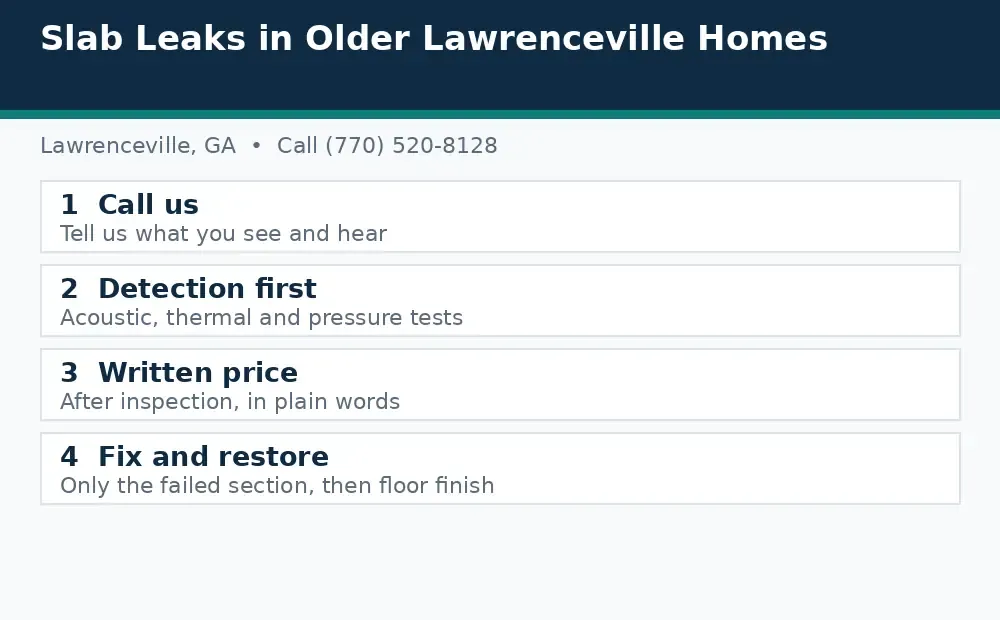
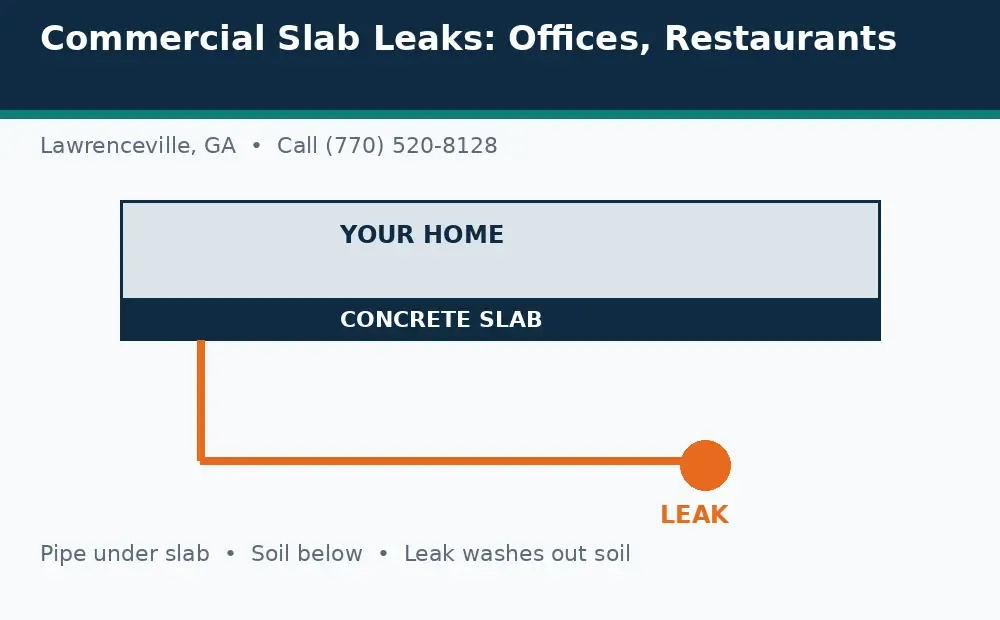
The working photo on this page is an illustrative working photo, not a photo of a specific job at a specific address. The diagrams are schematics, not to scale, made to explain the signs, process, options, or costs on this page in plain words. Call us at (770) 520-8128 if you are unsure what you are seeing.
Does homeowners insurance cover a slab leak at all?
The honest answer is that it depends on the policy, and this post cannot answer it for any individual home. The companion question most homeowners ask first — whether coverage exists — is covered on the site's insurance coverage post, and the short version is that sudden, accidental water damage is often treated differently from long-term wear, gradual leaks, or maintenance issues. What this post covers is the process after that question: what to do, in what order, so that whatever your policy says, your claim file is complete and your home is protected while the claim is assessed.
That distinction matters because the two most common claim mistakes have nothing to do with policy wording. The first is waiting: water keeps working while a claim is pondered, and damage that could have been limited grows. The second is tidying up before documenting: drying, moving, or throwing away damaged material before anyone has photographed it removes the very evidence the claim needs. The process below is built to avoid both mistakes. It is general information about how claims typically proceed, not advice about any specific policy, and where your insurer's instructions differ from this page, your insurer's instructions win.
What should I do in the first hours after finding a leak?
First, stop the water if you can do so safely. The main shut-off is usually near where the supply enters the house or at the meter; if you are unsure, or if water is near electrics, do not wade in — call for help and keep clear. Then, before anything is moved, dried, or repaired, photograph and video the scene: the wet area, the flooring, the walls, any standing water, and the meter reading if you can capture it safely. Note the date and time, when you first noticed the sign, and what the sign was — a bill jump, a warm floor, a sound, a damp patch. That note, written while the memory is fresh, is worth more than a reconstruction a week later.
Next, call a detection service. Detection matters for the claim as well as for the repair, because a detection report says what leaked, where, and on which line — hot-water, cold-water, or drain — in a form an adjuster can follow. Keep the report with your photos and notes. If the leak is active and the house is taking on water, say so plainly when you call; emergency slab leak repair in Lawrenceville exists for exactly that situation. Do not authorise a full repair before the insurer has had a chance to see the damage, unless waiting would clearly cause much worse damage — and if you must act urgently, photograph everything first and keep every receipt.
How do I report the claim, and what should I ask the insurer?
Call your insurer's claims line promptly and describe the facts: what you found, when, what you have done so far, and what detection has shown. Ask four questions and write the answers down with the name of the person you spoke to: what documentation do you need from me, do you want to send an adjuster before repair work starts, are there preferred or required contractors for any part of the work, and what is the claim number and the next step. Those answers shape everything that follows, and they vary by insurer, so no web page can substitute for them — including this one.
Then build one folder, physical or digital, and put everything in it: photos and videos with dates, meter readings, water bills showing the jump, the slab leak detection report, every estimate and invoice, and a log of every call with dates and names. If an adjuster visits, walk them through the same folder rather than relying on conversation. Adjusters assess files, and a file that tells the story in order — sign, detection, damage, plan — is easier to approve than a pile of loose papers. Keep copies of everything you send; never hand over your only copy of a report or a photo set.
What happens with the adjuster, estimates, and settlement?
An adjuster, where one is assigned, reviews the damage and the proposed repair plan against the policy. Expect questions about when the leak started, how it was found, and what the repair involves, including whether flooring and concrete restoration are part of the same claim or handled separately. Estimates help here: a written price for detection, a written price for the repair method, and a separate note for restoration work, each itemised, let the adjuster see what each part costs instead of facing one lump sum. The planning ranges on this site — detection $300–$600, spot repair $500–$4,000, lining $800–$3,000, reroute $1,500–$5,500, repipe $4,500–$15,000+ — are planning ranges, not quotes, and they are not a substitute for the written prices your technician gives after inspection.
Settlement follows the adjuster's review, and it may not cover everything you hoped — some parts of a job, such as the pipe repair itself versus the resulting water damage, can be treated differently, and that treatment depends on the policy wording. If part of the claim is declined, ask for the reason in writing and for the specific policy section relied on, and keep that letter in the folder. You can then decide, with the facts in front of you, whether to proceed with repair regardless, to seek a second view, or to phase the work. Whatever you decide, do not let a claim dispute delay stopping an active leak: water damage grows while paperwork waits, and the cleanup and drying guide in this batch explains the drying side once the water is stopped. For homes in Collins Hill and ZIP 30043, the routine is the same; only the insurer's process varies.
What documentation makes the strongest claim file?
Think of the file as a timeline a stranger must understand without you in the room. It should open with the first sign and its date, then the meter evidence or bill comparison that supports it, then the detection report naming the line and location, then dated photos of the damage, then itemised estimates, then invoices, then the correspondence log. Gaps in that timeline are where questions arise: a photo with no date, a repair with no detection report, a bill jump with no meter reading. Fill the gaps before you submit, not after the adjuster asks.
Two documents deserve special care. The first is the detection report, because it converts a homeowner's suspicion into a located, identified leak — keep the original and send copies. The second is the restoration note: what flooring and concrete work the repair requires, photographed before and after, because restoration is often where a claim file is thinnest. If you use the site's damage risk scale while you wait, treat its output as a personal planning aid, not claim evidence; only the technician's report and your dated photos carry weight with an insurer.
Claim documentation checklist
| Document | Why it matters | When to capture it |
|---|---|---|
| Dated photos and video | Shows damage before cleanup | Immediately, before anything moves |
| Meter readings / bill comparison | Supports that water was lost | Day of discovery |
| Detection report | Names the line and location | At the detection visit |
| Itemised estimates | Separates detection, repair, restoration | Before work starts |
| Invoices and receipts | Proves what was paid | As work completes |
| Call and correspondence log | Records who said what, when | Every contact |
Keep originals and send copies. If your insurer asks for something not on this list, add it to the folder and note the request and the date — the folder is the claim.
Stop the water Shut off safely, or keep clear and call for help if water is near electrics.
Document first Photos, video, meter reading, and a dated note before cleanup or repair.
Call promptly Report the claim, ask what documentation is needed, and note the claim number.
File in order Sign, detection, damage, estimates, invoices, correspondence — one folder, copies kept.
What to tell us when you call
When you call, tell us what you noticed, when it started, and where in the house it shows. Mention your ZIP code, whether the water meter moves with everything off, and whether the sign is on a hot-water or cold-water line if you know. That short list helps the technician bring the right equipment and plan the visit. You do not need to know the cause before you call — that is what detection is for.
Call (770) 520-8128 and describe what you are seeing in plain words. We will talk through the next step and arrange a detection visit.
Call Us Today
Fast local slab leak detection and repair in Lawrenceville, GA, ZIPs 30043–30046.
Call Us: (770) 520-8128Frequently asked questions
Should I repair the leak before the insurer sees it?
Generally, let the insurer or adjuster see the damage first, unless waiting would clearly cause much worse damage. If you must act urgently, photograph everything first and keep every receipt.
What is the most important document in a slab leak claim?
The detection report, with your dated photos. It names what leaked and where, which turns a homeowner's report into evidence an adjuster can follow.
Does insurance cover the pipe repair itself?
That depends on the policy: resulting water damage and the pipe repair itself can be treated differently. Ask your insurer for the specific policy wording rather than assuming either way.
How long should I keep claim documents?
Keep the full folder — photos, reports, estimates, invoices, and correspondence — until the claim is fully settled and the repair and restoration are complete.
Can I use the site's cost ranges in my claim?
Planning ranges are not quotes and are not claim evidence. Use the written prices your technician gives after inspection, itemised by detection, repair, and restoration.