 Lawrenceville Slab Leak Detectors
How Long Can a Slab Leak Go Undetected?
A slab leak in a Lawrenceville home can go undetected for weeks or months, because signs — a bill, a sound, a damp patch — are easy to dismiss. Homeowners in Downtown Lawrenceville and Collins Hill, ZIPs 30046 and 30043, should know the longer water escapes, the more damage follows.
Key takeaways
- Slow leaks hide longest: a pinhole may show only as a creeping bill for a long time before any damp appears.
- The damage clock runs on water volume and time together — a small leak running for months can out-damage a large leak found in days.
- Bill comparison with the same period last year is the check most likely to catch a long-running leak.
- No timeline in this post is a prediction for any home — soil, leak size, and pipe position all change it.
What this looks like in a Lawrenceville home
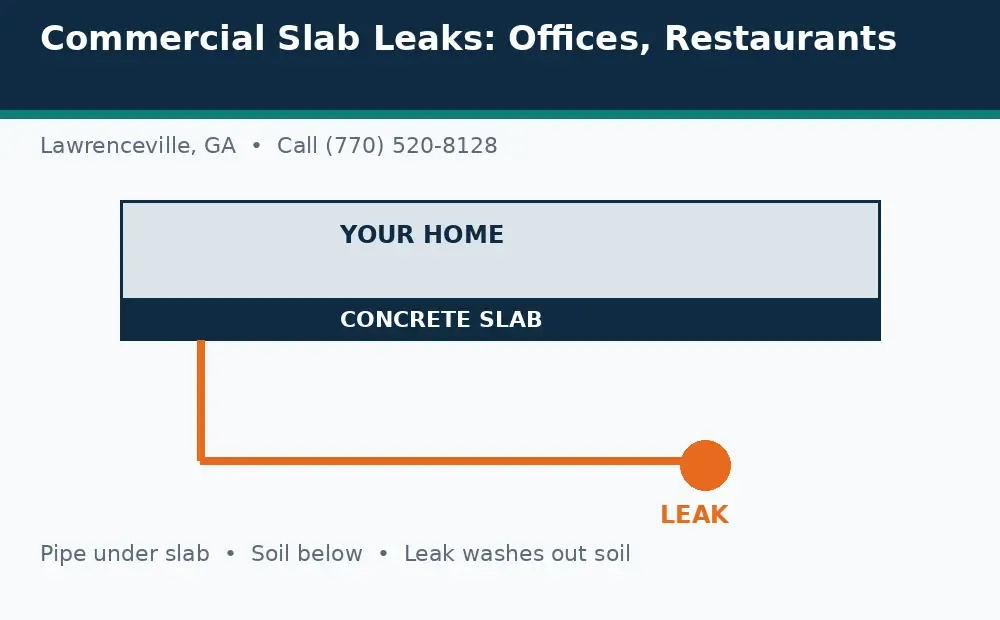
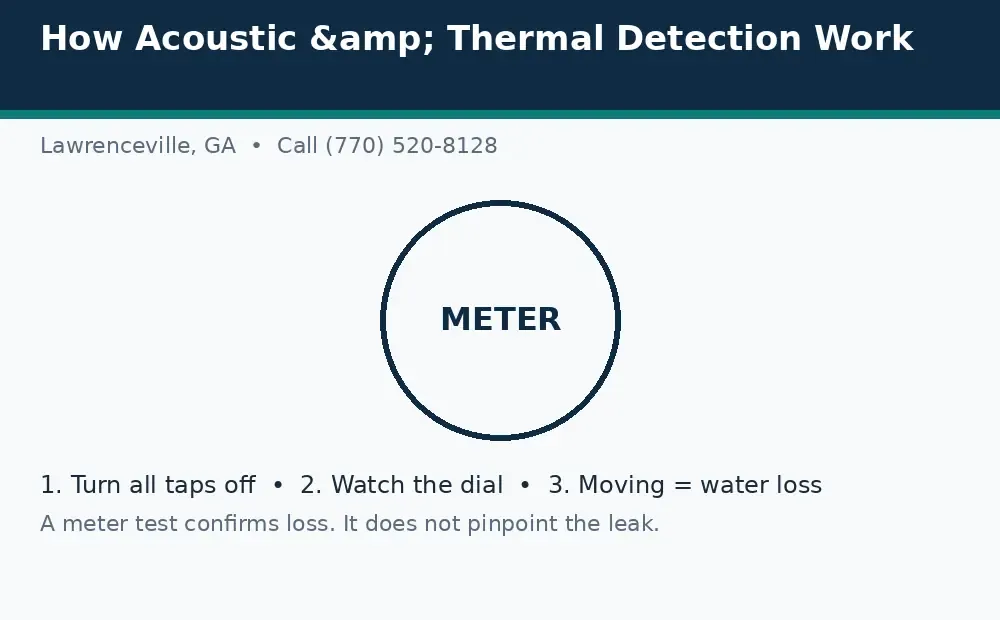
The working photo on this page is an illustrative working photo, not a photo of a specific job at a specific address. The diagrams are schematics, not to scale, made to explain the signs, process, options, or costs on this page in plain words. Call us at (770) 520-8128 if you are unsure what you are seeing.
Why can a slab leak hide for so long?
A slab leak hides because everything about it is indirect. The pipe is under concrete, so there is nothing to see; the water escapes into soil and the slab edge, so there is often nothing to hear; and the early loss is small, so the bill moves by an amount that looks like ordinary variation. A homeowner who checks the bill against last month sees noise; a homeowner who checks against the same period last year sees a trend. That difference — noise versus trend — is why so many slab leaks run for a billing cycle or several before anyone connects the signs.
The hiding is helped by the house itself. A damp patch under a rug, a warm spot in a room nobody walks barefoot in, a sound masked by a television or a washing machine — each sign is individually easy to explain away, and slab leaks rarely present all their signs at once. The pattern that catches them is accumulation: two signs together, or one sign that persists and grows, over weeks. That is why the signs guide insists on two-or-more-signs thinking, and why the symptom checker exists: a single sign is a curiosity, but a cluster is a case for a meter test the same day.
What happens while a leak runs undetected?
While water escapes, it does three things at once, at different speeds. It washes fine soil from around and beneath the slab, slowly changing the support under the concrete. It keeps building materials damp — flooring, baseboards, wall bases — which leads to warping, smell, and the conditions mould favours, though no timeline for mould growth is stated here because none has been supplied for this site. And it keeps costing money through the water bill, month after month, in amounts that individually look modest and cumulatively do not. None of these effects announces a deadline, and none of them reverses itself when the leak is eventually fixed — the soil washout, the damp damage, and the bills already paid are all history by then.
The honest limit on this section is that no timeline can be given for any specific home. A large leak on a hot-water line under a living room behaves differently from a pinhole on a cold-water line under a rarely used room; soil, slab thickness, and pipe position all change the story. What can be said without inventing numbers is directional and true: longer running means more water lost, more soil moved, and more damp exposure, and every one of those grows with time rather than staying flat. That direction is the whole argument for early detection, and it does not need a fabricated timetable to be convincing. If you suspect a leak has been running, the detection service is the step that stops the clock, whatever the clock reads.
Which leaks hide longest, and which reveal themselves fast?
Slow pressurised leaks hide longest, because their early signature is almost entirely financial: a bill that creeps rather than jumps. Pinhole corrosion failures belong here, and so do small joint leaks that lose a little at a time. Drain-side leaks hide differently: they may show no bill change at all, because drain water is not metered supply water, and their signs — smell, gurgling, slow drains — are easy to attribute to a blocked drain rather than a broken one under the slab. Hot-water leaks reveal themselves faster than cold-water leaks of the same size, because warmth on the floor is a sign with no innocent explanation in most rooms.
Large supply failures reveal themselves fastest of all, through pooling, pressure collapse, or a spinning meter — the burst end of the spectrum covered by the burst pipe guide in this batch. The practical lesson is to match the check to the hiding style: bill comparison and meter tests catch slow supply leaks; smell, gurgling, and drain behaviour catch drain-side leaks; warmth catches hot-water leaks. A homeowner who only watches for damp patches will miss the leak that only moves the bill, and a homeowner who only watches the bill will miss the leak that only smells. The routine that catches all three is the same one the prevention guide in this batch lays out, run on a schedule rather than on suspicion.
How do I tell how long my leak has been running?
You usually cannot tell precisely, and anyone who claims otherwise from a web page is guessing. What you can do is bound it: the earliest bill that shows the jump, the earliest dated photo of a damp patch, the earliest note of a sound or a warm spot, and the meter reading that confirms current loss together give a window, not a date. That window is useful — it tells the technician how much water may have been lost in total, it frames the insurance documentation, and it sets expectations for drying and restoration — but it remains a window, and it should be presented as one.
Build that window before the detection visit, not after. Gather bills for the last several periods and compare each with the same period last year; note the first period that breaks the pattern. Gather any dated photos, even casual ones that happen to show a floor or a wall before the sign was noticed. Write down when each sign was first noticed, as honestly as memory allows, including uncertainty — 'noticed the warm spot in late summer, unsure of the month' is more useful than a false precise date. Bring that bundle to the visit, and mention it when you use the damage risk scale, which asks how long symptoms have been noticed precisely because duration changes the risk picture, even though it cannot date the leak exactly.
What should I do today if I think a leak has been running a while?
Do the checks that stop the clock rather than the checks that admire the problem. Run a meter test today with everything off; if the meter moves, rule out the quick mimics and call for detection, saying plainly that you believe the loss has been running for some time. Do not wait for a more dramatic sign to justify the call — the dramatic sign is what early detection exists to prevent. Do not cover damp areas with new flooring or rugs in the meantime, and do not run dehumidifiers over the area in a way that hides the sign before the visit; the technician needs to see what the leak has been doing, not a tidied version of it.
While you wait, protect the record: dated photos of every sign, bills in order, meter readings with dates, and a note of when each sign appeared. That record serves the repair plan, the drying plan, and any insurance file, following the same documentation habits as the insurance claim process guide. For homes in Downtown Lawrenceville and ZIP 30046, the advice is identical, because the hiding mechanism — concrete, slow loss, dismissible signs — does not vary by neighbourhood. The only variable that matters is time, and today is the earliest day left to stop it.
Hiding style vs best check
| Leak style | How it hides | Check most likely to catch it |
|---|---|---|
| Slow pinhole, supply side | Creeping bill, no damp for a long time | Bill vs same period last year; meter test |
| Hot-water line leak | Warmth dismissed or unnoticed | Barefoot floor check; thermal imaging at detection |
| Drain-side leak | No bill change; smell or gurgling blamed on blockage | Smell, gurgling, slow drains together; camera |
| Large supply failure | Reveals fast: pooling, pressure collapse | Meter spinning; shut off and call immediately |
Match the check to the hiding style. Watching only for damp misses the leak that only moves the bill.
Compare Bill vs same period last year — trends expose slow leaks, monthly noise hides them.
Test Meter with everything off — current loss, sized by movement.
Cluster Two or more signs together, or one sign that persists and grows.
Stop the clock Detection now, not at the next dramatic sign.
What to tell us when you call
When you call, tell us what you noticed, when it started, and where in the house it shows. Mention your ZIP code, whether the water meter moves with everything off, and whether the sign is on a hot-water or cold-water line if you know. That short list helps the technician bring the right equipment and plan the visit. You do not need to know the cause before you call — that is what detection is for.
Call (770) 520-8128 and describe what you are seeing in plain words. We will talk through the next step and arrange a detection visit.
Call Us Today
Fast local slab leak detection and repair in Lawrenceville, GA, ZIPs 30043–30046.
Call Us: (770) 520-8128Frequently asked questions
Can a slab leak really go unnoticed for months?
Yes. A slow leak under concrete may show only as a creeping bill for a long time, especially if no damp patch appears. Bill comparison with the same period last year is the check most likely to catch it.
Does a long-running leak always cause foundation damage?
Not always, and no timeline is promised here. Longer running means more water lost and more soil moved, which increases the risk — but the outcome depends on leak size, soil, and pipe position, and only an on-site assessment can judge a specific home.
How can I estimate how long my leak has been running?
Bound it, do not date it precisely: the earliest bill showing the jump, the earliest dated photo, and the earliest note of a sign together give a window. Bring that bundle to the detection visit.
Is a slow leak less urgent than a burst?
Less dramatic, not less important. A slow leak running for months can lose more water in total than a burst found in a day, and it keeps working on soil and flooring the whole time.
What should I do first if I suspect a long-running leak?
Run a meter test today, rule out the quick mimics, and call for detection, saying plainly that you believe the loss has been running for some time.