 Lawrenceville Slab Leak Detectors
Burst Pipe Repair in Lawrenceville: What to Do First
A burst pipe in a Lawrenceville home needs the water off fast, then detection of which line failed. Homeowners in Downtown Lawrenceville and Gwinnett Place, ZIPs 30046 and 30044, should shut the main supply if safe, avoid rooms where water meets electrics, and note when the burst started.
Key takeaways
- Shut the main water supply off first if you can do so safely — every minute of flow adds damage.
- Stay out of rooms where water is near outlets, panels, or appliances, and do not touch wet electrics.
- A burst pipe and a slab leak overlap but are not the same: a burst under the slab still needs detection to locate it.
- Photograph the damage before cleanup — it matters for repair planning and for any insurance file.
What this looks like in a Lawrenceville home
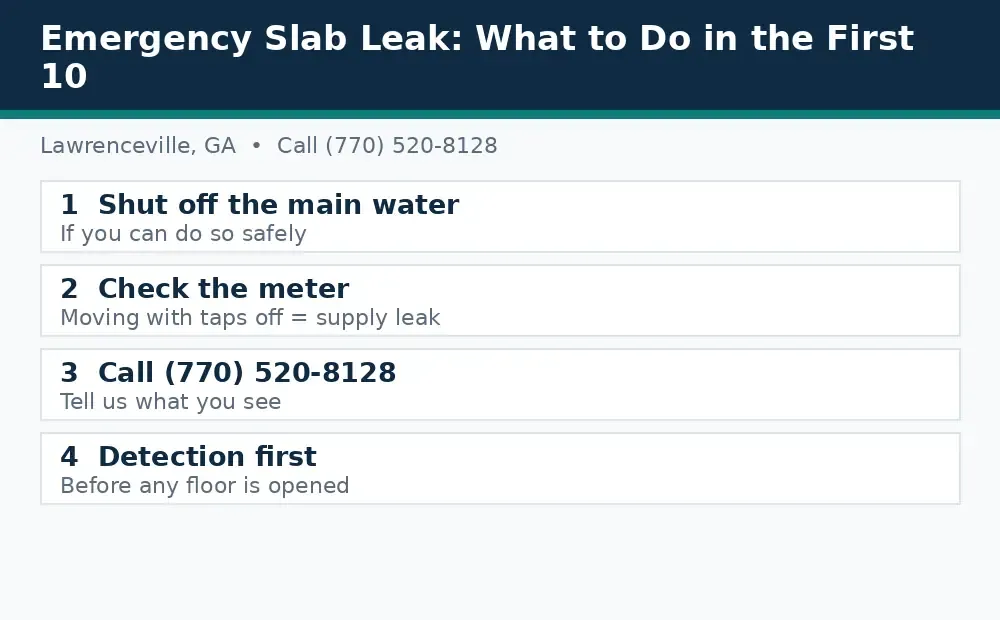
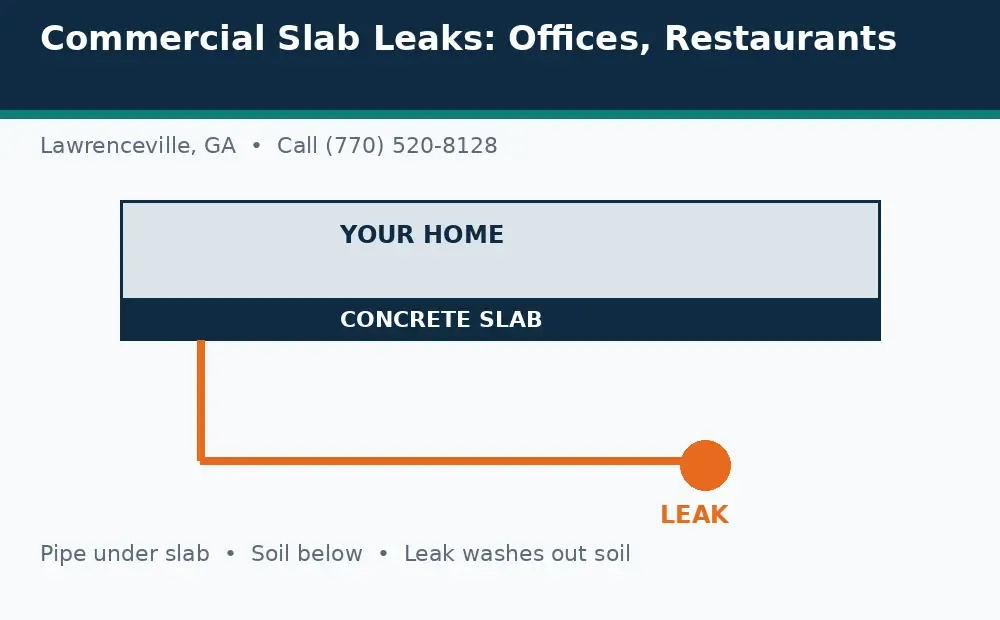
The working photo on this page is an illustrative working photo, not a photo of a specific job at a specific address. The diagrams are schematics, not to scale, made to explain the signs, process, options, or costs on this page in plain words. Call us at (770) 520-8128 if you are unsure what you are seeing.
What counts as a burst pipe, and how is it different from a leak?
A burst pipe is a pipe that has split, cracked open, or separated at a joint so that water escapes freely, rather than seeping through a pinhole or a slow joint failure. The difference matters in the first hour, because a burst can release a large volume of water quickly, while a slow leak announces itself over days through a bill or a damp patch. Both need the water stopped and the failed section identified, but a burst compresses the timeline: shut-off and help come first, and the detective work about exactly which section failed comes second, once the flow has stopped.
A burst can happen anywhere in the system — a visible pipe in a wall or ceiling, or a buried line under the slab. When the burst is under the slab, homeowners sometimes call it a slab leak, and the repair conversation overlaps with slab leak repair in Lawrenceville. The distinction still matters for planning, because a burst under concrete needs detection to locate the failed section before any floor is opened, just as a slow slab leak does. Do not assume the burst is where the water appears: water travels, pools at low points, and shows up rooms away from the failure.
What do I do in the first ten minutes?
First, shut the main water supply off if you can reach it safely. The shut-off is usually near where the supply enters the house or at the meter by the street. Turn it, confirm the flow stops, and then stay clear of any room where water is near electrical outlets, panels, or appliances. If water is already near electrics, do not wade in to reach a switch or a valve — leave the room, keep others out, and call for help from a dry place. Moving water and electricity together is the one danger in this situation that outranks property damage.
Second, protect what you can without taking risks: move rugs, electronics, and valuables out of the water's path, lift curtains and furniture legs where you safely can, and open a path for the water to drain rather than pool. Third, note the time and what you saw — when the flow started, where water first appeared, whether the meter was spinning, and whether the burst followed any event such as work on the plumbing or a pressure change. That note becomes the first page of the repair story, and it is far more reliable written now than reconstructed later. Then call emergency help in Lawrenceville and say plainly that a pipe has burst, whether the water is off, and whether any room is unsafe to enter.
How is a burst pipe under the slab found and fixed?
Once the water is off, the job becomes detection, even though the failure was dramatic. A technician will typically start with pressure testing to confirm which side of the system lost integrity — hot-water, cold-water, or drain — and then use acoustic listening or thermal imaging to narrow the failed section, just as with a slower slab leak. The burst itself does not remove the need for location: opening the floor in the wrong place helps nobody, and a burst section can sit some distance from where water surfaced. The detection step is what turns a flooded room into a repair plan with a defined scope.
The fix then follows the same options as other slab failures, chosen by the same logic: a single failed section in a sound pipe points to spot repair; a failing run points to rerouting; a system that keeps failing points toward repiping. The planning ranges on this site apply here too — detection $300–$600, spot repair $500–$4,000, reroute $1,500–$5,500, repipe $4,500–$15,000+, all labelled planning ranges, not quotes, with a written price after inspection. What changes with a burst is urgency and sequencing, not the menu: stop the water, find the failure, price the fix in writing, then repair and restore. If the burst is outside the slab, in a wall or ceiling, access is usually simpler, but the same order — stop, locate, price, fix — still protects you from paying for the wrong scope.
What happens after the repair, and what should I watch for?
After the failed section is repaired or bypassed, two jobs remain: drying and watching. Drying matters because water that soaks into flooring, baseboards, and the slab edge keeps working after the pipe is fixed — it feeds damp, smell, and flooring damage that only shows up weeks later. The drying process is covered in detail on the site's cleanup and drying guide, and the key discipline is the same: document before cleanup, dry thoroughly, and do not cover a damp area with new flooring until it is genuinely dry. If flooring or concrete restoration is part of the job, it is planned as its own step, not rushed behind the pipe repair.
Watching matters because a burst is sometimes a symptom, not an isolated event. A pipe that bursts where corrosion had thinned it may have neighbours in the same condition, and a pressure spike that burst one joint may have stressed others. In the weeks after a repair, keep the simple routine: compare each water bill with the same period last year, run a water meter test with everything off, and glance at floors and baseboards in the rooms that flooded. Any new sign — a bill jump, a damp patch, a sound — is a reason to call promptly, not a reason to assume the first repair failed. For homes in Downtown Lawrenceville and ZIP 30046, that routine is identical; what varies is the house, not the checklist.
Can a burst pipe be prevented?
No prevention routine guarantees a pipe will never burst, but the same checks that catch slow leaks also catch the conditions that precede bursts. A yearly pressure reading flags pressure stress before it finds a weak joint. A yearly meter test catches slow loss that can precede a failure. A walk-around that notices new cracks, shifting paving, or a damp patch gives a failing section less time to run unnoticed. And knowing where the main shut-off is — and that everyone in the house knows too — is the single most valuable burst preparation there is, because it turns the first ten minutes from panic into a single action.
If your home has already had a burst, ask the technician what the failure looked like: corrosion thinning, a failed joint, or a pressure event each point to a different next step, from watching the rest of the run to considering a reroute or repipe for that line. That conversation is also where the damage risk scale can help you think through how long symptoms had been present before the burst, though it is a planning aid, not a diagnosis. Prevention, in the end, is less about any single gadget and more about shortening the time between something going wrong and someone competent looking at it.
Burst pipe: first-hour checklist
| Step | Do this | Do not do this |
|---|---|---|
| Stop the water | Shut the main supply if safe | Do not wade into water near electrics |
| Protect | Move valuables, lift rugs and furniture legs | Do not switch on wet appliances or outlets |
| Record | Note time, first signs, meter reading | Do not tidy up before photographing |
| Call | State burst, water off or on, unsafe rooms | Do not wait to see if it stops on its own |
| Detect | Locate the failed section before opening floors | Do not authorise a floor opening blind |
A burst that has stopped because the main is off is still a burst: the failed section remains, and the system should not be repressurised until the failure is located and the fix is planned.
Off Main supply off, if safe. Confirm the flow has stopped.
Clear People and pets out of rooms where water meets electrics.
Note Time, first appearance, meter state, any preceding event.
Call Emergency help with a plain account: burst, water status, unsafe rooms.
Detect Pressure test and listening or imaging to locate the failure before repair.
What to tell us when you call
When you call, tell us what you noticed, when it started, and where in the house it shows. Mention your ZIP code, whether the water meter moves with everything off, and whether the sign is on a hot-water or cold-water line if you know. That short list helps the technician bring the right equipment and plan the visit. You do not need to know the cause before you call — that is what detection is for.
Call (770) 520-8128 and describe what you are seeing in plain words. We will talk through the next step and arrange a detection visit.
Call Us Today
Fast local slab leak detection and repair in Lawrenceville, GA, ZIPs 30043–30046.
Call Us: (770) 520-8128Frequently asked questions
Is a burst pipe the same as a slab leak?
Not exactly. A burst is a pipe that has split or separated and releases water freely; a slab leak is a leak in a pipe under the slab, which may be slow or sudden. A burst under the slab is both, and it still needs detection to locate it.
Should I turn the water back on after a burst?
No, not until the failed section is located and the fix is planned. Repressurising a failed section restarts the flooding and can widen the failure.
How fast should I call for a burst pipe?
Immediately after the water is off and people are safe. A burst is an emergency call, not a next-week appointment, because water damage grows while the system waits.
Will insurance cover a burst pipe?
That depends on the policy and the cause. Document everything before cleanup, keep the detection report and all receipts, and follow the claim process your insurer sets out.
Can a burst pipe happen again in the same house?
It can, if the cause was corrosion, pressure, or a failing run rather than a one-off event. Ask the technician what the failure looked like, and watch the rest of the run with meter tests and bill comparisons.