 Lawrenceville Slab Leak Detectors
Slab Leak Prevention Guide for Lawrenceville Homes
You can lower slab leak risk in a Lawrenceville home by checking water pressure, keeping drainage away from the slab edge, and running a yearly meter test. Homes in Downtown Lawrenceville and Collins Hill, ZIPs 30046 and 30043, benefit most when small leaks are caught early, before they grow.
Key takeaways
- Check your water meter with everything off at least once a year — a moving dial means water is going somewhere.
- Keep gutters, downspouts, and grading moving water away from the slab edge, not toward it.
- Watch for two or more signs together: bill jump, warm floor, running-water sound, damp flooring, or low pressure.
- A prevention habit does not replace detection — if signs appear, book a detection visit before opening any floor.
What this looks like in a Lawrenceville home
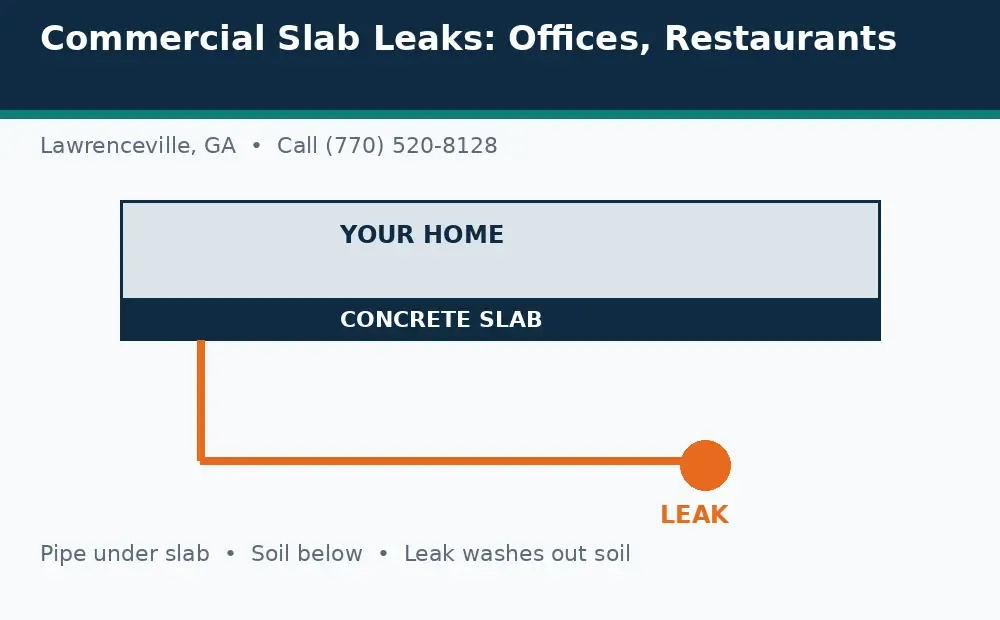
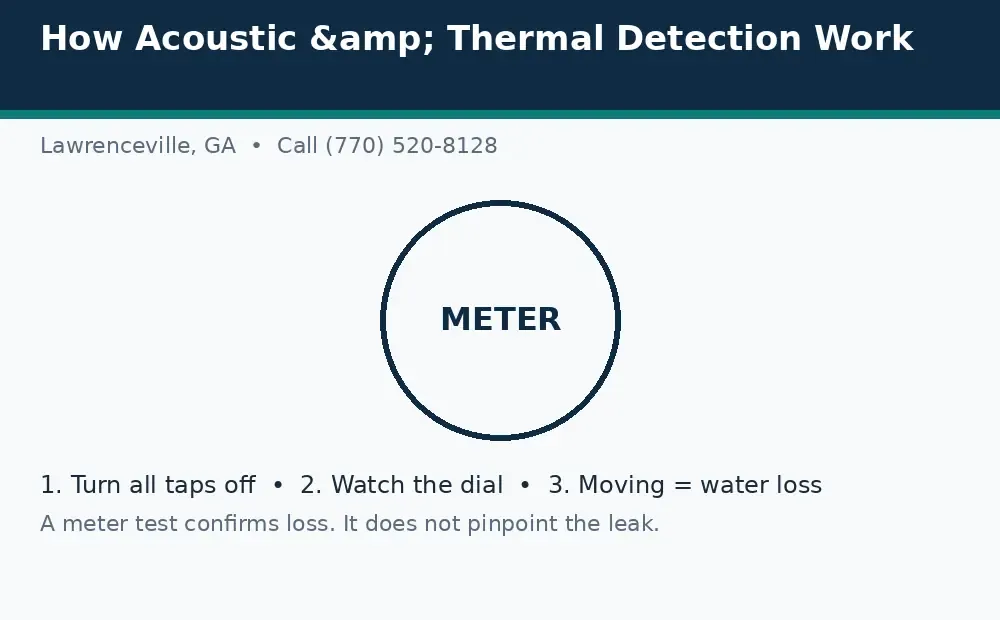
The working photo on this page is an illustrative working photo, not a photo of a specific job at a specific address. The diagrams are schematics, not to scale, made to explain the signs, process, options, or costs on this page in plain words. Call us at (770) 520-8128 if you are unsure what you are seeing.
What actually causes a slab leak in a Lawrenceville home?
A slab leak is a leak in a water pipe that runs under the concrete slab your house sits on. The pipe itself is out of sight, so the leak usually announces itself indirectly: a water bill that jumps for no clear reason, a warm patch on the floor, the sound of running water when every tap is off, or a damp spot that never quite dries. In Lawrenceville homes the usual suspects are age and wear on the pipe, shifting ground, and pressure that runs higher than the pipe and its joints were meant to carry day after day. None of these announce a date in advance, which is why prevention here means regular checks, not a one-time fix.
That is also why a prevention guide has to be honest about its limits. You cannot see a pipe under concrete, and you cannot stop metal from aging by wishing it well. What you can do is remove the avoidable stresses — high pressure, water pooling against the slab, and long periods where a small leak runs unnoticed — and you can shorten the time between a leak starting and someone finding it. If you already see two or more signs, skip the prevention checklist and go straight to slab leak detection in Lawrenceville, because at that point you are no longer preventing a leak, you are looking for one.
How do I check my water pressure, and why does it matter?
High water pressure is one of the quietest stresses on a home's pipes. You will not feel it at the tap as anything dramatic — the shower may even feel satisfyingly strong — but every joint, valve, and length of pipe under the slab lives under that pressure around the clock. Over years, that constant load works on weak points, especially where a pipe already has a thin spot from corrosion. A simple pressure gauge that screws onto an outdoor hose bib gives you a reading in a minute, and it is one of the cheapest checks a homeowner can do. If the reading looks high compared with what your fixtures are rated for, a plumber can talk through pressure regulation options for your home.
Do the check the same way each time so the readings mean something: same tap, taps inside the house closed, and a note of the number and the date. A single reading tells you less than a pattern, and a pattern tells you whether pressure is creeping up or holding steady. Keep the note with your other house records, next to your water bills, so a future technician can see the history at a glance. If pressure is normal and steady, that is useful news too — it rules out one stressor and points attention back to the other checks on this page, starting with the water meter leak test, which catches water loss that pressure readings cannot.
What should I look for around the outside of the house?
Walk around the slab edge a few times a year and look for the things that push water where it should not go. Gutters that overflow in rain, downspouts that dump right beside the foundation, and ground that slopes toward the house all keep the soil around the slab wetter than it should be. Wet soil moves more, and moving soil is harder on buried pipes than stable, well-drained soil. None of this guarantees a leak or prevents one on its own, but drainage is one of the few factors you can actually control from outside the house, and it costs attention rather than money to keep right.
While you walk, look for the small signs that belong on the same checklist: a patch of grass that stays greener or softer than the rest, a damp line on an outside wall, or soil that stays wet days after rain has stopped. Inside, the matching check is a quick look at floors and baseboards in rooms that sit over pipe runs — the kitchen, bathrooms, laundry, and water-heater area. If you find a damp spot, a warped board, or a musty smell that was not there before, treat it as a reason to run the meter test the same day rather than a reason to wait for the next walk-around. Homes in Sugarloaf and Collins Hill follow the same routine; the soil and slab construction questions are the same across Lawrenceville's ZIPs 30043–30046.
Do trees, roots, and driveways really affect pipes under a slab?
Tree roots get blamed for a lot of pipe trouble, and the truth is narrower than the reputation. Roots chase water, so a root can exploit a joint or crack that already exists, and it can add pressure around a buried line outside the slab. What roots do not generally do is punch a healthy pipe open from the outside. The practical prevention step is therefore about placement and awareness: know roughly where your main supply line enters the house, avoid planting thirsty trees right over that route, and if a large tree already stands close to the house, watch the ground between the tree and the slab for new lifting or cracking. If a driveway or patio slab has shifted or cracked near the house, note it too — shifting surface concrete can be a clue about ground movement below.
The same logic applies to anything that changes the ground around the house: a new patio, a regraded yard, or a long dry spell followed by heavy rain. Ground that swells and shrinks moves, and buried pipes move with it until a joint or a thin section gives way. You cannot stop Georgia weather, but you can keep a simple record — dates of grading work, new cracks, or new wet patches — so that if a leak does appear, the technician has a timeline instead of a mystery. That record is also exactly what to mention when you use the slab leak symptom checker before you call, because it turns a vague worry into a list of dated observations.
How often should I inspect, and what does a good routine look like?
A workable routine fits on one page and takes less than an hour a year, spread across the seasons. Once a year, run the meter test: everything off, read the dial, wait, read again, and write both numbers down. Twice a year, walk the outside of the house for drainage and new cracks, and glance at floors and baseboards in the wet rooms. Every time a water bill arrives, compare it with the same period last year rather than last month, because seasonal use swings hide leaks while year-on-year comparison exposes them. If any check comes back odd — a moving meter, a bill jump you cannot explain, a new damp spot — that check stops being routine and becomes a reason to call.
Keep the routine in the same place as your other house notes, and keep it simple enough that you will actually repeat it. A checklist nobody repeats is worse than no checklist, because it creates false confidence. If you rent out the property or manage it for someone else, hand the routine to whoever lives there and ask them to report a bill jump or a damp spot promptly; a leak in an empty or inattentive property is how a small problem gets months to grow. And if a check ever points at a real leak, remember the order that protects your floor and your wallet: detection first, written price after inspection, and only then the fix — the same order described on the acoustic and thermal detection guide, which explains how a technician narrows the location before anything is opened.
Prevention checklist: what to do, and what it catches
| Check | How often | What it can catch |
|---|---|---|
| Water meter test | Once a year | Hidden water loss on the pressurised side |
| Pressure gauge reading | Once a year | Pressure stress on pipes and joints |
| Outside walk-around | Twice a year | Drainage problems, new cracks, wet patches |
| Bill comparison (same period last year) | Every bill | Gradual leaks that monthly comparison hides |
| Floor and baseboard glance | Twice a year | Damp, warping, musty smell, warm spots |
None of these checks proves there is no leak. A meter test cannot catch a drain-side leak, and a visual walk cannot see under concrete. The checklist shortens the time a leak runs unnoticed; it does not make a home leak-proof, and any failed check deserves a detection visit, not another month of watching.
Meter first Everything off, read the dial, wait, read again. A moving dial means water is leaving the system somewhere.
Pressure second Screw a gauge onto a hose bib, note the number and the date, and compare it next time.
Walk third Gutters, downspouts, grading, and the slab edge — water should move away from the house, not toward it.
Act fourth Any failed check becomes a call, not a note for next year. Detection comes before any repair decision.
What to tell us when you call
When you call, tell us what you noticed, when it started, and where in the house it shows. Mention your ZIP code, whether the water meter moves with everything off, and whether the sign is on a hot-water or cold-water line if you know. That short list helps the technician bring the right equipment and plan the visit. You do not need to know the cause before you call — that is what detection is for.
Call (770) 520-8128 and describe what you are seeing in plain words. We will talk through the next step and arrange a detection visit.
Call Us Today
Fast local slab leak detection and repair in Lawrenceville, GA, ZIPs 30043–30046.
Call Us: (770) 520-8128Frequently asked questions
Can prevention stop a slab leak completely?
No. Regular checks lower the risk and shorten the time a leak runs unnoticed, but they cannot stop pipe aging or ground movement, and they cannot see under concrete. Prevention is a habit, not a guarantee.
How often should I run a water meter test?
At least once a year, and any time a bill jumps or a damp spot appears. Everything off, read the dial, wait, read again, and write both numbers down.
Does high water pressure really cause slab leaks?
Pressure is one stressor among several. Constant high pressure works on joints and thin pipe sections over time, so a yearly gauge reading is a cheap, useful check — but normal pressure does not rule out a leak.
Should I worry about tree roots near the house?
Roots exploit existing cracks and joints and add pressure around buried lines; they rarely break a healthy pipe on their own. Note trees near the supply route and watch for new lifting or cracking between the tree and the slab.
What should I do if a prevention check fails?
Treat a failed check as a reason to book detection, not to wait. Tell us which check failed, what you measured, and when the sign started, and we will plan the visit from there.