 Lawrenceville Slab Leak Detectors
White Powder on a Concrete Floor: Is It a Slab Leak in Lawrenceville, GA?
White powder on a concrete floor in Lawrenceville, GA is efflorescence — mineral salts left when water moves through the slab. In ZIPs 30043 and 30044, near Collins Hill, it can point to a slab leak, but groundwater and new concrete cause it too. A meter test tells which.
What this looks like in a Lawrenceville home
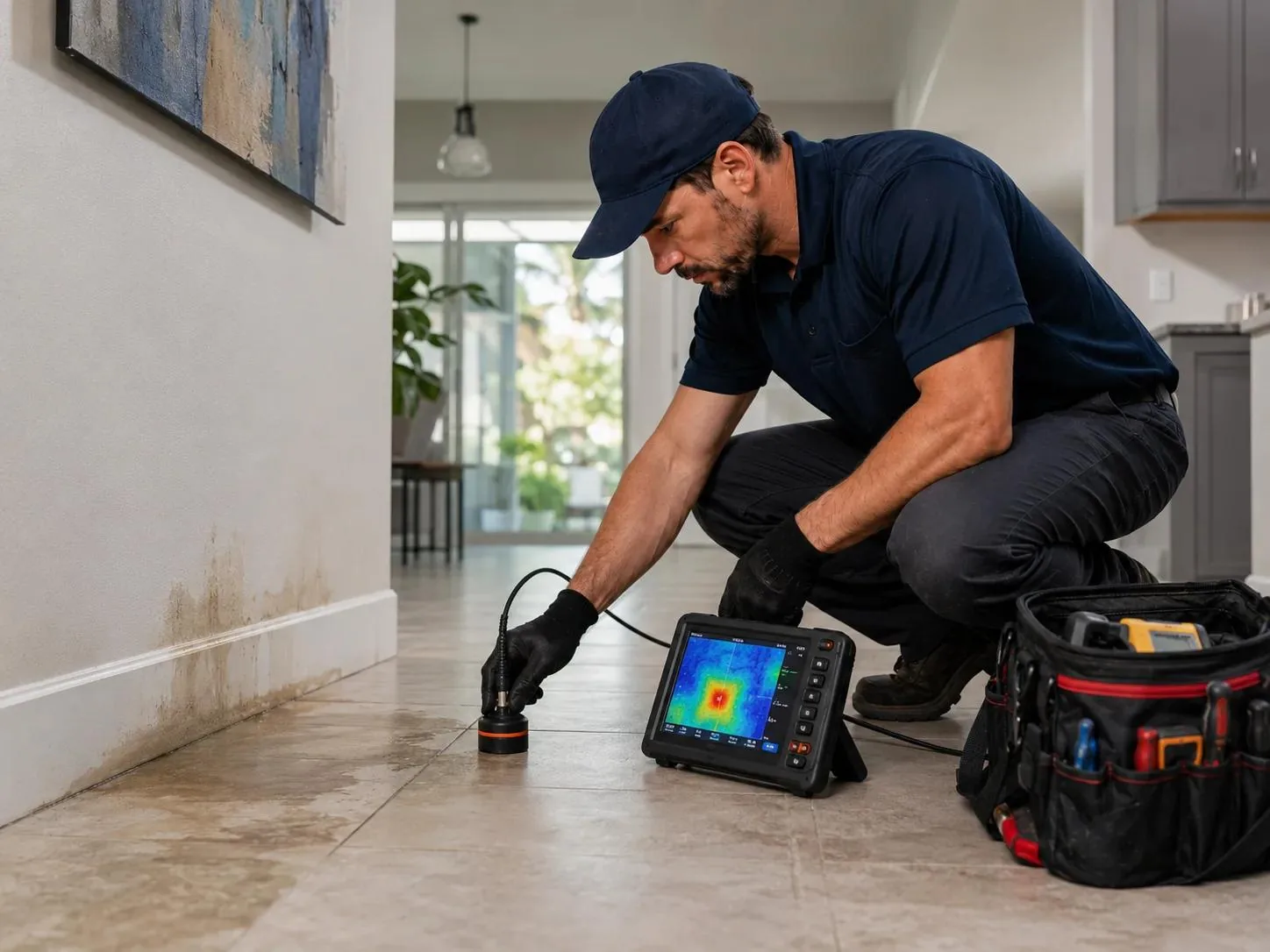
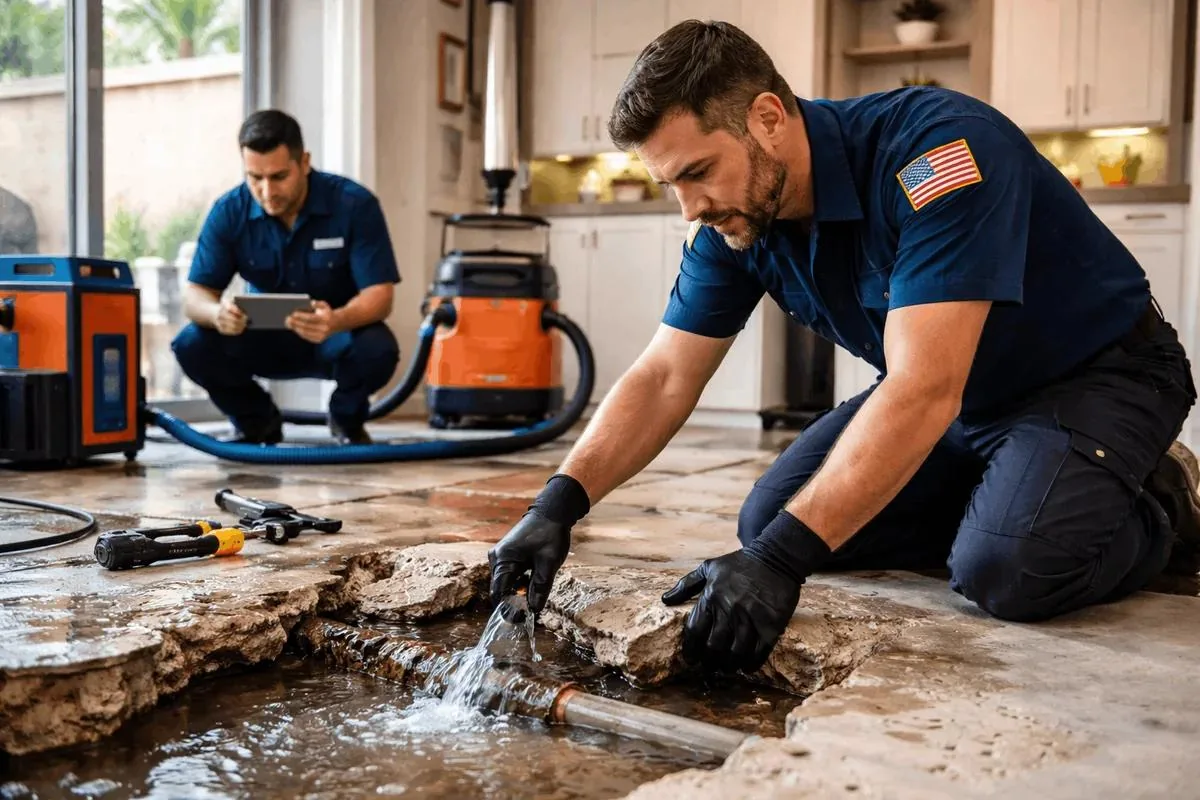
The images on this page are generic illustrations — a thermal image and a spot-repair photo — not photos of this business's own work or of a specific home. Call us at (770) 520-8128 if you are unsure what you are seeing.
What the white powder on a concrete floor actually is
That white powder on the garage floor, the basement slab, or the concrete under a pulled-back rug is usually efflorescence: mineral salts that water carries through concrete and leaves behind when the water evaporates. Concrete looks solid, but it is porous, and water moves through it slowly, dissolving salts from the cement as it goes. When the water reaches the surface and dries, the salts stay behind as a white, powdery crust. Brush it with a dry hand and it comes off as dust, and that is the first way to tell it apart from mold. Mold is a living thing, and it grows on a surface that stays damp: it is usually dark, green, or black, it looks fuzzy or blotchy, and it smears when you touch it. Efflorescence is white or pale grey, it feels dry and chalky, and it brushes off clean. The two are often confused, and the confusion matters, because they point to different problems: mold points to dampness at the surface, while efflorescence points to water moving through the slab itself. In Lawrenceville the conditions for it are common. Most homes here sit on a slab poured over Georgia red clay, and that clay holds moisture rather than draining it away, so the soil under a slab can stay wet for weeks after rain. A slab that sits on wet clay is a slab with water pressing against it from below, and any crack, joint, or pipe opening is a route for that water to travel up through the concrete. The powder shows up most often where the concrete is bare and the water can dry in the open: garage floors, laundry rooms, the slab under a water heater, and the edge of a patio slab. Where flooring covers the slab, the same water shows up differently, as a musty smell or a warped board, and the musty-smell guide explains what that smell usually means.
When the powder points to a slab leak — and when it does not
Efflorescence proves one thing and one thing only: water is moving through the concrete. It does not prove where the water is coming from, and a slab leak is only one of four common sources. The first is the concrete itself: a new slab keeps drying out for months after it is poured, and the water used to mix and cure it carries salts to the surface as it dries. Powder on a slab poured within the last year, with no other symptom, is usually curing, and it fades as the slab finishes drying. The second is groundwater: rain soaks the clay under and around the slab, and the water wicks up through the concrete, especially where the ground outside is higher than the slab, the gutters dump water next to the foundation, or the slab has no vapor barrier underneath it. The third is drainage: a patio slab that holds standing water, or a driveway that slopes toward the house, keeps the concrete wet from above, and the patio-slab guide covers what standing water under a slab can mean. The fourth is a plumbing leak under the slab, and this is the one that needs a professional, because the water never stops: a broken hot or cold water line under the slab feeds water into the soil day and night, and the powder keeps coming back no matter how often you sweep it away. Three things separate a leak from the other causes. The powder returns fast, within days of being brushed off, and in the same spot. It comes with other signs: a warm patch on the floor over a hot-water line, a water bill that jumped without explanation, a musty smell in the same room, or a baseboard that is damp at the bottom. And it shows up far from any outside water source, in the middle of a room rather than at the edge where rain hits. Any one of those on its own is weak evidence; two or three together are a reason to test.
The other signs that turn powder into a leak suspect
A slab leak rarely gives you one sign. It gives you a cluster, and the white powder is usually the one you notice last, because it builds up slowly while the other signs come and go. The warm patch is the most direct: run your bare foot across the floor where the powder is, and if one patch feels warmer than the rest, a hot-water line may be leaking underneath, warming the slab from below. The warm-spot guide explains what a warm patch usually means and what to check next. The water bill is the next check: compare the last three bills, and if usage jumped with no change in the household, water is going somewhere. The high-water-bill guide walks through that comparison. The musty smell is the third: a slab leak keeps the soil and the slab edge damp, and damp concrete and damp baseboards smell musty even when nothing looks wet. The fourth is the meter test, and it is the only one that gives you a reading instead of a hunch: turn off every tap and appliance that uses water, watch the meter, and if the dial or the leak indicator moves, water is leaving the system somewhere. The water meter leak test guide walks through the check step by step, and the slab leak symptom checker runs through the signs one by one. The sound of running water when every tap is off is another, and the running-water guide covers what to listen for and where. None of these signs proves a leak on its own, and the powder does not either. What they do together is narrow the question from “is something wrong?” to “is water leaving the pipes?”, and the meter test answers that question.
What to do first: the meter test, then detection
Start with the meter test, because it costs nothing and it separates a plumbing leak from groundwater and curing in one step. Turn off every tap, the dishwasher, the washing machine, and the ice maker, and make sure nobody flushes a toilet while you watch. Find the water meter, usually near the street, and look at the dial or the small leak-indicator triangle. If it is still, no water is leaving the system, and the powder is almost certainly groundwater, curing, or drainage, not a leak under the slab. If it moves, water is being lost somewhere, and the next step is detection. Detection is a visit, not a guess: a pressure test narrows the loss to a line, acoustic listening follows the sound of the leak through the slab, and thermal imaging looks for the warm patch a hot-water leak leaves behind. The detection-methods guide maps each method to the question it answers, and the acoustic and thermal detection guide explains the listening and imaging steps. The published planning range for detection in Lawrenceville is $300–$600, and a written price follows the inspection, not the phone call. While you wait, do two things and avoid two others. Do dry-brush the powder off and note the date, so you can see how fast it returns, and do photograph the spot, because a photo taken a week apart shows the return better than memory does. Do not seal over the powder with paint or a coating: a sealer traps the moisture in the concrete and hides the sign without stopping the water. And do not assume the powder is harmless because it brushes off easily: powder that returns within days, in the same spot, with a warm floor or a moving meter, is a sign that deserves a test, not a broom.
If it is a leak: the repair routes
If detection finds a pipe leaking under the slab, the repair routes are the ones in the comparison guide: a spot repair opens the slab at the marked leak and replaces the damaged section, a reroute abandons the old line and runs a new one through the walls or the attic, trenchless lining seals the pipe from the inside, and a whole-home repipe replaces the system overhead. The published planning ranges on this site are spot repair $500–$4,000, lining $800–$3,000, reroute $1,500–$5,500, and whole-home repipe $4,500–$15,000 or more, with a written price following inspection. The repair cost guide carries all five ranges together, including detection. After the repair, the concrete and the floor need putting back, and the concrete and floor restoration page covers what that looks like. The powder itself does not need a separate repair: once the water stops moving through the slab, the salts stop arriving, and the powder stops coming back. What does need attention is the drying: the water damage cleanup guide covers what that looks like, and a floor laid over damp concrete traps the moisture underneath it, so do not rush to cover the slab again. If the meter test shows no loss and detection finds no leak, the powder is a moisture problem, not a plumbing problem, and the fix is drainage, grading, or a vapor barrier — work for a drainage or waterproofing contractor, not a leak detection company. Either way, the test is what tells you which kind of problem you have.
What to tell us when you call
When you call, tell us where the powder is, how fast it comes back after you brush it off, whether the floor feels warm there, and whether the meter moves with every tap off, plus your ZIP code. That short list tells us whether we are looking for a leak, and what the detection report will need to show.
Call (770) 520-8128 and describe what you are seeing in plain words. We will talk through the meter test first, then detection if the test points that way.
Call Us Today
Fast local slab leak detection and repair in Lawrenceville, GA, ZIPs 30043–30046.
Call Now to Speak to a SpecialistFrequently asked questions
Is white powder on my concrete floor a sign of a slab leak?
It can be, but it is not proof. The powder, called efflorescence, proves water is moving through the slab, and a leak under the slab is one cause. A leak becomes likely when the powder comes back within days of being brushed off and comes with other signs: a warm patch, a water bill that jumped, a musty smell, or a meter that moves with every tap off. The meter test separates a leak from groundwater or curing.
Is the white powder on concrete mold?
No. Efflorescence is mineral salts left behind when water dries, and it brushes off as a white powder. Mold is an organism that grows on damp surfaces: it is usually dark, green, or black, it looks fuzzy or blotchy, and it smears when you touch it. If the white stuff brushes off dry and chalky, it is efflorescence. Either way, the dampness behind it deserves attention, and if the powder keeps returning with a musty smell, find the moisture source.
How do I remove efflorescence from a garage floor?
Dry-brush it off with a brush, sweep up the dust, and let the slab dry. Do not seal or paint over it first: a coating traps moisture in the concrete and hides the sign without stopping the water. Watch how fast it returns. Powder back within days, in the same spot, means water is still moving through the slab. If it returns with a warm floor or a moving meter, run the meter test.
Will efflorescence go away on its own?
Sometimes. Powder on a new slab often fades as the concrete finishes drying out after the pour. But powder that keeps returning on a slab means water is still moving through the concrete, and it will not stop until the source is fixed. If the powder is back days after cleaning, or it appears with a damp baseboard or a musty smell, the source is active. A meter test tells you whether that source is a pipe under the slab.
Does efflorescence mean my slab is damaged?
Not by itself. Efflorescence is a sign of water movement, not a measurement of damage. A slab can carry powder for years from groundwater alone and still be sound. What matters is the source and how long the water has been moving: a leak that soaks the clay under one patch of slab can swell the clay and push the slab up, and water that reaches the floor above can warp boards and feed mold. Detection finds the source.