 Lawrenceville Slab Leak Detectors
Sprinkler Leak or Slab Leak in Lawrenceville, GA?
A sprinkler leak or a slab leak can both leave a wet patch in a Lawrenceville yard, but they behave differently. In ZIP 30044, near Sugarloaf, the timing test tells them apart: irrigation water appears when the system runs, while a slab leak keeps the ground wet around the clock.
What this looks like in a Lawrenceville home
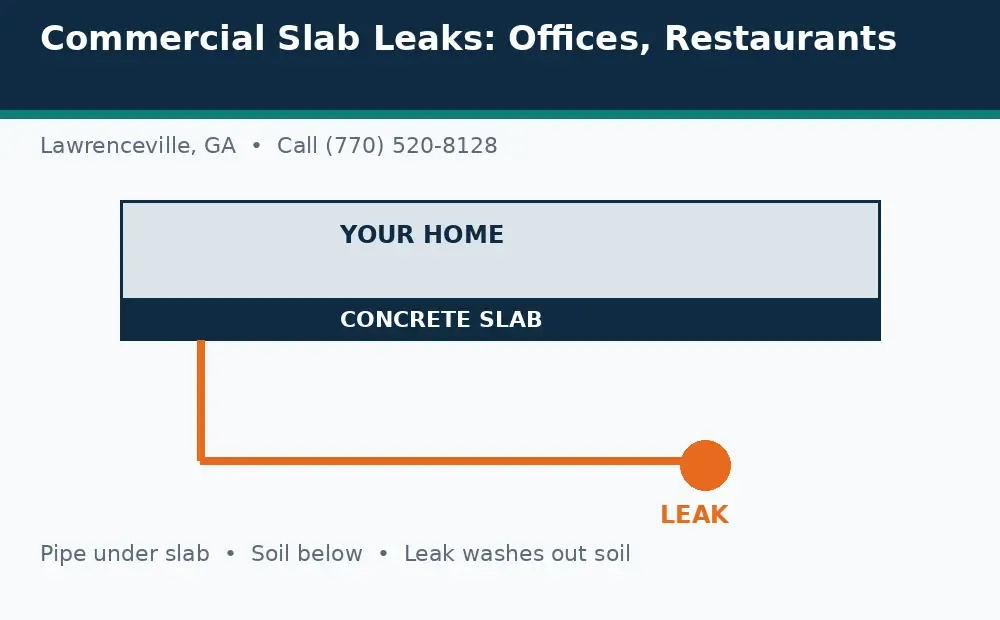
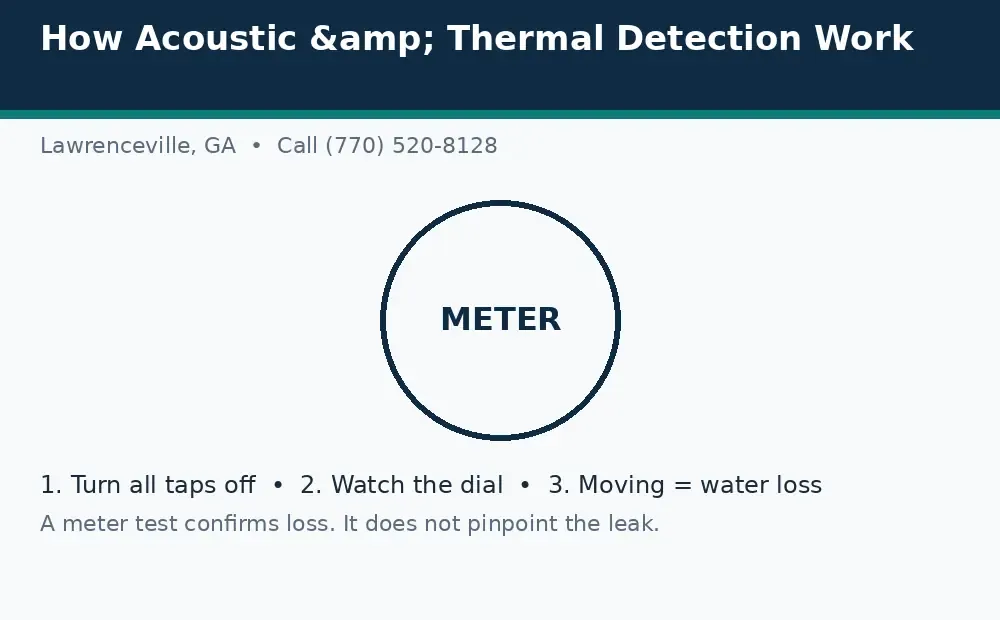
The images on this page are generic diagrams — a house on a slab with a pipe underneath, and a water meter leak test — not photos of this business's own work or of a specific home. Call us at (770) 520-8128 if you are unsure what you are seeing.
The short answer: timing is the tell
A wet patch in the yard sets off the same worry whatever caused it, and in Lawrenceville the two most common suspects are a sprinkler fault and a slab leak. They look alike from the grass — a soggy strip, a patch that stays green when the rest of the lawn has gone brown, a soft spot underfoot — but they behave differently, and the difference is time. A sprinkler system only loses water when it runs. Its pipes sit under pressure for the minutes a zone is on, and a cracked lateral, a stuck valve, or a broken head leaks during that window and then stops. A slab leak never stops. A pressurized supply line under the concrete leaks around the clock, so the ground stays wet through dry spells, through the night, and through the days the sprinkler system has not run at all. That is the first test, and it costs nothing: turn the irrigation off at its main shutoff, leave it off, and watch the patch. The yard leak guide covers the same question from the lawn's point of view — wet spots and lush grass — and it starts with the same advice: check the meter and isolate irrigation first. If the patch dries out with the system off, the sprinkler side is where the water came from. If it stays wet, the water is coming from somewhere that does not switch off, and a slab leak or a main-line break moves to the top of the list. The main water line break guide explains how a break between the meter and the house behaves the same way — constant, not timed — and why it belongs in the same check.
How a sprinkler system leaks
An irrigation system is a small network of its own: a controller that opens one zone at a time, a valve for each zone, lateral pipes feeding the heads, and a backflow preventer where the irrigation line connects to the house water supply. Each part fails in its own way. A zone valve can stick open, so one zone keeps watering long after its slot on the schedule has passed. A lateral pipe can crack where a mower, an edger, or a tree root has caught it, and that crack only leaks while its zone is running. A sprinkler head can break off at the base, and the water then bubbles up in one spot instead of spraying across the lawn. The backflow preventer can weep at its seals, leaving a damp patch near the side of the house. None of these is a slab problem, and none of them can explain a wet patch that never dries, because none of them is under pressure when the system is off. There is one case worth naming separately. A sprinkler main that runs along the foundation and leaks every time the system runs keeps the soil on that side of the house wet, and in Lawrenceville that soil is red clay. The Georgia red clay guide explains why that matters: clay swells when it is wet and shrinks when it dries, so a strip of soil that is always wet on one side of the house and dry on the other moves unevenly, and the slab rides that movement. The sprinkler leak still is not the slab leak, but it can feed the ground movement that stresses the joints under the slab, which is one more reason to find it and stop it rather than let it run all season.
Three tests that separate them
Start with the timing test, because it needs no tools. Turn the irrigation off at its main shutoff — not at the controller, which only stops the schedule, but at the valve that feeds the whole system — and leave it off for several dry days. Mark the edge of the wet patch with a couple of sticks so you can see whether it shrinks. A sprinkler patch dries from the edges in. A slab-leak patch holds its ground, and it often stays wet in the middle through a dry spell. The second test is zone by zone. Turn the system back on and run one zone at a time, watching the patch and the ground around each head while that zone runs. A head that geysers, a valve box that fills with water, or a strip that suddenly goes soggy while its zone is on points at that zone, and you have found the irrigation side of the problem. The third test is the meter test, and it is the one that settles the question. Turn off every tap and appliance, shut the irrigation main, and watch the meter dial. The water meter leak test guide walks through the check step by step, and the slab leak symptom checker runs through the signs one by one. If the dial moves with the irrigation off and every tap closed, water is leaving a pressurized supply line somewhere — the slab or the main line — and it is not the sprinkler system. If the dial holds still with the irrigation off and then moves when you open one zone, the loss is in that zone. Do the test twice if you are unsure, once in the morning and once after the house has been quiet for half a day, and write down what the dial did each time.
Signs that point to the slab, not the sprinkler
Some signs never belong to a sprinkler system, because a sprinkler system cannot reach inside the house. A warm patch on the floor over a hot-water line is a supply leak, not irrigation — the warm spot guide explains how to read it. A water bill that jumped with no change in the watering schedule, and no new zone or longer run times, points the same way; the high water bill guide walks through the comparison. The sound of running water when every tap is off and the irrigation is off is a supply leak talking, and the running water guide explains what that sound means. Damp flooring, a musty smell near a baseboard, or grout that never dries are indoor signs, and a sprinkler head cannot make them. The signs guide lists the full cluster, and two or three together are a reason to test rather than to keep watching the lawn. The pattern to hold on to is simple: outside-only signs with a clear link to the watering schedule belong to the irrigation system, and indoor signs, or outdoor signs that ignore the schedule, belong to the house plumbing. A wet patch that sits over the line where the supply enters the house, rather than over a sprinkler zone, is also worth noting, because the supply line and the irrigation main often take different routes, and the patch follows the pipe that is leaking.
What detection does when the tests disagree
Sometimes the tests point both ways: the patch dries a little with the system off but never fully, or the meter moves with the irrigation off on one check and holds still on the next. That is when detection earns its keep, because guessing wrong costs either a torn-up lawn or a torn-up floor. Acoustic listening follows the sound of escaping water through the slab, and thermal imaging looks for the warm patch a hot-water leak leaves behind; the acoustic and thermal detection guide explains both, and the detection methods guide covers the full set. A camera inspection of the drain and sewer lines rules out the drain side, which matters because a drain leak can also leave a wet patch outside without ever moving the meter. Be clear about the split of the work. We do not repair sprinkler systems. Our part is finding which line is losing water — slab, main line, or irrigation — and saying so plainly. If the loss is in the irrigation system, the fix belongs to an irrigation contractor, and the detection report tells them which zone to open. If the loss is under the slab, the repair routes are the ones in the comparison guide: a spot repair opens the slab at the marked leak and replaces the damaged section, a reroute abandons the old line and runs a new one through the walls or the attic, trenchless lining seals the pipe from the inside, and a whole-home repipe replaces the system overhead. The spot repair versus reroute versus repipe guide compares them, and the repair cost guide carries the published planning ranges: detection $300–$600, spot repair $500–$4,000, lining $800–$3,000, reroute $1,500–$5,500, and whole-home repipe $4,500–$15,000 or more, with a written price following inspection. Either way, the concrete and the floor need putting back after the repair, and the concrete and floor restoration page covers what that looks like.
What to tell us when you call
When you call, tell us which zones run and when, whether the wet patch follows the watering schedule or stays wet with the system off, what the meter dial did with the irrigation shut off, and whether you have seen any indoor signs — a warm patch, a damp floor, a musty smell — plus your ZIP code. That short list tells us whether we are looking at a sprinkler fault, a main line, or a slab leak, and what the detection should show first.
Call (770) 520-8128 and describe what you are seeing in plain words. We will talk through the timing test first, then detection if the test points that way.
Call Us Today
Fast local slab leak detection and repair in Lawrenceville, GA, ZIPs 30043–30046.
Call Now to Speak to a SpecialistFrequently asked questions
Can a sprinkler leak look like a slab leak?
Yes. Both can leave a wet patch, a soggy strip, or a patch of lawn that stays green while the rest goes brown. The difference is timing: a sprinkler leak only loses water while its zone is running, so the patch dries when the system is off for several dry days. A slab leak runs around the clock, so the ground stays wet through dry spells and through the nights the system has not run.
How do I test whether the wet spot is my sprinkler system?
Turn the irrigation off at its main shutoff, not just at the controller, and leave it off for several dry days, marking the edge of the wet patch so you can see whether it shrinks. Then run one zone at a time and watch the patch and each head. Finally, do the meter test with the irrigation main shut: if the dial moves with every tap off, the loss is in a pressurized supply line, not the sprinkler system.
Can a sprinkler leak damage my slab or foundation?
On its own, a sprinkler leak rarely damages a slab directly, because the water is outside the house and the leak stops when the system stops. The risk is indirect: a main leaking along the foundation keeps the red clay on one side wet, and clay that swells on one side and shrinks on the other moves the ground under the slab. The bigger risk is that it hides a real slab leak, giving the wet patch an innocent explanation.
My water bill jumped — sprinkler or slab leak?
Compare the bill with the watering season. A valve stuck open can run one zone far longer than its schedule, and that shows as a jump in the months the system runs. A bill that jumps with no change in the schedule, and stays high in the months the system is off, points at the house plumbing. The meter test with the irrigation main shut settles it: a moving dial with every tap off means a supply-line loss.
Should I turn off my sprinkler system if I suspect a slab leak?
Yes, at least while you test. Turning the system off at its main shutoff removes the biggest innocent explanation for a wet patch, and the lawn can wait a few days while you watch. It does not fix a slab leak, and it does not hide one either: if the patch stays wet with the system off, the water is coming from a line that does not switch off, and that is exactly what you need to know.