 Lawrenceville Slab Leak Detectors
How to Find a Water Leak Underground in Lawrenceville, GA
Finding a water leak underground in Lawrenceville, GA, starts at the meter, not with a shovel: a meter test confirms the loss and a shut-off test says whether the break is inside or outside. In ZIPs 30043 and 30045, from Sugarloaf to Collins Hill, detection marks the spot first.
What this looks like in a Lawrenceville home
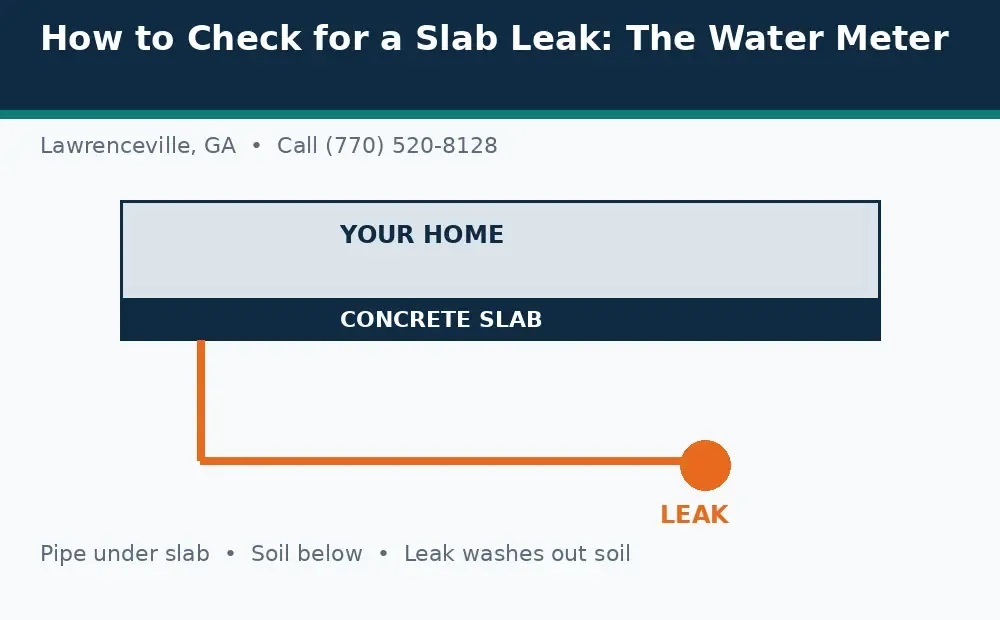

The images on this page are generic illustrations — a water-meter-check diagram and a leak-signs diagram — not photos of this business's own work or of a specific home. Call us at (770) 520-8128 if you are unsure what you are seeing.
The short answer: confirm, narrow, walk, then pinpoint
Finding a water leak underground in Lawrenceville starts at the meter, not with a shovel. A buried service line — the pipe that runs from the meter at the street to the house — can leak for weeks with nothing visible on the surface, because the water drains into the soil instead of pooling. The sequence has four steps: a meter test confirms water is actually being lost; a shut-off test says whether the break is inside the house, outside it, or under the slab; a walk along the line's path reads the ground for where the water is surfacing; and professional detection pinpoints the break so only one small hole is dug. Skipping a step is how yards get torn up on a guess. The main water line break guide covers the same line's signs in more detail; this guide is the finding process itself.
Each step rules something out: the meter test rules out a running toilet, a dripping tap, or a stuck irrigation valve; the shut-off test rules out the whole inside of the house; the yard walk rules out the wrong stretch of line; and detection rules out digging in the wrong place. In Lawrenceville's red clay, water escaping underground travels sideways until it finds the easiest way up, so the wet patch can sit several feet from the break, or not appear at all. Detection comes before any digging, because digging on a guess tears up a yard and often misses the break. The published planning range for detection is $300-$600, a planning range only, with a written price following inspection.
Step 1: the meter test — confirm the loss
The meter test is the single best first step, and it costs nothing. Turn off every tap and appliance that uses water — faucets, washing machine, dishwasher, ice maker, irrigation — and no toilet flushing. Then find the meter, usually in a box near the curb, lift the lid carefully, and watch the small leak-indicator dial or triangle on the meter's face. If it is spinning, water is moving. If your meter has no leak indicator, write down the reading, wait 15 to 30 minutes with no water used, and read it again: a reading that has moved means water is escaping from a pressurised line. The water meter leak test guide walks through the check step by step, and the meter test post explains how to read the result.
A moving dial confirms a loss, but not where it is — that is why the next step exists. A dial that never moves rules out a supply leak: the water you are seeing is rain, runoff, a sprinkler, or a drain. Do the test twice if you are unsure, once in the morning and once after the house has been quiet for half an hour. A bill that stays high across two billing periods, plus a dial that moves with everything off, points underground with real confidence.
Step 2: the shut-off test — inside, outside, or slab
With the loss confirmed, the shut-off test splits the system in two. Close the main shut-off valve where the water line enters the house, then check the meter again. If the meter stops moving, the leak is inside the house — under the slab or in a wall — because the water is escaping on the house side of the valve. If the meter keeps moving with the main valve closed, the leak is outside, in the buried service line between the meter and the house, because that is the only section still under pressure. That single distinction decides the whole job: an inside leak is a slab leak investigation, an outside leak is an underground line investigation, and the two use different tools and different repair routes.
Know where the valve is before you need it. The main shut-off is usually where the line enters the house — often in the garage, a utility closet, or near the water heater — and a valve that has not moved in years can seize, so the time to find that out is on a dry day, not during a flood. The shut-off valve guide shows where to look and how to test it. If you cannot find the valve, or it will not turn, that is a reason to call, not a reason to skip the test — the test is what keeps a slab investigation from being sold for an outside leak, and an outside repair from being sold for a slab leak.
Step 3: walk the line's path and read the ground
Once the shut-off test says the leak is outside, walk the likely path of the line from the meter to the house — the service line usually runs fairly straight, and the ground along it is where the signs appear. Look for a soggy patch that stays wet days after the last rain, ground that has sunk or feels soft underfoot, a strip of grass greener and faster-growing than the rest, water pooling or bubbling on a slope, and a warm patch on the ground in the morning for a hot-water line. Look at the edges too: a damp strip beside the driveway or patio, soil that stays soft beside the foundation, or water where a deck meets the house. The yard leak guide covers these signs in more detail.
Read the signs with the clay in mind: water from a buried leak spreads sideways before it surfaces, so the wet patch can appear several feet from the break, and in sandy soil or gravel it may not appear at all. A single sign can have an innocent cause — rain, sprinkler overspray, a neighbour's downspout — and what separates a leak from weather is persistence: ground that stays wet through a dry spell, a patch that returns after you dry it, a bill that stays high across two billing periods. Photograph the patch and note the date, so the technician has a timeline instead of a single sighting. And do not dig on what the walk shows: buried gas, electric, and communication lines run through many yards, and Georgia's call-before-you-dig number is 811 — call it before any digging so those lines are marked first.
Step 4: how a technician pinpoints it without digging
Once the leak is confirmed in the service line, the goal is to mark the exact spot so only one small hole is dug. Line tracing comes first: an electronic locator follows the pipe's route from the meter to the house, so the search starts on the line rather than on a guess. Then acoustic listening follows the sound of escaping water along that route — a ground microphone is moved along the line to find where the leak noise is loudest, and in quiet conditions it can narrow the break to within a few feet. For a plastic line, which carries sound poorly, a technician may use tracer gas, a harmless gas pumped into the line that escapes at the leak point, where a detector picks it up. Tracer gas is mentioned here only as a method a technician may use, not as a service on its own. A leak noise correlator is another option: sensors at two access points, such as the meter and a hose bib, calculate the leak's position from the noise's travel time. Thermal imaging can help with a hot-water line, but it is less useful outdoors, where sun warms the ground unevenly.
For a drain or sewer line, the tools change: a drain is not pressurised, so listening does not work, and a camera shows the pipe's interior instead. The sewer camera inspection guide covers that. Whatever the method, the result is the same: a marked spot on the ground, not a trench. If the methods disagree, the honest answer is more detection, not a hole in the yard. The detection methods guide maps each method to the question it answers.
Who owns the line — and who to call
The ownership boundary decides who pays and who to call first. Water in Lawrenceville now comes from Gwinnett County Water Resources, which took over the city's water distribution system on December 1, 2020: the county owns the meter and the line up to it, and the homeowner owns the line from the meter to the house. A water-main issue is the county's job; everything past the meter is a plumber's job. That is why the shut-off test matters — it tells you which side of the boundary the leak sits on before anyone is called.
The line's identity matters too. If detection shows the leak is in an irrigation line, that is an irrigation contractor's job, not a slab leak repair, and we will say so rather than sell a repair on the wrong line. The same applies to a drain: a soggy patch with a smell, slow drains, and no bill jump point at a drain, not a supply line. And if the leak turns out to be under the slab rather than in the yard — the shut-off test says inside, or the line runs under the patio — the repair routes are the ones in the repair cost guide: detection $300-$600, spot repair $500-$4,000, lining $800-$3,000, reroute $1,500-$5,500, and whole-home repipe $4,500-$15,000 or more, all published planning ranges only. A permit may be needed depending on the scope. Whatever route is chosen, the ground and the surface need putting back properly — the concrete and floor restoration service page covers that step.
What to tell us when you call
When you call, tell us what the meter did with everything off, what happened when you closed the main valve, where the wet patch is and whether it returns in dry weather, and your ZIP code. That short list tells us whether the break is inside or outside, and lets us plan detection around your line.
Call (770) 520-8128 and describe your situation in plain words. We will talk through detection first, then a repair plan that fits your home.
Call Us Today
Fast local slab leak detection and repair in Lawrenceville, GA, ZIPs 30043–30046.
Call Now to Speak to a SpecialistFrequently asked questions
How do I know if I have a water leak underground?
Do the meter test: turn off every tap and appliance, including irrigation and the ice maker, and watch the meter's dial for 15 to 30 minutes. A moving dial means water is escaping from a pressurised line. Then close the main shut-off valve where the line enters the house: if the meter keeps moving, the leak is in the buried service line from the meter to the house. A bill that stays high across two billing periods agrees.
Why can't I see water if the leak is underground?
Because the water drains into the soil instead of pooling on the surface. In Lawrenceville's red clay, water from a buried leak spreads sideways before it finds the easiest way up, so the wet patch can appear several feet from the break — or not appear at all, especially in sandy soil or gravel around the pipe. So a buried leak can run for weeks with no visible water, and the bill is often the first sign.
Should I dig to find an underground water leak?
No. Digging on a guess tears up the yard and often misses the break, because the wet patch can sit several feet from it. Buried gas, electric, and communication lines also run through many yards, so call 811 before any digging so those lines are marked first. Detection — line tracing, acoustic listening, and tracer gas where needed — marks the exact spot so only one small hole is dug.
Is an underground leak my responsibility or the county's?
The homeowner owns the line from the meter to the house, and Gwinnett County Water Resources owns the meter and the line up to it — the county took over Lawrenceville's water distribution on December 1, 2020. A water-main issue is the county's job; everything past the meter is a plumber's job. The shut-off test tells you which side of that boundary the leak sits on before anyone is called.
How much does it cost to find and fix an underground water leak?
The published planning range for detection is $300-$600, a planning range only. The repair price depends on the route: spot repair $500-$4,000, lining $800-$3,000, and reroute $1,500-$5,500, with the route decided by what detection finds and whether the pipe can be lined. The written price comes after inspection, and the yard restoration depends on the size of the opening and the surface to match.