 Lawrenceville Slab Leak Detectors
How to Shut Off Your Water Main in Lawrenceville, GA
To shut off the water main in a Lawrenceville home, find the valve where service line enters the house, often near the water heater or garage wall. Sugarloaf and Gwinnett Place homes, ZIPs 30044 and 30045, close a lever valve with a quarter turn, or a wheel valve clockwise.
What this looks like in a Lawrenceville home
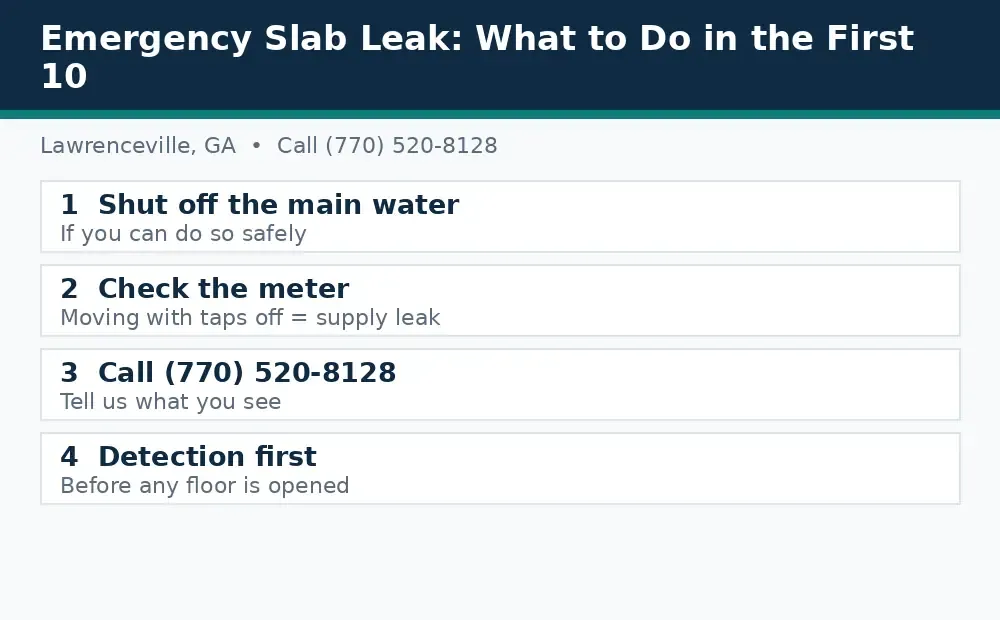
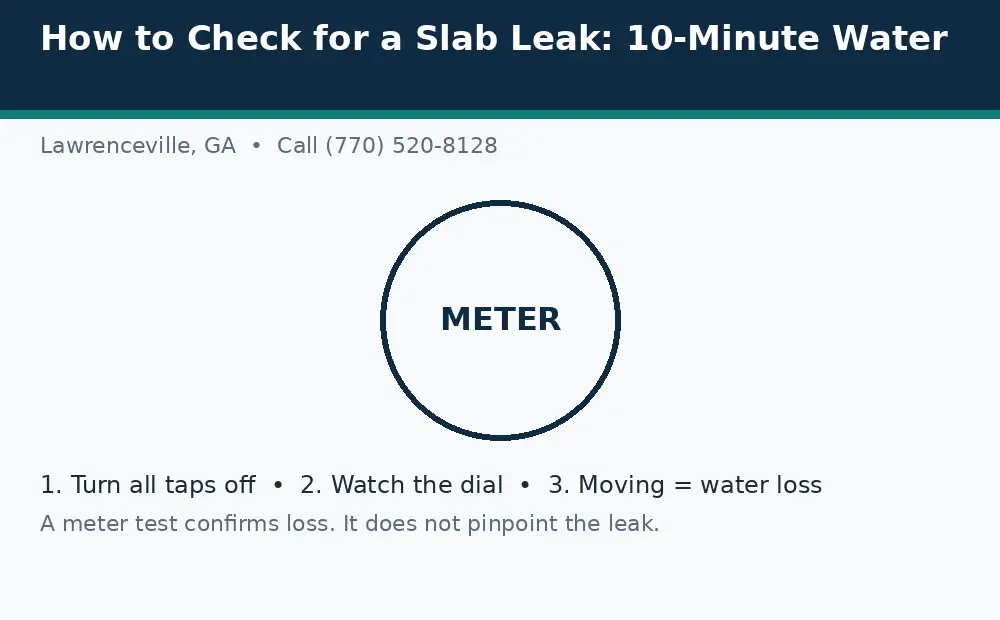
The images on this page are illustrative diagrams, not photos of a specific job at a specific address, and they are not presented as this business's own work. Call us at (770) 520-8128 if you are unsure what you are seeing.
Find it before you need it
The main shutoff valve is the single most useful thing to know in a plumbing emergency, and the time to find it is a quiet afternoon, not the moment water is spreading across a floor. In a Lawrenceville home built on a concrete slab, there is usually no basement wall to check, so start where the service line enters the house: near the water heater, along the garage wall facing the street, in a utility closet, or on an exterior wall near the hose bib closest to the street. A second way to find it is to follow the line from the water meter toward the house; the customer-side shutoff sits along that route, where the line enters the building. If you find a valve and are not sure it is the main, test it on a calm day: close it, check that taps run dry, then reopen it and confirm normal flow.
Once you find it, label it. A bright waterproof tag on the valve, plus a note in your phone saying which room and wall it is on, turns a panicked search into a thirty-second walk. Tell everyone in the household where it is, including older children, because the person home during a leak is not always the person who found the valve. Homes in Sugarloaf and Gwinnett Place vary by builder and era, so a neighbour's valve location is a hint, not a fact about your house. Your own valve, found and labelled, is the only location that counts when water is running.
Ball valve or gate valve: tell them apart
Most homes have one of two valve types, and they close differently. A ball valve has a straight lever handle that sits parallel to the pipe when the water is on; it closes with a single quarter turn, until the lever sits perpendicular to the pipe. A gate valve, the older style, has a round wheel handle; it closes by turning clockwise, and it may take several full turns before the flow stops. Knowing which type you have before an emergency matters, because a quarter-turn lever that you keep cranking, or a wheel you expect to stop in one turn, wastes the seconds when water is spreading fastest.
| What you see | Valve type | How to close it |
|---|---|---|
| Straight lever, parallel to the pipe | Ball valve | Quarter turn until the lever is perpendicular to the pipe |
| Round wheel handle | Gate valve | Turn clockwise, several turns, until the flow stops |
| Valve in a buried box near the street | Meter-box valve | Do not force it; see the meter-box section below |
| No valve you can identify | Unknown or concealed entry | Document the entry point and arrange plumber help before an emergency |
Whichever type you have, never force a valve that resists, sticks, or leaks at the stem. A forced stem can snap and turn a controlled shutoff into a larger repair, so a stuck valve is a job to report, not a test of strength. If your valve has not been turned in years, work it gently on a calm day, and if it will not move freely, have it looked at before you need it in earnest.
Shut it off, step by step
When water is escaping where it should not, use the closest working shutoff first. If the leak is clearly limited to one fixture — a toilet, a sink, a washing machine — close that fixture's own stop valve on its supply line and leave the rest of the house running. If the source is unclear, the water is spreading, or a fixture valve does not stop it, go straight to the main shutoff: close it by its type, lever or wheel, without forcing it. Then open a tap at the lowest level of the house, or an outdoor spigot, to release trapped pressure and confirm the flow has stopped. Standing water near outlets or electrical equipment is a reason to stay clear of that area and call, not to wade in and hunt for a valve.
After the flow stops, do three things before anything else. First, note what you saw: where the water appeared, how fast it spread, and whether it was clean water or sewage, because that description shapes the next call. Second, take photos of the affected areas for your own records and any later insurance conversation, as the insurance claim process guide recommends. Third, call and describe it in plain words; a slab leak call starts with detection, as the emergency repair page explains, and shutting off the water does not diagnose the leak underneath. If the leak is a main water line break outside the slab, the same shutoff still buys you the same protection while the break is located.
The meter box is not your first move
Many Lawrenceville homes also have a valve in a buried meter box near the street, but that box usually holds two different things: the water provider's side and your side. The provider's valve is their equipment, and opening, closing, or forcing it without their permission can create a problem that is yours to explain. Your first move is always your own inside shutoff. If your home genuinely has no customer-side valve you can identify, or the inside valve is stuck, that is the moment to call the water provider or a plumber rather than improvising with a meter key in the box. The Lawrenceville utilities guide covers who to call for the supply side, and the water meter leak test guide shows how the meter itself is read once the flow is controlled.
The same caution applies to a valve that leaks once turned, or a shutoff that slows the flow without stopping it. A partially closed valve is not a completed shutoff, and a leaking stem is a fault to report. In either case, keep the valve where it is, note what happened, and call: a technician can replace a failed valve far more cheaply than a snapped stem or a flooded room costs. Do not shut off gas, electrical equipment, or a water heater's fuel from a plumbing article's instructions either; if you are unsure about any of those, leave them alone and ask when you call.
After the water is off
Turning the water back on is not the reverse of an emergency; it is a decision that should wait for the leak to be understood. Once the flow is stopped and the call is made, leave the main valve closed until the leak has been located or a technician advises otherwise. Reopening it to test whether the leak has stopped simply restarts the damage, and a leak under a slab does not heal while the water is off. While you wait, keep the affected area clear, avoid running fixtures on the affected line, and keep your photos and notes together. If flooring or contents are wet, the cleanup and drying guide explains what happens next in general terms, without promising drying times.
One practical question people ask is whether a water heater needs attention while the supply is off. The honest answer is that it depends on the heater and the setup, so do not guess from a general article: ask the technician when you call, and mention the heater type if you know it. The same rule covers everything else attached to the supply: if an instruction would have you operate equipment you do not recognise, skip it and ask. A shutoff done well is a simple, boring success — water stops, damage stops spreading, and the next step is a calm call, not a second emergency.
Practice once, then label it and leave it
A valve that has never been turned is a valve you cannot trust in an emergency. Pick a calm day, close your main valve, confirm the taps run dry, reopen it, and confirm normal flow returns. If it sticks, leaks at the stem, or will not fully close, you have learned something valuable on a day when it costs nothing, and you can have it addressed before it matters. Then label the valve, note its location in your phone, and tell the household. That five-minute practice, done once, is the whole difference between a leak that soaks a room and a leak that stops at a puddle.
For homes in Downtown Lawrenceville and Collins Hill, the same habit pairs naturally with the meter test: a shutoff you trust plus a meter reading you understand turns a frightening discovery into a short sequence — stop the water, read the meter, call (770) 520-8128. Detection then finds the leak, and a written price follows inspection, in that order, every time.
What to tell us when you call
When you call, tell us that you shut off the main, where the water appeared, how fast it spread, and whether it was clean water or sewage. Mention your ZIP code and whether any valve stuck, leaked, or failed to stop the flow. That short list lets the technician plan the visit around a stopped, documented leak rather than an active flood. You do not need to know the cause before you call — that is what detection is for.
Call (770) 520-8128 and describe what happened in plain words. We will talk through the next step and arrange a detection visit.
Call Us Today
Fast local slab leak detection and repair in Lawrenceville, GA, ZIPs 30043–30046.
Call Us: (770) 520-8128Frequently asked questions
Where is the main water shutoff in a slab-foundation home?
Usually where the service line enters the house: near the water heater, along the garage wall facing the street, in a utility closet, or on an exterior wall near the street-side hose bib. Follow the line from the water meter toward the house if you cannot see it. Locations vary by builder, so find and label your own valve rather than trusting a neighbour's layout.
How do I tell a ball valve from a gate valve?
A ball valve has a straight lever handle parallel to the pipe when open, and it closes with one quarter turn until the lever is perpendicular to the pipe. A gate valve has a round wheel handle and closes by turning clockwise over several full turns. Never force either type; a stuck or leaking valve should be reported, not muscled.
I closed the main valve but water is still coming out. What now?
First, confirm you closed the right valve and fully: a lever must sit perpendicular to the pipe, a wheel must be turned until the flow stops. If the flow only slows, the valve itself may be failing. Leave it where it is, note what happened, avoid standing water near electrics, and call a plumber or your water provider promptly.
Should I shut off the water at the meter box by the street?
Not as a first move. The meter box usually holds the provider's valve as well as yours, and the provider's side is their equipment. Use your own inside shutoff first. Only turn to the meter box if you have no identifiable customer-side valve, and then call the water provider or a plumber rather than forcing an unfamiliar valve.
Can I turn the water back on myself after shutting it off?
You can reopen a valve you closed for practice, once you have confirmed normal flow. After a real leak, leave the main closed until the leak is located or a technician advises otherwise, because reopening it restarts the damage. A leak under a slab does not heal while the water is off, so detection comes before restoration.