 Lawrenceville Slab Leak Detectors
Water Hammer and Slab Leaks in Lawrenceville, GA
Water hammer is the bang you hear when a tap or appliance valve shuts off suddenly, and it can strain the joints under the slab. In Lawrenceville, near Collins Hill in ZIP 30043, a louder bang, paired with a rising bill or damp floor, is a reason to test.
What this looks like in a Lawrenceville home
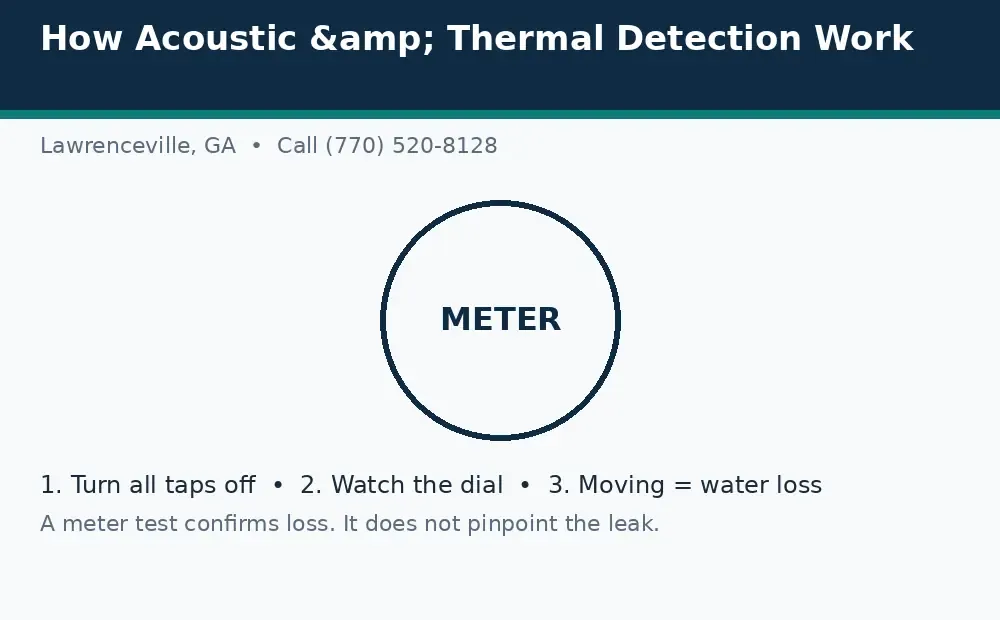
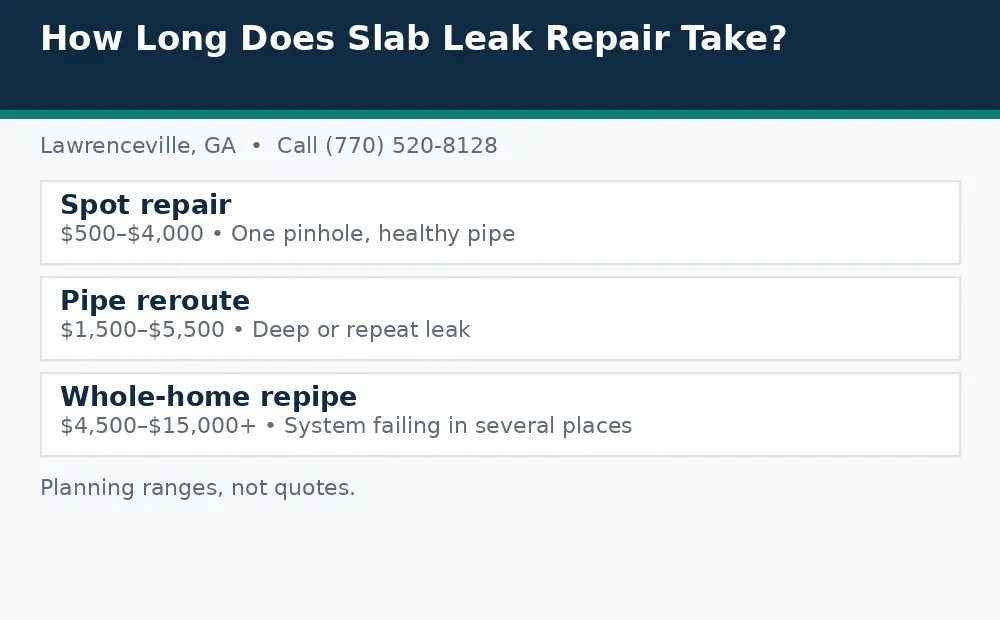
The images on this page are generic diagrams — a water meter leak test, and slab leak repair options — not photos of this business's own work or of a specific home. Call us at (770) 520-8128 if you are unsure what you are seeing.
What water hammer is
Water hammer is the bang, thud, or knock you hear in the pipes a moment after a tap or an appliance valve shuts off. It is not the water itself hitting anything. It is a pressure surge: water moving through a pipe has momentum, and when a valve closes suddenly that momentum has nowhere to go, so it turns into a shock wave that races back and forth through the pipe until it dies out. The valves that close fastest cause it most often — the solenoid in a washing machine or dishwasher that snaps shut in a fraction of a second, a single-lever faucet closed with a flick, a toilet fill valve seating hard. Older homes with air chambers, the short vertical stubs of pipe meant to cushion the shock, get it when those chambers fill with water and stop cushioning. The guidance from the National Environmental Services Center is plain about the stakes: water hammer that is not controlled damages pipes, fittings, and valves, causes leaks, and shortens the life of the system. That is the link to slab leaks. One bang will not break a sound pipe. A hundred bangs a week, month after month, fatigue the joints, and a joint under a slab cannot be seen, tightened, or watched, so it fails quietly. The high water pressure guide covers the other half of the pressure story: normal household pressure runs around 40 to 60 or 50 to 70 PSI, and readings above 80 PSI are widely treated as too high for a home system, which makes every shock worse.
How to tell water hammer from other pipe noises
Not every pipe noise is water hammer, and the differences matter because each one points at a different problem. Water hammer is a single bang or a short series of knocks that follows a shutoff by a beat — the washing machine stops filling, and then the pipes bang. It is tied to a trigger, and it stops by itself. A slab leak sounds different: the running water guide describes a hiss, a whoosh, or the sound of water running when every tap is off, and it does not stop, because the leak does not stop. Ticking or creaking as pipes warm up or cool down is expansion, not hammer, and it fades as the temperature settles. Rattling that runs the whole time a tap is open is usually a loose pipe moving in its strap, not a shock wave. Sputtering at a tap, with bursts of air, is air in the line, not hammer. The check that sorts them out is the trigger test: note exactly which valve sets it off, and whether the bang follows that valve every time. If the washing machine always ends its fill with a bang, and nothing else does, you have found the valve. If the sound goes on with every tap off and no appliance running, it is not water hammer at all, and the meter test is the next step. The signs guide lists the rest of the cluster to watch for while you listen.
Why it matters under a slab
A joint under a slab lives a harder life than a joint in a wall. It sits in soil that moves, it carries water at full pressure, and nobody can see it. Water hammer adds a repeated shock to that life. Each surge is a brief spike above the normal pressure, and each spike tugs at the joint a little. In a new system with tight joints, that tug is absorbed. In an older copper system, where the joints have already seen decades of pressure cycles, the same tug works the joint looser a fraction at a time, until it starts to weep. Lawrenceville's red clay makes the combination worse. The Georgia red clay guide explains how clay swells when it is wet and shrinks when it dries, so the ground under the slab is always moving a little, and a joint that is already being tugged by pressure surges is also being pulled by the soil. The older-homes guide covers the materials that fail first, and the what causes slab leaks guide lists pressure, corrosion, and soil movement side by side, because in a real house they arrive together. A bang that is new, or a bang that has got louder over a few months, is the warning worth acting on: it means something changed — a chamber waterlogged, a valve seating harder, pressure creeping up — and the joints are taking more shock than they were. A bang that has been there for years at the same volume, with no other sign, is less urgent, but it is still worth a pressure check, because the cost of the check is a gauge and a few minutes.
The homeowner checks
Four checks, in order, and none of them needs a tool you do not already have except a pressure gauge, which screws onto an outdoor hose bib. First, find the trigger. Run each appliance and tap one at a time — washing machine, dishwasher, each faucet, each toilet — and write down which one sets the bang off and how loud it is. A single trigger points at that valve; every valve doing it points at the pressure. Second, check the static pressure. Screw the gauge onto a hose bib with all taps closed, and take the reading more than once, since pressure moves through the day. The high water pressure guide explains the check in full: around 40 to 60 or 50 to 70 PSI is normal, and above 80 PSI is widely treated as too high. Third, look for the leak the hammer may already have caused. Check under sinks and at visible joints near the pipes that bang, look for a warm patch on the floor, and watch the water bill against the last few months. The high water bill guide walks through the comparison. Fourth, run the meter test. Turn off every tap and appliance, watch the dial, and if it moves, water is leaving a pressurized line somewhere. The water meter leak test guide walks through the check step by step, and the slab leak symptom checker runs through the signs one by one. If the meter holds still, there is no active supply leak, and the hammer is a problem to fix before it becomes one. The prevention guide covers the habits that help either way, including a yearly pressure check, which is the cheapest way to catch a creeping problem early.
What fixes it — and what detection does first
The standard fixes for water hammer are straightforward, and they are plumbing jobs, not detection jobs. Loose pipes get secured so they cannot swing and rattle. A water hammer arrestor — a small device with a cushion of air or a spring that absorbs the shock — gets fitted near the fast-closing valve that causes the bang. Where static pressure is high, bringing it down takes the force out of every surge. Those fixes stop the hammer, but they do not answer the question that matters first: has the hammer already opened a joint under the slab? That is our part. If the meter test shows a loss, or the signs point at a leak, detection finds it before any floor is opened. Acoustic listening follows the sound of escaping water through the slab, and thermal imaging looks for the warm patch a hot-water leak leaves behind; the acoustic and thermal detection guide explains both, and the detection methods guide covers the full set. If a leak is found, the repair routes are the ones in the comparison guide: a spot repair opens the slab at the marked leak and replaces the damaged section, a reroute abandons the old line and runs a new one through the walls or the attic, trenchless lining seals the pipe from the inside, and a whole-home repipe replaces the system overhead. The spot repair versus reroute versus repipe guide compares them, and the repair cost guide carries the published planning ranges: detection $300–$600, spot repair $500–$4,000, lining $800–$3,000, reroute $1,500–$5,500, and whole-home repipe $4,500–$15,000 or more, with a written price following inspection. After the repair, the concrete and the floor need putting back, and the concrete and floor restoration page covers what that looks like.
What to tell us when you call
When you call, tell us which appliance or tap sets the bang off, when the noise started and whether it has got louder, the pressure reading if you took one, and what the meter dial did with every tap off, plus your ZIP code. That short list tells us whether we are looking at a hammer problem, a leak the hammer has already caused, or both, and what the detection should show first.
Call (770) 520-8128 and describe what you are hearing in plain words. We will talk through the trigger test first, then detection if the test points that way.
Call Us Today
Fast local slab leak detection and repair in Lawrenceville, GA, ZIPs 30043–30046.
Call Now to Speak to a SpecialistFrequently asked questions
Can water hammer cause a slab leak?
Not by itself in a sound, new system — one bang will not crack a healthy pipe. The damage is cumulative: repeated pressure surges fatigue the joints, and a joint under a slab cannot be seen or tightened, so it fails quietly. Combined with older copper joints, high static pressure, and Lawrenceville's moving red clay, a joint that was already tight can start to weep. The hammer is a cause worth fixing before it becomes a leak.
Is water hammer dangerous?
The bang itself is not an emergency, and a pipe is unlikely to burst from a single surge. The danger is what it does over time: it loosens fittings, stresses valves, and shortens the life of the system, and a leak it causes under a slab can run unseen for months. Treat a new or louder bang as a prompt to check the pressure and run the meter test, and call promptly if any leak sign appears.
How do I tell water hammer from a slab leak?
By timing. Water hammer is a bang or a short series of knocks that follows a shutoff by a beat — the washing machine stops filling, then the pipes bang — and then it stops. A slab leak sounds like running water or a hiss that goes on with every tap off, because the leak never stops. The meter test settles it: a dial that moves with every tap off means water is leaving a pressurized line.
What stops water hammer?
The standard fixes are securing loose pipes so they cannot swing, fitting a water hammer arrestor near the fast-closing valve that causes the bang, and bringing static pressure down where it is high. Those are plumbing jobs. Before any of them, check whether the hammer has already opened a joint: run the meter test, watch the bill, and look for a warm patch or damp floor. Fix the leak first if there is one, then stop the hammer.
My pipes bang only when the washing machine runs — is that water hammer?
Very likely. A washing machine solenoid valve snaps shut in a fraction of a second, the fastest-closing valve in most homes, so it is the most common trigger. Note whether the bang is new or louder, and check the static pressure with a gauge on a hose bib. Then run the meter test with every tap off: if the dial holds still, there is no active leak, and the fix is stopping the hammer before it wears a joint out.