 Lawrenceville Slab Leak Detectors
Selling a Lawrenceville Home With a Slab Leak History
Selling a Lawrenceville home with a slab leak history is workable when the leak is located, repaired, and documented, because buyers trust a paper trail more than reassurance. Downtown Lawrenceville and Collins Hill sellers, ZIPs 30046 and 30043, should gather detection reports, repair invoices, and restoration records before listing.
What this looks like in a Lawrenceville home
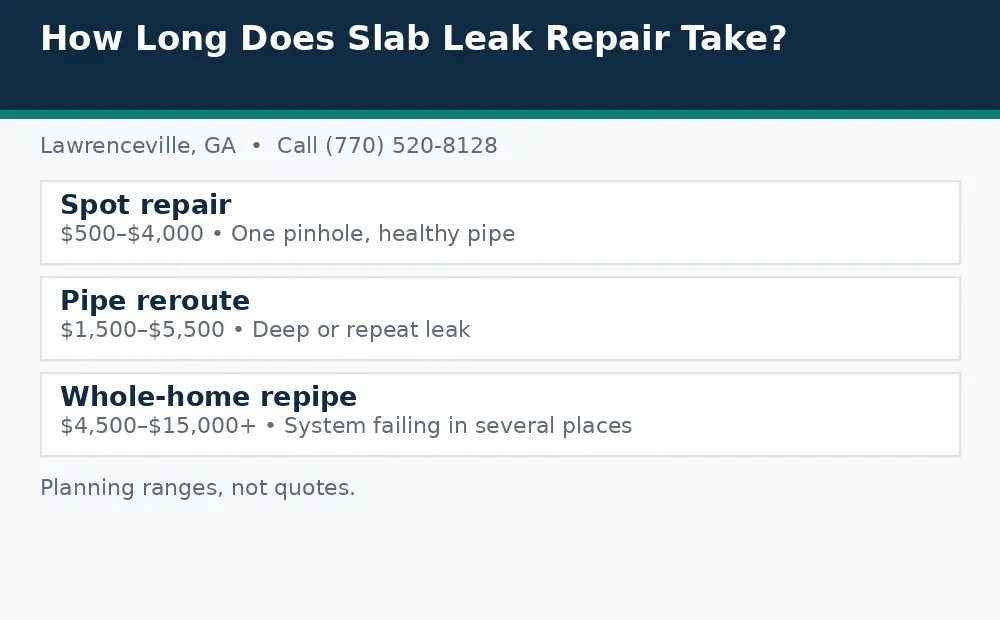
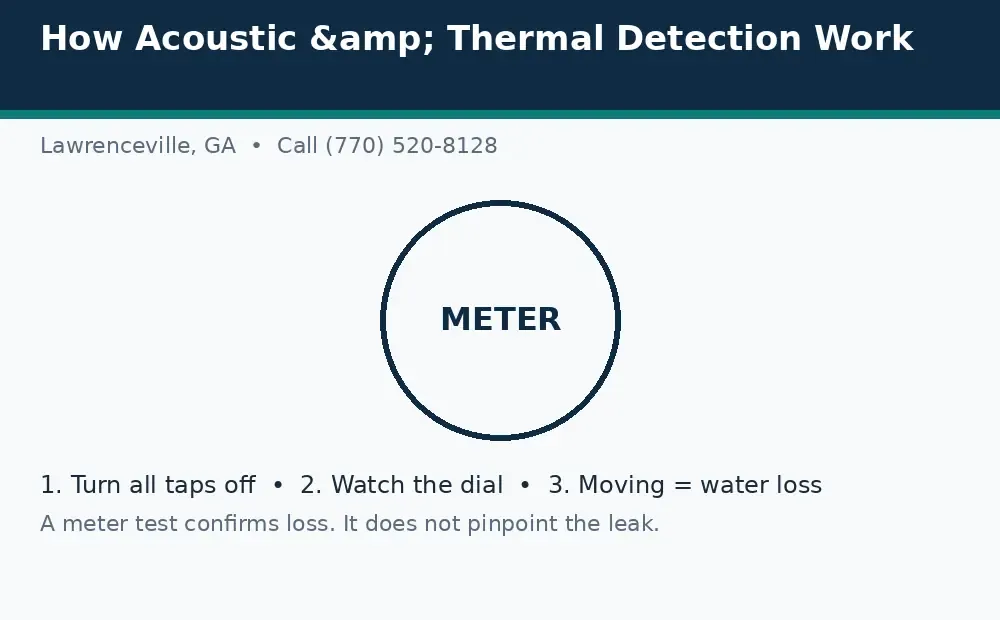
The images on this page are illustrative diagrams, not photos of a specific job at a specific address, and they are not presented as this business's own work. Call us at (770) 520-8128 if you are unsure what you are seeing.
The short answer: a documented repair sells; a hidden history does not
A slab leak in a home's past does not make that home unsellable. What worries buyers is not that a pipe once leaked — pipes leak, and buyers know it — but that they cannot tell whether the leak was found properly, fixed properly, and finished properly. A seller who can hand over a detection report showing where the leak was, an invoice showing what was done about it, and a record of the concrete and flooring being put back has answered the buyer's real question before it is asked. A seller who can only say "it was fixed" has not, and the gap between those two positions is where deals stall, prices get cut, and inspections turn into renegotiations. That is the whole logic of this guide: the repair matters, but the record of the repair matters just as much, and both should be in place before the home is listed, not assembled in a panic after an offer.
There is also a timing point that sellers miss. An active, unrepaired leak is a different sale from a repaired leak with a history, and the two should never be treated the same way. An active leak keeps damaging the home while it sits on the market — water keeps moving under the slab, flooring keeps deteriorating, and every week of showings is another week of damage a buyer will eventually price in. A repaired leak, by contrast, is a closed chapter with paperwork. If you know or suspect a leak is active, the sensible order is detection first, repair second, listing third, even if that delays the listing by weeks. The buying-home inspection guide explains the same sequence from the buyer's side, which is useful reading for a seller: it shows exactly what a careful buyer will look for, and therefore what your file needs to contain.
Step one: get a detection report, not a guess
Every selling decision that follows depends on knowing what actually happened under the slab, and that knowledge comes from detection, not from memory. A detection visit uses acoustic listening, thermal imaging, and meter and pressure testing to confirm whether a leak exists and, if it does, which line is losing water and where. The detection methods guide explains how those methods narrow a location before anything is opened, and the detection-visit preparation guide explains what happens on the visit itself. For a seller, the visit produces something a verbal account never can: a written, dated record that a specific line was tested, what the tests showed, and where the leak was marked. That record becomes the first page of the disclosure file, and it is the page that keeps a buyer from having to take your word for it.
Detection also protects a seller who is not sure there is a leak at all. Signs like a bill that climbed without a change in habits, a warm patch on the floor, or the sound of running water with everything off — all covered in the signs guide — are reasons to test, not conclusions to disclose as facts. Testing first means you disclose a finding, not a suspicion, and you price or repair around a finding, not around a fear. If the tests come back clear, that result is itself useful: it lets you answer buyer questions with a recent test rather than with silence. And if the tests find a leak, you have learned it on your own timetable, with time to repair it properly, rather than learning it from a buyer's inspector on a deadline.
Step two: repair, credit, or price it in — honestly
Once detection has located the leak, a seller generally faces three routes, and competitor selling guides for other cities lay them out the same way: repair before listing, offer a credit, or price the home to reflect the problem. None of them is universally right, and the honest choice depends on the leak, the repair, and the seller's timetable. Repairing before listing usually makes the most sense when the fix is clear and the home will be on the market for weeks anyway, because it removes the buyer's biggest unknown and stops further damage. A credit can work when the repair is well-defined and priced, so the buyer can see exactly what the credit covers. Pricing it in without a repair or a credit is the weakest route, because it asks the buyer to carry both the cost and the uncertainty, and buyers discount uncertainty far more generously than they discount a known invoice.
| Route | When it fits | What the buyer needs to see |
|---|---|---|
| Repair before listing | Fix is clear; time allows; leak is active | Detection report, repair invoice, restoration record |
| Credit at closing | Repair is priced in writing; buyer wants control | Written repair price, detection report, scope in writing |
| Price it in | Only with full disclosure and a priced scope | Detection report and a written repair estimate |
Whichever route you choose, the repair itself should be chosen on the leak's facts, not on what looks cheapest on paper. The spot repair versus reroute versus repipe guide compares the options, and the published planning ranges on the repair-cost guide give the shape of the decision: spot repair $500-$4,000, lining $800-$3,000, reroute $1,500-$5,500, repipe $4,500-$15,000+, with detection $300-$600. Those are planning ranges, never a computed quote for your home, and a written price follows inspection. A seller who discloses a repair without its price, or a credit without a written scope behind it, has disclosed half a fact, and buyers treat half a fact as a warning sign. The questions-before-approving guide is written for homeowners approving a repair, and its questions — what testing supports the diagnosis, what exactly gets opened, who restores the floor — are exactly the questions a buyer will ask about your repair afterwards.
Step three: build the disclosure file
The disclosure file is the practical heart of selling with a slab leak history, and it should be assembled before listing, not during negotiation. At minimum it contains the detection report, the repair invoice with the method and location stated, any post-repair test result, the concrete and floor restoration record, and any insurance claim paperwork for the water damage, if a claim was made. The insurance claim process guide walks through that paperwork from the homeowner's side. Keep photographs of the work in progress if you have them, and keep any warranty paperwork the repair came with, noting honestly whether a warranty transfers to a new owner — do not promise transferability you have not confirmed in writing.
One caution belongs here, and it is important. This guide is general information about selling with a leak history, not legal advice, and disclosure forms and duties vary by state and by form. Competitor guides written for other states describe their own states' forms and rules, and those descriptions are not Georgia rules and should not be quoted as if they were. Before you fill in any disclosure form, talk to your real estate agent and, where the history is complicated — a repeat leak, a large repair, an insurance dispute — to a real estate attorney, and answer the form's actual questions in plain words with your documents attached. Do not minimize, do not round a repair down to a smaller story, and do not describe a spot repair as a repipe or a reroute as a full replacement. Buyers forgive a repaired leak far more readily than they forgive a disclosure that turns out to have been shaded, and inspectors have a habit of finding the difference.
What buyers and inspectors will actually ask
It helps to rehearse the questions, because they are predictable. Was the leak supply or sewer? A sewer leak under the slab is a different job with different handling, and the sewer versus supply guide explains the distinction a buyer will want drawn. Was it repaired once, or has it leaked more than once? A single repaired leak reads very differently from a pattern, and the recurring leaks guide explains when repeat leaks point toward reroute or repipe rather than another spot repair. Was the floor restored, and by whom? Restoration is covered by the concrete and floor restoration page, and a buyer will want to know whether the patch is finished flooring or a concrete patch awaiting flooring. Is there any remaining dampness, musty smell, or warped flooring? The mold and water damage guide and the cleanup and drying guide explain why drying, not just pipe repair, decides whether a room is truly finished.
Answering those questions well is mostly a matter of having the file ready and letting it speak. You do not need to sell the repair; you need to show it. A short, factual summary — when the leak was found, how it was located, what was done, what was restored, and what remains — attached to the documents, does more persuading than any amount of reassurance. If the home has had no leak at all but a buyer asks anyway, a recent meter test result, explained in the water meter leak test guide, is a calm, factual answer. And if you are still at the stage of wondering whether there is a leak to disclose, run the damage-risk scale tool and book detection before you list: finding out on your own timetable is always cheaper, in money and in stress, than finding out on a buyer's timetable.
What to tell us when you call
When you call, tell us whether you are selling soon or already listed, whether the leak is active or already repaired, and what paperwork you already have — detection reports, invoices, restoration records, or nothing yet. Mention your ZIP code and whether the signs point to a supply or a sewer line. That short list lets us plan a detection visit that produces the record your sale needs.
Call (770) 520-8128 and describe your situation in plain words. We will talk through detection first, then a repair and records plan that fits your listing timetable.
Call Us Today
Fast local slab leak detection and repair in Lawrenceville, GA, ZIPs 30043–30046.
Call Us: (770) 520-8128Frequently asked questions
Can I sell a Lawrenceville home that had a slab leak?
Yes, if the leak was located, repaired, and documented. Buyers worry most about uncertainty, not about a repaired pipe, so a file with a detection report, a repair invoice stating the method and location, and a restoration record answers their questions before they are asked. An active, unrepaired leak is a harder sale, because it keeps damaging the home while it sits on the market.
Do I have to tell buyers about a past slab leak?
This guide is general information, not legal advice, and disclosure forms and duties vary by state and by form. As a practical matter, buyers, inspectors, and lenders tend to find leak histories anyway, and a disclosed repair with documents is far easier to sell than a history discovered late. Talk to your real estate agent, and to a real estate attorney where the history is complicated, before you complete any disclosure form.
Should I repair the leak before listing, or offer a credit?
Repairing before listing usually makes the most sense when the fix is clear and the home will be marketed for weeks, because it removes the buyer's biggest unknown and stops further damage. A credit can work when the repair is priced in writing so the buyer can see exactly what it covers. Pricing the home down without a repair or a credit is weakest, because buyers discount uncertainty heavily.
What paperwork should I gather before listing?
Gather the detection report, the repair invoice with method and location stated, any post-repair test result, the concrete and floor restoration record, and any insurance claim paperwork if a claim was made. Add photographs of the work if you have them and any warranty paperwork, noting honestly whether a warranty transfers to a new owner. Do not promise transferability you have not confirmed in writing.
What if the leak keeps coming back — does that change the sale?
Yes. A single repaired leak reads very differently from a pattern of repeat leaks, and buyers will ask about it directly. Repeat leaks can point toward reroute or repipe rather than another spot repair, which changes both the repair price and the story you tell buyers. Get detection evidence for each leak, keep every repair record, and let the file show the pattern honestly rather than leaving buyers to discover it.