 Lawrenceville Slab Leak Detectors
Questions to Ask Before You Approve a Slab Leak Repair
Before approving a slab leak repair in Lawrenceville, ask what testing supports the diagnosis, which line leaks, how precisely it is located, why this method was chosen, and what the written price covers. Downtown Lawrenceville and Sugarloaf homeowners, ZIPs 30046 and 30045, should ask them first.
Key takeaways
- Ask for the evidence first: which tests, which line, and how precisely the leak is located.
- Ask why this method and not the others — the answer should mention your pipe, not just the price.
- Ask what gets opened and who restores it, before work starts, not after.
- Ask for the price in writing, itemised by detection, repair, and restoration.
What this looks like in a Lawrenceville home
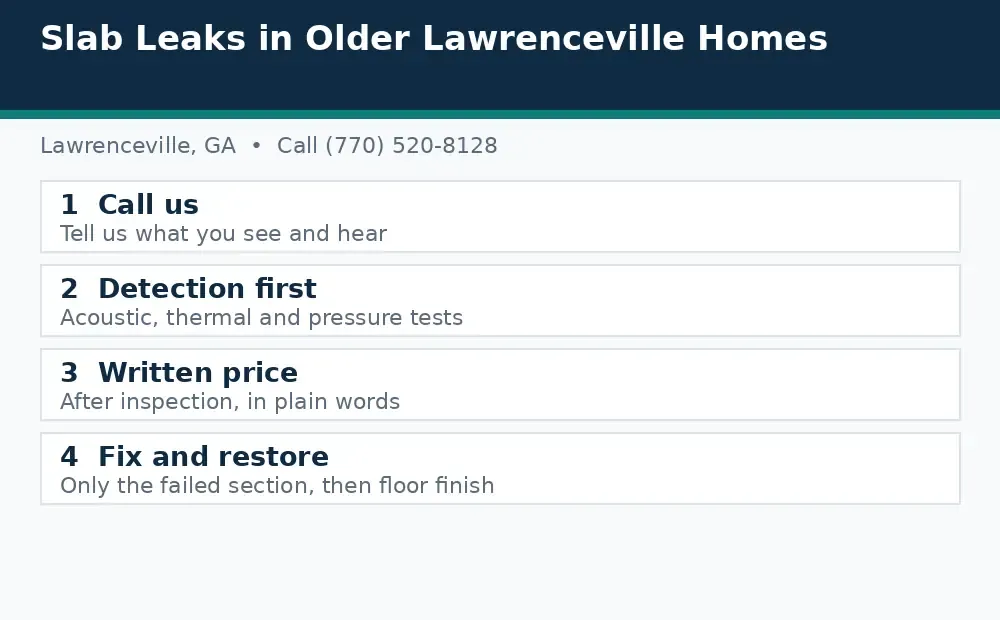
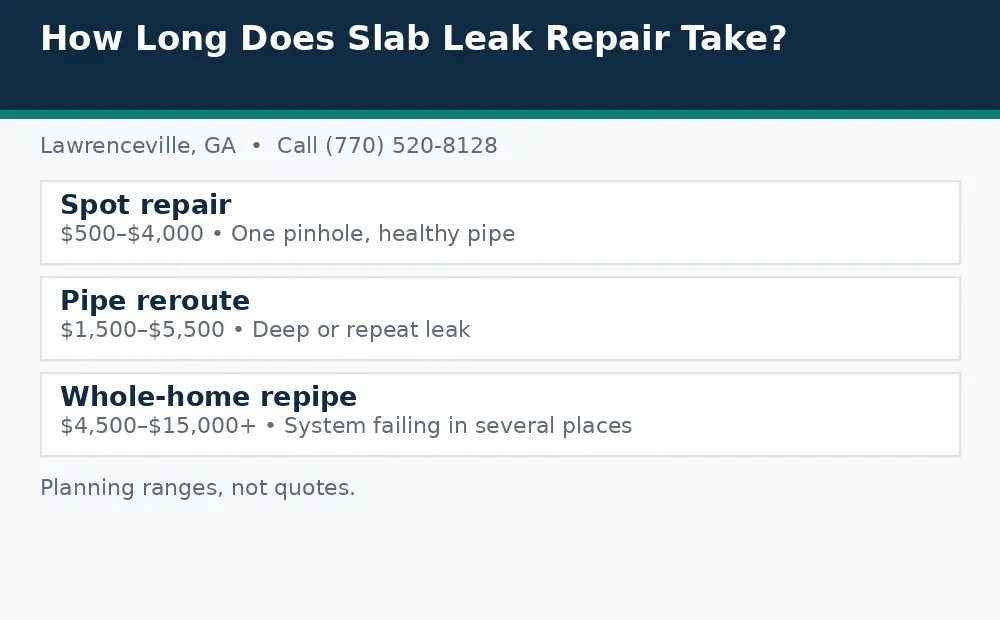
The working photo on this page is an illustrative working photo, not a photo of a specific job at a specific address. The diagrams are schematics, not to scale, made to explain the signs, process, options, or costs on this page in plain words. Call us at (770) 520-8128 if you are unsure what you are seeing.
Why ask questions at all, when the technician is the expert?
Because you are the one living with the consequences. A slab leak repair opens your floor or your walls, costs real money, and leaves restoration work behind it. The technician brings expertise you do not have, but you bring something the technician does not: the authority to approve, the budget it comes from, and the home it happens in. Good technicians expect questions and answer them plainly; a technician who rushes past questions or answers them with impatience is giving you information too, just not the kind you hoped for.
Questions also protect the technician's work from misunderstanding. A homeowner who approves a reroute believing it means no disruption at all will be unhappy when walls are opened, even though rerouting was the right call. A homeowner who approves a spot repair believing the whole run is renewed will be unhappy at the next leak, even though the spot repair was done well. Most repair disputes are expectation disputes, and expectations are set — or not set — in the conversation before approval. The seven questions below are designed to set them properly, and they apply whether the job is a spot repair, a reroute, a lining, or a repipe.
What testing supports this diagnosis, and which line is leaking?
Start here, because everything else rests on it. Ask which tests were run — pressure testing, acoustic listening, thermal imaging, camera, meter test — and what each one showed. Ask which line is leaking: hot-water, cold-water, or drain. A hot-water leak and a drain leak are different jobs with different tools, and a diagnosis that cannot name the line is not yet a diagnosis. If the answer is vague, ask what would make it precise, and whether that step happens before or after you approve.
Also ask what the testing did not show. A meter test confirms loss exists but cannot place it under the slab; acoustic listening places a pressurised leak but cannot assess a drain line's interior; a camera shows a drain's condition but says nothing about a supply line. A technician who volunteers those limits is more trustworthy, not less, because limits are where honest diagnosis lives. If you have not yet had detection, the detection service page explains the sequence, and the detection visit guide in this batch tells you how to prepare so the testing answers these questions the first time.
How precisely is the leak located, and why this method?
Precision is the difference between opening one area and opening several. Ask how the location was marked, how confident the technician is in that mark, and what happens if the leak is not exactly where marked — is the plan adjusted, or does the opening grow? A precise, marked location with a stated fallback is a professional answer; a shrug and a large proposed opening is a reason to pause and ask for more detection, not more demolition.
Then ask why this method was chosen over the others, in terms of your pipe. A good answer mentions the leak's position, the pipe's material and condition, the flooring above it, and the history of the run — for example, that lining was ruled out because the camera showed a collapsed section, or that rerouting was chosen because the run had leaked before. A weak answer mentions only speed or price. Price matters, and the planning ranges on this site — detection $300–$600, spot $500–$4,000, lining $800–$3,000, reroute $1,500–$5,500, repipe $4,500–$15,000+ — frame the conversation, but the method should be justified by the pipe first and the price second. The methods comparison guide gives you the vocabulary to follow that justification.
What gets opened, and who restores the concrete and flooring?
This is the question homeowners most often forget until the floor is already open. Ask exactly what will be opened — how large an area, in which room, through what material — and what the restoration includes: concrete refill, flooring replacement or repair, baseboards, paint, and cleanup. Ask who does the restoration: the same technician, a separate trade, or you. Ask what happens if the flooring cannot be matched — tile from a discontinued range, hardwood with a patina no new board shares — because 'restored' can mean several different finishes, and you should know which one you are approving.
Get the restoration answer in the same written scope as the repair, not as a verbal assurance. If restoration is excluded, that is not necessarily a problem, but it changes your budget and your timetable, and you should know it before approval rather than after the pipe is fixed and the floor is still open. For homes in Sugarloaf and Collins Hill with tile or hardwood over the slab, this question routinely matters more than the pipe question, because the floor is what you live with afterwards.
What does the written price cover, and what happens after the repair?
Ask for the price in writing, itemised: detection, repair method, materials, restoration, and anything excluded. Ask whether the price is fixed for the stated scope or an estimate that moves if the opening grows. Ask what post-repair testing happens — a pressure test after the fix, a meter check, a camera pass where relevant — because a repair without a confirming test is an assertion, not a result. And ask what to watch for afterwards and who to call if a sign returns: a bill jump, a damp patch, a sound. The answer should include a timeframe for a follow-up check and a plain route back to the technician, not a vague 'call us if worried'.
Finally, ask what would change the recommendation. A technician who can say 'if the camera had shown X, I would have recommended Y instead' is showing their working, and showing their working is the strongest evidence you are dealing with a professional. Take notes during the conversation, keep them with the written price, and compare them with the repair cost estimator ranges before you sign. Approval given on evidence, in writing, with restoration agreed, is the closest thing this industry offers to a guarantee — and it is available on every job, including yours, if you ask for it.
The seven questions, as a checklist
| # | Question | A good answer includes |
|---|---|---|
| 1 | What testing supports this? | Named tests and what each showed |
| 2 | Which line is leaking? | Hot-water, cold-water, or drain, with evidence |
| 3 | How precisely is it located? | A marked location and a fallback plan |
| 4 | Why this method? | Pipe, position, flooring, and run history |
| 5 | What gets opened? | Area, room, and material, stated plainly |
| 6 | Who restores, and to what finish? | Concrete, flooring, and matching, in writing |
| 7 | What does the written price cover? | Itemised scope, exclusions, and post-repair testing |
Take this list to the visit. A technician who welcomes it is a technician you can approve with confidence.
Evidence Tests, line, and location — before any method is discussed.
Method Why this route, in terms of your pipe and your floor.
Opening What comes up, how large, and what it looks like afterwards.
Writing Itemised price, restoration, and post-repair testing, all in writing.
What to tell us when you call
When you call, tell us what you noticed, when it started, and where in the house it shows. Mention your ZIP code, whether the water meter moves with everything off, and whether the sign is on a hot-water or cold-water line if you know. That short list helps the technician bring the right equipment and plan the visit. You do not need to know the cause before you call — that is what detection is for.
Call (770) 520-8128 and describe what you are seeing in plain words. We will talk through the next step and arrange a detection visit.
Call Us Today
Fast local slab leak detection and repair in Lawrenceville, GA, ZIPs 30043–30046.
Call Us: (770) 520-8128Frequently asked questions
Should I get a second opinion before approving?
If the diagnosis is vague, the opening is large, or the price is far outside the published planning ranges, a second detection opinion is reasonable. Bring the first report so the second visit builds on it rather than repeating it blindly.
What if the technician cannot answer one of the seven questions?
Ask what step would answer it, and whether that step happens before approval. An unanswered question about location or method is a reason to pause, not a reason to sign.
Is a verbal price ever acceptable?
No, not for a slab job. Detection, repair, materials, restoration, and exclusions should all be written down before work starts, so both sides share the same scope.
What if the repair uncovers something unexpected?
Ask in advance how surprises are handled: does work pause for a revised price, or continue within an agreed allowance? Agree that process before approval, while you still have leverage.
Do these questions apply to emergency repairs too?
Yes, abbreviated, not skipped. In an emergency, ask for the line, the location evidence, the method reason, and the written price — even in short form — before the floor opens.