 Lawrenceville Slab Leak Detectors
Recurring Slab Leaks: When Spot Repair Stops Making Sense
Recurring slab leaks in a Lawrenceville home — a second or third leak on the same run — mean the pipe itself is failing, not that repairs were done badly. Homeowners in Collins Hill and Downtown Lawrenceville, ZIPs 30043 and 30046, should judge the run, not just the latest hole.
Key takeaways
- A second leak on the same run is a pattern, not bad luck — ask what the run's condition is, not just what the new hole costs.
- Spot repair fixes one hole; it does not renew the rest of the run that produced it.
- Reroute replaces one run's route; repipe replaces the system. The evidence for each is different.
- Every decision uses published planning ranges only — a written price after inspection, never a computed figure.
What this looks like in a Lawrenceville home
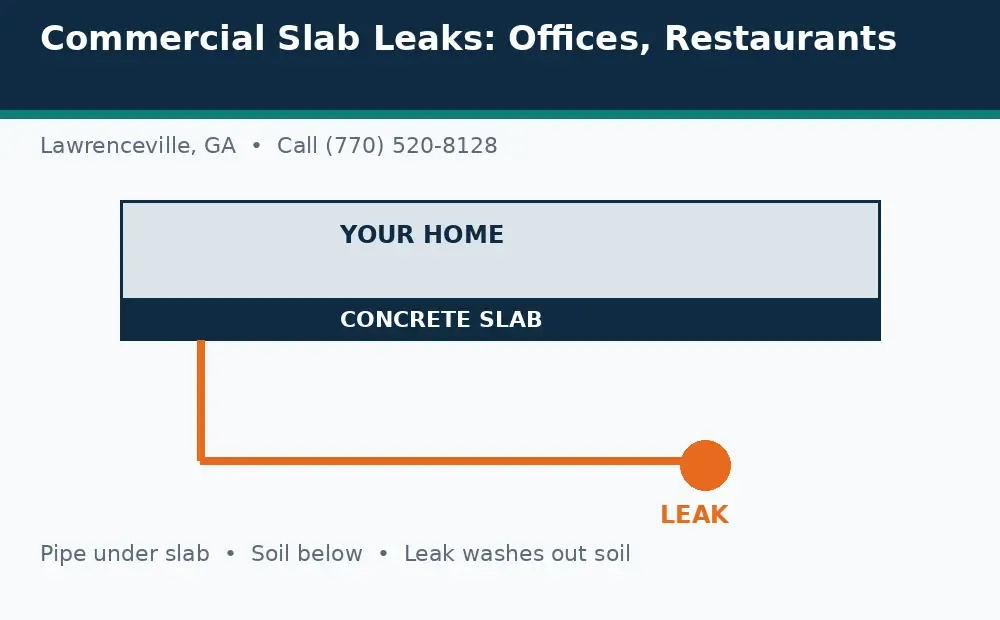
The working photo on this page is an illustrative working photo, not a photo of a specific job at a specific address. The diagrams are schematics, not to scale, made to explain the signs, process, options, or costs on this page in plain words. Call us at (770) 520-8128 if you are unsure what you are seeing.
When does a second leak change the decision?
The first leak in a home is usually a spot decision: find it, fix that section, restore, and move on. The second leak on the same run changes the question. It is no longer only 'where is this hole' but 'why does this run keep failing, and what will the third hole cost in flooring, drying, and disruption'. That shift is the repipe trigger in its simplest form — not a rule that two leaks automatically mean a repipe, but a prompt to judge the run as a whole instead of pricing one more hole in isolation.
The evidence that matters is concrete: which run leaked each time, how far apart the leaks were, what the pipe looked like at each repair, and whether pressure testing or a camera picture shows general thinning or isolated damage. A run that leaked twice in the same area for the same reason is telling a different story from a home that leaked once on a hot-water line and once, years later, on an unrelated cold-water branch. The technician's report from each visit is what separates those stories, which is why keeping every report matters. If you are weighing the next fix, start from the spot repair vs reroute vs repipe guide, then bring your leak history to the conversation.
What are the actual trigger points for reroute or repipe?
There is no universal number — no honest guide can say 'three leaks means repipe' for every house — but there are recognisable trigger points that technicians weigh together. Repeat leaks on the same run, leaks appearing in different places along one run, visible general corrosion or thinning where a section was opened, discoloured water that persists, and a run whose material and age match the failing pattern all push the decision away from another spot repair. Each trigger on its own is a warning; several together are a case.
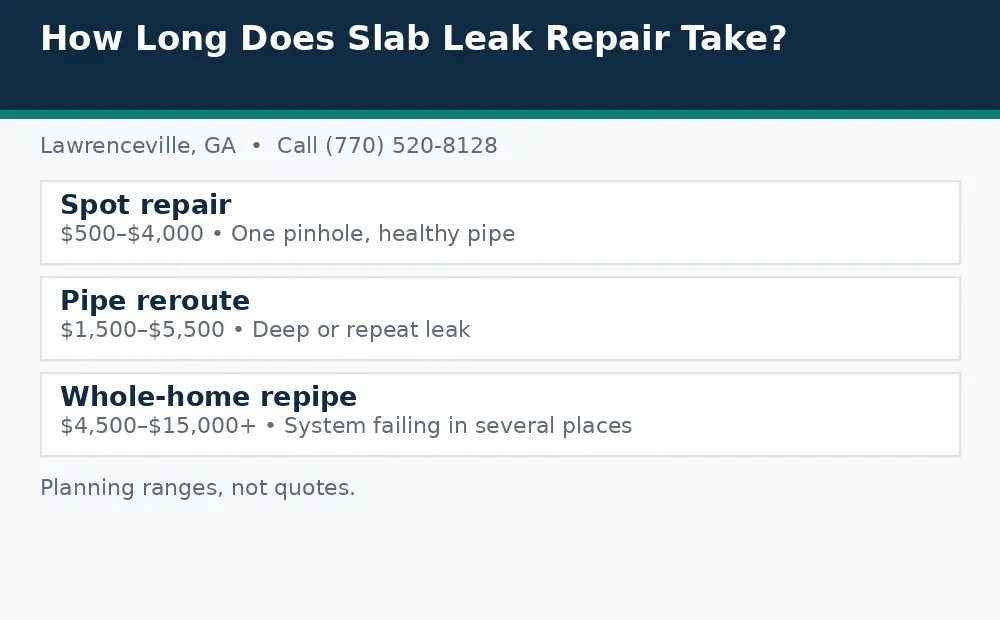
Rerouting fits when the problem is concentrated in one run: the run is replaced by a new route that avoids the slab, while the rest of the system stays. Repiping fits when the problem is system-wide: leaks on multiple runs, or a material and age picture that says the next run is a matter of time rather than chance. The planning ranges frame the money honestly — spot repair $500–$4,000, reroute $1,500–$5,500, repipe $4,500–$15,000+, all planning ranges, not quotes — but the decision itself is made on the pipe evidence and the disruption history, not on the price list. A written price after inspection should arrive with the reasoning: which trigger points were found, and why the recommended route answers them.
Why does spot repair keep failing on a failing run?
Spot repair does exactly what it promises and nothing more: it replaces the failed section. On a sound run, that is the whole job, and it lasts. On a run whose wall is thinning along its length, a spot repair leaves the rest of that thinning wall in place, still under pressure, still aging. The next hole is then not a failure of the repair but a failure of the remaining pipe, appearing wherever the wall is thinnest next. Homeowners sometimes conclude the first repair was faulty; more often, the run was already telling its story and nobody had yet read the whole run.
That is why the conversation after a repeat leak should include the run's condition, not just the new hole's location. Pressure testing can show whether the run holds pressure evenly; a camera, where the line allows it, can show the pipe's interior condition; and the history of where previous holes appeared maps the pattern. If the evidence says the run is generally sound and the new leak is unrelated, another spot repair is perfectly sensible — the trigger framework does not force a repipe, it forces the question. The slab leak repair service page covers the menu, but the trigger decision itself is always made from the house's own history, and homes in Collins Hill and ZIP 30043 with older under-slab lines are where the question comes up most.
How do I compare reroute and repipe honestly?
Compare them on three things: scope, disruption, and what is left behind. Reroute replaces one run's route, usually with less work than a full repipe, and leaves the rest of the system untouched — good when the problem is genuinely one run. Repipe replaces the system, costs more and disrupts more rooms, and leaves no aging run behind to fail next — good when the problem is system-wide. A reroute that leaves three aging runs in place is not a saving if two of them leak next year; a repipe for one bad run is not value if the rest of the system is sound and young.
Disruption deserves the same honesty. Rerouting still opens walls or ceilings along the new route; repiping opens more of them, though usually not the slab itself. Restoration — patching, painting, flooring — is part of both jobs and should be priced and agreed in writing alongside the pipe work, not discovered afterwards. If you are comparing the two, ask for both options priced in writing where both are genuinely viable, with the trigger evidence for each, and decide on the evidence rather than on the lower number alone. The repair cost estimator lets you walk the published planning ranges for each route before that conversation, so the written prices arrive in a context you already understand.
What should I do after the second leak?
First, do not authorise a third spot repair on reflex. Ask for the run's history to be laid out: where each leak was, what was found each time, and what the current evidence says about the rest of the run. Second, keep every report, photo, and invoice in one folder — the pattern is only visible when the history is together, and it is also the file an insurer will want if a claim follows. Third, keep the house safe in the meantime: the same meter-test and bill-comparison routine that catches first leaks catches the next one early, and a leak caught early costs less in drying and restoration whatever the pipe decision turns out to be.
Finally, decide on a timetable that fits the evidence. A run with several trigger points and an active loss should not wait for a convenient month; a single repeat with an otherwise sound run can reasonably be repaired and watched, with a clear note of what would change the decision next time. Either way, the decision should be written down — method, reasoning, restoration, price after inspection — so that the next person who looks at the house, including a future buyer or technician, can see why it was made. That written record is also what the questions before approving a repair guide in this batch is designed to help you obtain.
Repeat-leak decision table
| Pattern | What it suggests | Usual next step |
|---|---|---|
| One leak, sound run | Isolated failure | Spot repair |
| Second leak, same run | Run may be failing | Judge the run; consider reroute |
| Leaks on multiple runs | System-wide aging | Consider whole-home repipe |
| Leak + discoloured water + thinning seen | General pipe deterioration | Reroute or repipe, by scope |
| Unrelated leaks, years apart | No pattern | Repair each on its merits |
Patterns guide the question; only the house's own evidence answers it. No count of leaks alone decides a repipe.
What to tell us when you call
When you call, tell us what you noticed, when it started, and where in the house it shows. Mention your ZIP code, whether the water meter moves with everything off, and whether the sign is on a hot-water or cold-water line if you know. That short list helps the technician bring the right equipment and plan the visit. You do not need to know the cause before you call — that is what detection is for.
Call (770) 520-8128 and describe what you are seeing in plain words. We will talk through the next step and arrange a detection visit.
Call Us Today
Fast local slab leak detection and repair in Lawrenceville, GA, ZIPs 30043–30046.
Call Us: (770) 520-8128Frequently asked questions
Does a second leak automatically mean I need a repipe?
No. A second leak on the same run is a trigger to judge the run, not an automatic repipe. Reroute fits a single failing run; repipe fits system-wide failure. The evidence decides.
How do I know if the run is failing or just unlucky?
Look at the pattern: same run or different runs, distance between leaks, what the pipe looked like at each repair, and whether pressure or camera evidence shows general thinning. A pattern across a run is evidence; isolated leaks years apart are not.
Is rerouting cheaper than repiping?
As a planning range, reroute is $1,500–$5,500 and repipe is $4,500–$15,000+, but the comparison only makes sense for the same scope. A reroute that leaves failing runs behind is not a saving.
Should I keep repairing the same run?
Each spot repair fixes one hole and leaves the rest of the run in place. If the run keeps producing holes, the money spent on repeated repairs, drying, and restoration eventually exceeds the reroute or repipe it was postponing.
What records help the decision?
Every detection report, repair invoice, photo, and bill comparison, in date order. The pattern is only visible when the history is together.