Slab Leak Under Hardwood Floor in Lawrenceville, GA?
A slab leak under a hardwood floor in Lawrenceville shows as cupping or crowning boards near Sugarloaf or Collins Hill in ZIP 30044 or 30045, with a warm patch, a musty smell, or a climbing water bill. Moisture wicks through the slab, so the boards tell on the pipe below.
What this looks like in a Lawrenceville home
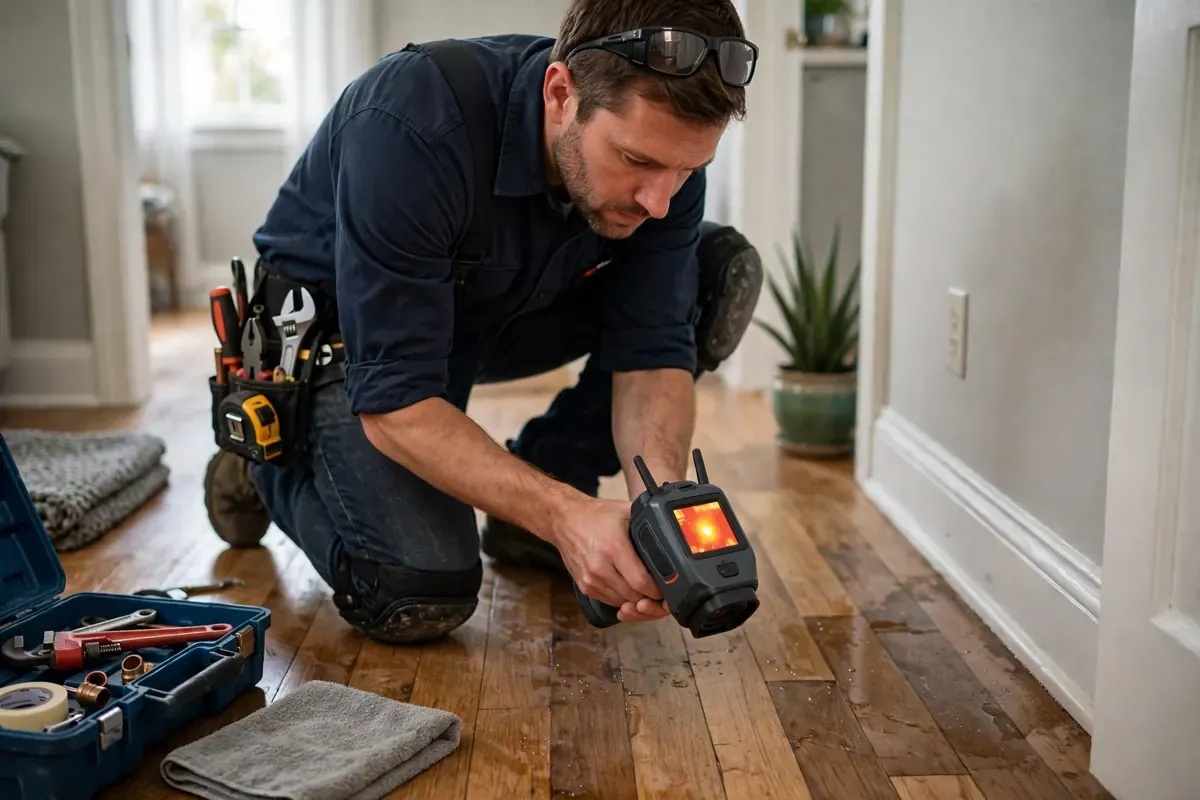

The images on this page are generic photos and diagrams of leak detection equipment in use, not photos of this business's own work or of a specific home. Call us at (770) 520-8128 if you are unsure what you are seeing.
How a slab leak reaches your hardwood
A slab leak is a pressurized water line failing under your concrete foundation, and hardwood is one of the first floor coverings to show it. Concrete looks solid, but it is porous enough to pass moisture upward, slowly and steadily, and wood is hygroscopic: it takes on water from the air and from whatever it touches, and it swells as it does. A leak under the slab keeps the concrete damp in one area, and the boards above absorb moisture from below, day after day, while their tops stay dry. That is the pattern that separates a slab leak from a spill. A spill wets the top of the boards and dries from the top; a slab leak wets the underside and keeps wetting it, because the pipe keeps leaking. In Lawrenceville, the ground under most slabs is red clay, which swells when wet and shrinks when dry, so a leak that runs for months does two kinds of damage at once: it feeds moisture into the boards, and it keeps the ground moving under the slab. The Georgia red clay guide explains why that movement matters, and the water damage cleanup guide covers what happens to floors and walls once the water has spread. Hardwood absorbs water slowly and releases it slowly, which gives you a window to act, but the damage you see today started weeks ago.
Cupping, crowning, buckling: reading what the boards say
Wood floors move in predictable ways when they take on moisture, and the shape of the movement is a clue to where the water came from. Cupping is the classic sign of water from below: the edges of a board rise higher than its centre, so the floor feels wavy under bare feet and catches the light in ridges along the seams. It happens because the underside of the board took on more moisture than the top, which is exactly what a slab leak does. Crowning is the opposite shape, the centre bowing up above the edges, and it usually means the top absorbed more moisture than the bottom, or that a cupped floor was sanded flat before it finished drying. Buckling is the worst stage: boards lift off the subfloor entirely, sometimes in a ridge you can see from across the room, and that usually follows a lot of water or a long wetting. Gaps between boards, dark stains along the grain, and a hollow tap are all part of the same picture. None of these shapes proves a slab leak on its own. Cupping can also come from high indoor humidity, a spill that sat unnoticed, or a damp crawl space in homes that have one. The pattern that points under the slab is cupping with no spill above it, in one area of the house, that keeps getting worse instead of drying out. The musty smell and warped floors guide covers the damp-floor signs in full, and the warm spot guide covers the one sign that belongs to hot-water leaks specifically: a patch of floor that feels warm for no reason.
The hardwood signs, room by room
Start where the water lines run. In the kitchen, check the boards in front of the sink and the dishwasher, and along the wall the refrigerator sits against, because the supply lines to those fixtures run under the slab. Cupping that follows the line of a wall, rather than sitting in the middle of the room, is worth a closer look. In the bathroom, check the boards just outside the door and along the baseboards, where water wicking up through the slab first reaches the surface; a musty smell at the base of the wall in the same spot strengthens the case. In the hallway, a warm patch under bare feet on a cool morning is the hot-water tell, and a water heater running more than it used to tells the same story. In the living room, look for boards that have gone dark along the seams, baseboards that have swollen or pulled away from the wall, and paint or drywall at floor level that has started to bubble. The signs guide puts the floor signs alongside the rest: a climbing water bill, the sound of running water with everything off, and low pressure at the taps. One sign on its own is a reason to test, not a diagnosis, and two or three together, especially with a meter that keeps moving, are a strong reason to call. The tile floor guide covers the same problem on tile, where the signs are different, because tile hides the moisture longer and shows it as loose grout and hollow-sounding tiles instead of cupping. If your home mixes the two, compare them: tile that sounds hollow in the same area where the hardwood cups is two floor coverings telling the same story.
Checks you can do before you call
Walk the floor barefoot first thing in the morning, before the sun has warmed it unevenly, and feel for a patch that is warmer than the floor around it, or for boards whose edges you can feel with your toes. A credit card laid flat across three boards will rock on a cupped board and sit flat on a sound one. Mark the worst boards with painter's tape and note the date, because a floor that keeps cupping over two weeks is a different story from one that has looked the same for a year. Then run the meter test, which is the check that matters most. Turn off every tap and appliance, watch the meter dial, and if it moves with nothing running, water is leaving the system somewhere. The water meter leak test guide walks through it step by step, and the slab leak symptom checker runs through the rest of the signs one by one. The shut-off test is the second check: if you can hear water moving under the floor, close the main valve, and if the sound stops, you are hearing a pressurized line. The shut-off guide shows where the main valve usually sits in a Lawrenceville home. Rule out the easy causes before you call: a spill that was mopped but never fully dried, a plant pot that drains onto the floor, condensation from a window or an exterior door, and a pet accident that soaked through. Each of those is a one-time wetting from above, and the floor dries from the top. A slab leak does not dry. Do not sand the boards, and do not refinish them, until the source is found. Sanding a wet floor locks the distortion in, and refinishing over a damp slab traps the moisture under the new finish, so the floor cups again within weeks. Photograph the cupping from floor level, where the ridges show, and write down the meter reading before you call, because both tell the technician where to start.
Detection and repair — and what happens to the floor
Your checks can tell you that something is leaking. They cannot tell you exactly where, and the floor should not be opened until detection has put a mark on it. Professional acoustic detection takes the hiss of the leak and turns it into a location: ground microphones far more sensitive than an ear are placed on the slab at several points, and the technician listens for where the sound peaks. For a hot-water leak, thermal imaging adds a second read, because the warm patch the leaking line leaves in the floor shows up on camera, and the two readings together are stronger than either alone. A pressure test can confirm which side is leaking, hot or cold, by isolating each line in turn. The detection methods guide covers the full set, including tracer gas as a method a technician may use, and the acoustic and thermal guide explains what the equipment does with the sound and the heat. Detection in Lawrenceville runs in the site's published planning range of $300–$600, with a written price following inspection, and the detection cost guide explains what the visit covers. Once the leak is found, the repair routes are spot repair, which opens the slab at the marked leak; a reroute, which abandons the old line and runs a new one through the walls or the attic; trenchless lining, which seals the pipe from the inside; and a whole-home repipe. The spot repair versus reroute versus repipe guide compares them, and the repair cost guide carries the published planning ranges: spot repair $500–$4,000, lining $800–$3,000, reroute $1,500–$5,500, and whole-home repipe $4,500–$15,000 or more. None of that work starts until detection has put a mark on the floor. After the pipe is fixed, the floor still has to dry, and it dries from both sides: the boards and the slab underneath both have to reach normal moisture readings before anything is sanded or refinished, because a slab can release moisture for weeks after the leak stops. Mild cupping often eases as the floor dries slowly and evenly, and boards that settle flat can then be sanded and refinished. Boards that buckled, or sat in contaminated water, are more likely to need replacing. The concrete and floor restoration page covers the restoration side of the job, and the mold and water damage guide covers what to watch for while the floor dries.
What to tell us when you call
When you call, tell us which rooms cup or buckle, whether any patch feels warm, what the meter dial did with every tap off, and whether the floor is solid or engineered hardwood, plus your ZIP code. That short list tells us whether we are listening for an active supply leak, a drain problem, or a humidity problem, and what the detection should show first.
Call (770) 520-8128 and describe the boards in plain words. We will talk through the meter test first, then detection if the tests point that way.
Call Us Today
Fast local slab leak detection and repair in Lawrenceville, GA, ZIPs 30043–30046.
Call Now to Speak to a SpecialistFrequently asked questions
Can a slab leak damage hardwood floors?
Yes. Concrete passes moisture upward, and hardwood absorbs it from below, so a leak under the slab can cup, crown, or buckle the boards above it, open gaps between them, and leave dark stains along the grain. A hot-water leak can also warm the floor in the same spot. The damage grows the longer the leak runs, which is why a floor that keeps cupping over weeks deserves a meter test, not a wait.
What does cupping mean, and is it always a slab leak?
Cupping means the edges of a board sit higher than its centre, when the underside took on more moisture than the top. It is the classic sign of water from below, but it is not always a slab leak: high indoor humidity, a spill that sat unnoticed, or a damp crawl space can cup boards too. Cupping with no spill above it, in one area, that keeps getting worse, plus a moving meter, points under the slab.
Can cupped hardwood floors go back to flat?
Sometimes. Mild cupping often eases as the floor dries slowly and evenly once the moisture source is fixed, and boards that settle flat can then be sanded and refinished. Buckled boards, which have lifted off the subfloor, seldom go flat again and usually need replacing. The deciding factor is a moisture reading on the boards and the slab, not how the floor looks, so do not sand or refinish until the readings are normal.
Should I sand or refinish cupped boards before the leak is found?
No. Sanding a wet floor locks the distortion in, because the boards are sanded flat while swollen and then shrink unevenly as they dry, which can turn cupping into crowning. Refinishing over a damp slab traps moisture under the new finish, so the floor cups again within weeks. Fix the pipe first, let the boards and the slab dry to normal moisture readings, and only then sand or refinish.
How do I tell a slab leak from a spill or humidity?
A spill wets the top of the boards, dries from the top, and usually sits near a sink, a plant, or a window. A slab leak wets the underside, keeps wetting it, and shows as cupping across several boards with no spill above. Humidity cups boards across the whole house, not one area. The meter test separates them: a meter that moves with everything off means water is leaving the system, and a spill cannot do that.