 Lawrenceville Slab Leak Detectors
Does Home Warranty Cover Slab Leaks? Lawrenceville
A home warranty can cover a slab leak in Lawrenceville, GA, but usually only the failed pipe — not the water damage it caused. American Home Shield lists slab leaks as a covered plumbing item, with a $1,000 limit for concrete access; other contracts differ, so read yours first.
What this looks like in a Lawrenceville home
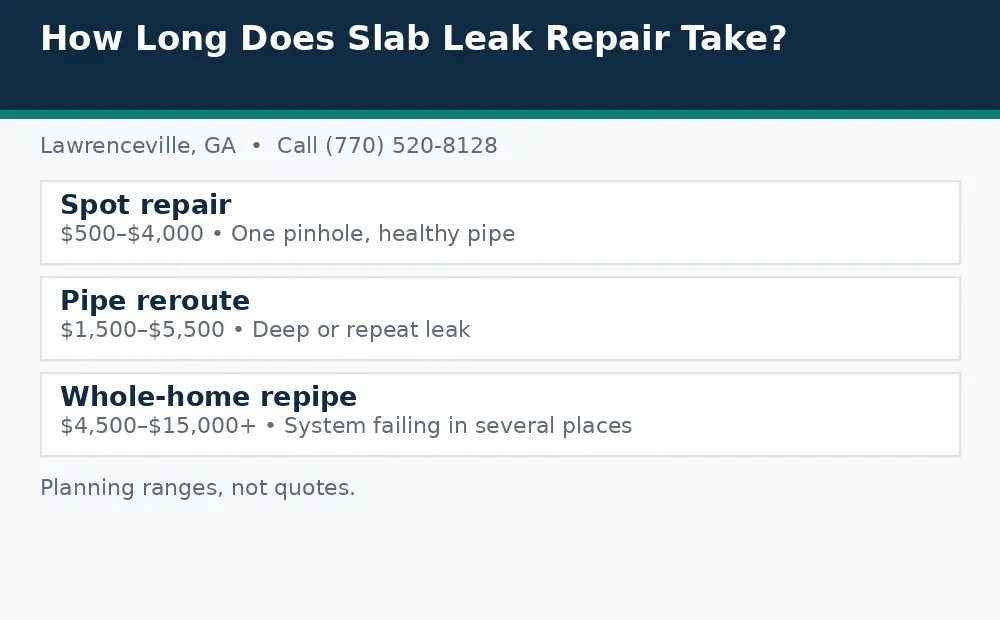
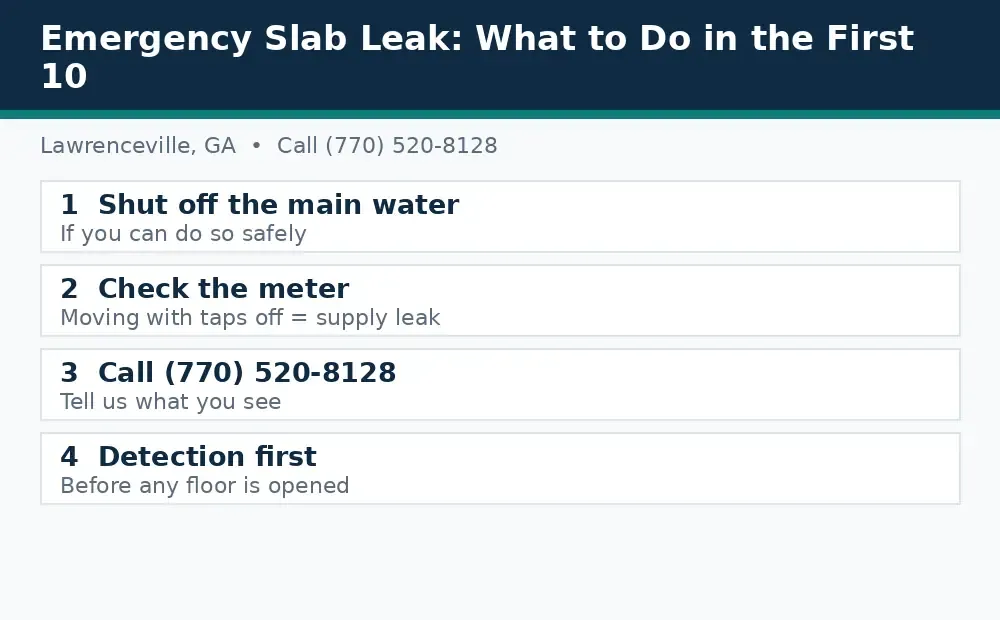
The images on this page are illustrative diagrams, not photos of a specific job at a specific address, and they are not presented as this business's own work. Call us at (770) 520-8128 if you are unsure what you are seeing.
The short answer: sometimes the pipe, rarely the damage
A home warranty is a service contract, not insurance. You pay a monthly or annual premium, and when a covered home system or appliance breaks down from normal wear and tear, the warranty company pays to repair or replace it, usually after a service fee. Homeowners insurance is different: it covers sudden and accidental damage to the home — the water damage a burst pipe causes, for example. A slab leak sits across both: the failed pipe is a system breakdown, which is warranty territory, while the ruined flooring and belongings are damage, which is usually insurance territory. That split is the whole answer in one sentence: a warranty can pay for the pipe, and it rarely pays for what the water did.
Whether it pays for the pipe depends on your contract, not on the leak. Home warranty contracts list the systems and components they cover, and they set limits — a dollar cap per term, a cap for work that needs concrete opened, and exclusions for things like damage from lack of maintenance or secondary damage. Two contracts from two companies can treat the same slab leak differently, and the same company's plans can differ by tier, state, and date. The homeowners insurance guide covers the insurance side, and the insurance claim process guide covers how a claim is documented. This guide covers the warranty side, and the first rule is the same on both: read your contract before you assume anything.
What home warranties usually cover — and where slab leaks sit
Most home warranty plumbing coverage is written around the lines inside the home: leaks and breaks in water, drain, gas, and vent lines, plus the fixtures and fittings connected to them. A slab leak is a leak in one of those lines — it just happens to be under concrete, which is why the contract's concrete-access wording matters more than the leak itself. American Home Shield lists slab leaks among the "Other Plumbing Components" on its published real-estate coverage page, as retrieved on 2026-11-07 — the leak itself is a covered plumbing item on that page. Its published plans page lists a $1,000 limit per agreement term for slab leaks, and allows up to $1,000 for access, diagnosis, repair or replacement of plumbing that is reachable only through a concrete floor, wall, or ceiling, including returning the opening to a rough finish.
Other companies draw the line differently. A November 2026 comparison of three sample contracts — American Home Shield, First American, and Choice Home Warranty — found First American excluding items in or under concrete on its Starter tier, then capping the work at $500 on Essential and $1,000 on Premium, while Choice set a single $500 access limit that also covers walls. Those are sample contracts, and your contract may differ by plan, state, and date — which is why the numbers here are a guide to what to look for, not a promise of what yours pays. The points to find in your own contract are: whether slab leaks are named as a covered item, the dollar limit for concrete access, the service fee per claim, and any exclusion for pre-existing conditions. The repair cost guide carries the published planning ranges for the work itself — detection $300-$600, spot repair $500-$4,000, lining $800-$3,000, reroute $1,500-$5,500, repipe $4,500-$15,000+ — so you can compare a warranty's limit against the scale of the job.
What a home warranty usually does not pay for
The consistent gap across warranty contracts is secondary damage — the harm the water does after it escapes. Warped flooring, ruined belongings, damp drywall, and mold are, in the contracts' own wording, secondary or consequential damage, and they are excluded. One comparison of three sample contracts put it plainly: all three pay for the line and refuse the water's aftermath. That is not a gap you can argue around; it is the product's design. The damage side is a homeowners insurance question, and the water damage cleanup guide covers what drying and restoration involve, while the mold and water damage guide covers the moisture and mold side.
Foundation and structural repair is also outside a standard home warranty — the slab, the foundation, and the walls are structural components, not systems, and warranty contracts exclude them. A slab leak that has washed soil from under the slab, or cracked flooring through settlement, raises a foundation question, and the slab leak versus foundation problem guide explains how to tell the two apart. Cosmetic finish beyond a rough finish is usually excluded too: a warranty may pay to return an opened floor to a rough finish and leave the tile, hardwood, or carpet to you — or to your insurance. Read the finishes and exclusions sections of your contract before you file, so the denial, if one comes, is not a surprise.
How a slab leak claim usually works
The claim starts with a phone call or an online filing, and with prompt reporting — contracts expect you to report a problem when you find it, not weeks later, and a delay can be used against the claim. You pay the service fee, and the warranty company usually assigns a contractor from its own network rather than the plumber you would choose yourself. That contractor confirms the problem, and the warranty company decides what it will pay based on the contract. What decides the claim is evidence, and that is where detection earns its keep: a detection report that locates the leak, identifies it as hot or cold, supply or drain, and records the meter and pressure results gives the warranty company — and your insurer — something concrete to decide on. The detection visit guide explains what a visit produces, and the detection methods guide explains the tests behind it.
If the claim is denied, ask for the reason in writing and check it against the contract wording yourself — denials sometimes rest on a clause that does not say what the denial letter implies, and sometimes they rest on one that does. A detection report also supports the other claim you may need to file: your homeowners insurance, which can cover the damage even when the warranty will not cover the pipe. The insurance claim process guide covers that documentation step by step. Do not let a running leak wait while paperwork moves: a supply leak runs 24 hours a day, and the water does not pause for a claim decision. If water is pooling or the meter is spinning fast, shut off the main if you can do so safely and call — the emergency guide covers the first steps in order.
What to do while the claim is pending
While the claim is open, run the meter test and keep the result: turn off every tap and appliance, including the ice maker and any irrigation, and watch the meter dial for 15 to 30 minutes. A moving dial is the simplest proof that water is being lost, and it costs nothing. The water meter leak test guide walks through the check, and the meter test post explains how to read it. Photograph everything — the wet patch, the flooring, the baseboards, the meter reading, the water heater area — with dates, and keep the water bills that show the jump. The shut-off guide shows where the valve usually sits in a Lawrenceville slab home, so you can stop the water fast if the leak worsens.
Detection first is the right order whatever the warranty decides, because the repair cannot be planned — or priced — until the break is located. The repair cost estimator gives a planning figure from the published ranges once detection has found the break, and the spot repair versus reroute versus repipe guide compares the routes. If the warranty pays, it pays against a located, documented leak; if it does not, you still have the report you need for your insurer and for the repair itself. Either way, the call is the same: describe the signs, say whether a warranty claim is open, and let detection turn a suspicion into a location.
What to tell us when you call
When you call, tell us whether a home warranty claim is open and which company holds it, what the contract says about slab leaks and concrete access if you know it, and what the meter did with everything off. Mention your ZIP code and which rooms are affected. That short list lets us plan detection around the claim as well as the leak.
Call (770) 520-8128 and describe your situation in plain words. We will talk through detection first, then a repair plan that fits your home.
Call Us Today
Fast local slab leak detection and repair in Lawrenceville, GA, ZIPs 30043–30046.
Call Now to Speak to a SpecialistFrequently asked questions
Does a home warranty cover slab leaks?
Often, but only the failed pipe — and only up to the contract's limits. Most home warranty plumbing coverage includes leaks and breaks in water and drain lines, and some companies name slab leaks as a covered item. The water damage the leak caused — warped floors, ruined belongings, mold — is usually excluded as secondary damage and belongs to a homeowners insurance claim. Read your contract before you file.
Does American Home Shield cover slab leaks?
On its published coverage pages, as retrieved on 2026-11-07, American Home Shield lists slab leaks among the covered “Other Plumbing Components,” and its published plans page lists a $1,000 limit per agreement term for slab leaks, including up to $1,000 for access through concrete. Plans, states, and dates vary, and the contract controls — check your own agreement for the slab-leak wording and the concrete-access limit.
Will a home warranty pay for the water damage from a slab leak?
Usually not. Warranty contracts pay to repair or replace the failed system — the pipe — and exclude the secondary or consequential damage the water causes: warped flooring, damaged belongings, damp drywall, and mold. That damage is a homeowners insurance question. File the warranty claim for the pipe and the insurance claim for the damage, and keep the detection report for both.
What if my warranty claim is denied?
Ask for the denial reason in writing, then check it against your contract's own wording — denials sometimes rest on a clause that does not say what the letter implies. A detection report that locates the leak and identifies it as hot or cold, supply or drain, supports an appeal and your homeowners insurance claim for the damage. Do not delay repair on a running leak while the paperwork moves.
Should I call a leak detection company before or after filing a warranty claim?
Detection first. The claim is decided on evidence, and a detection report — location, hot or cold, supply or drain, meter and pressure results — is the evidence the warranty company and your insurer need. Call, describe the signs, say whether a claim is open, and let detection turn a suspicion into a location before anyone talks about repair.