 Lawrenceville Slab Leak Detectors
Can You Hear a Slab Leak in Lawrenceville, GA?
Yes, you can often hear a slab leak in Lawrenceville as a hiss or rushing sound under the floor, clearest at night when the house is quiet. Near Sugarloaf in ZIP 30044, a sound that stops when the water main closes points to a pressurized supply line under the slab.
What this looks like in a Lawrenceville home
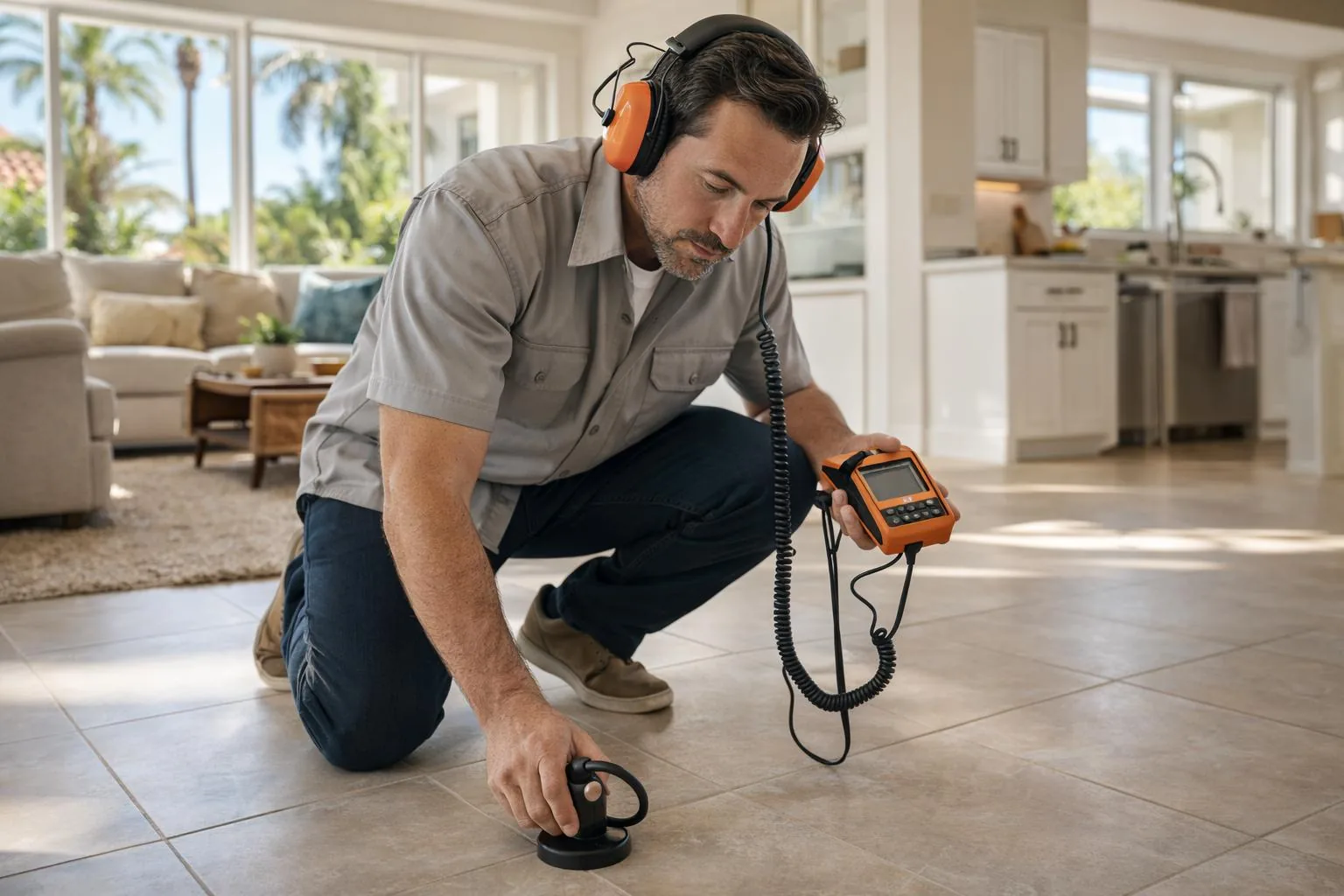
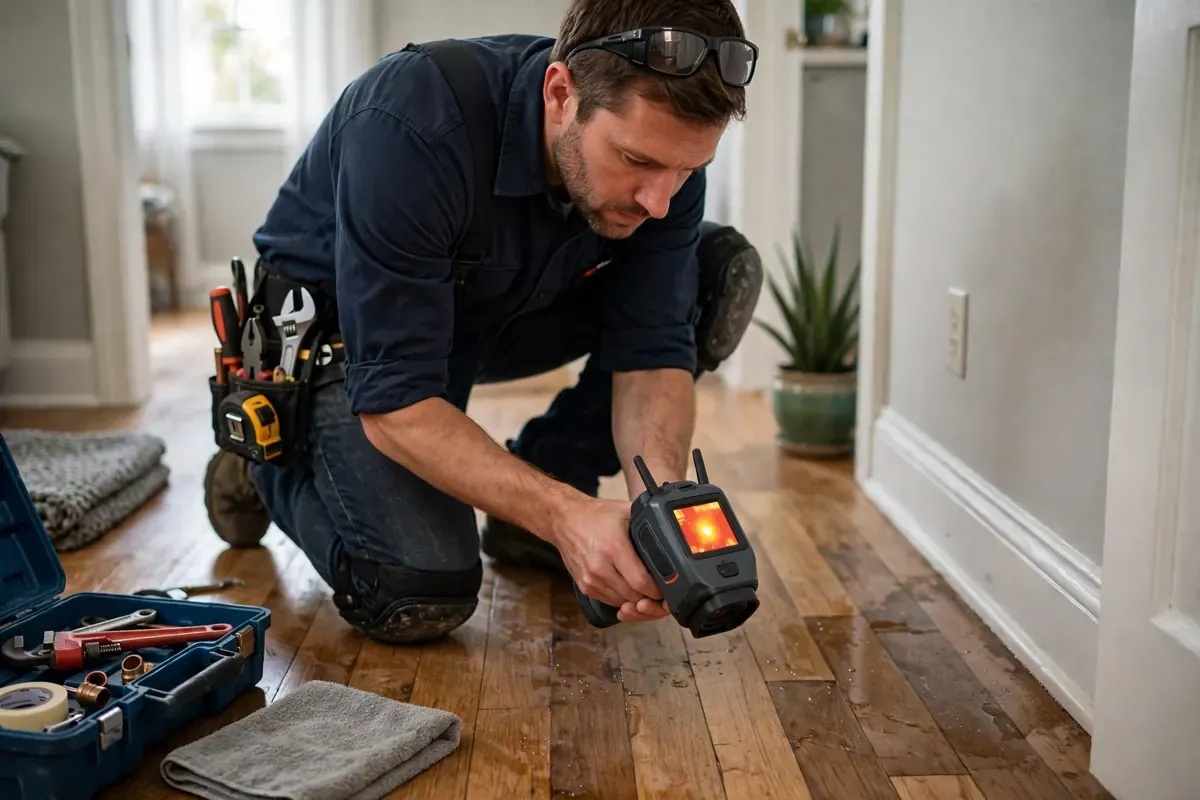
The images on this page are generic photos of leak detection equipment in use, not photos of this business's own work or of a specific home. Call us at (770) 520-8128 if you are unsure what you are seeing.
What a slab leak sounds like
A slab leak is a pressurized pipe losing water under concrete, and moving water makes noise. What you hear depends on the size of the break and whether the line carries hot or cold water. A small pinhole leak in a high-pressure line usually makes a steady hiss, like air escaping, or a faint whoosh that does not come and go. A larger break lets more water through, and that sounds like running water, or a hose running somewhere out of sight. A slow, steady drip can sound like a faucet dripping underground, a soft tap that repeats at the same pace. A hot-water leak sometimes adds a ticking or popping sound as the pipe expands and contracts with the heat, a rhythm that follows hot-water use rather than staying constant. The sound does not always sit directly over the leak. Water carries sound along the pipe, and concrete spreads it, so the loudest spot on the floor is only an approximate guide to where the break is, and the leak can be several feet away. Not every slab leak makes a sound you can hear. A very slow leak under a thick slab may be too quiet to reach your ear, and a drain-line leak is not pressurized at all, so it leaks silently and shows up as damp flooring instead. Silence, on its own, never rules a leak out, which is why the meter test matters even when the house sounds quiet. The signs guide puts sound in its place: a steady hiss with everything off is a medium-strength sign, worth checking alongside the meter, a warm floor spot, and the water bill. One sign on its own is a reason to test, not a diagnosis.
How to listen for a slab leak in your own home
Start by making the house as quiet as you can. Turn off the heating and cooling, the television, the dishwasher, and the washing machine, and wait until nobody is running water anywhere. Late at night or early in the morning is best, when the street is quiet and the house has settled. Kneel and press your ear close to the floor in the room where you think the sound is coming from, then move slowly across the room, listening for where the sound gets louder and where it fades. Tile carries sound better than carpet, so a hiss that is clear on a tiled kitchen floor may be muffled under carpet in a bedroom, which is why it helps to check hard floors first and then compare with the carpeted rooms. A drinking glass pressed against the floor works as a simple listening aid, and a mechanic's stethoscope from an auto-parts store does the same job with more reach: set the probe on a clean stretch of floor, hold still, and listen for a steady hiss rather than a single knock. Mark the loudest spot with painter's tape and note the time, because a sound that is there at midnight and gone by morning tells a different story from one that never stops. If the sound is loudest near a bathroom or the kitchen, say so when you call, but do not break the floor open at the loudest spot. The sound is a clue to where to start looking, not a map of the break, and opening concrete on the strength of an ear alone is how floors get opened in the wrong place. The slab leak symptom checker runs through the rest of the signs one by one, and the acoustic and thermal detection guide explains what professional listening equipment does with the same sound.
The shut-off test that confirms the sound
A sound you can hear is only useful once you know what is making it, and the shut-off test answers that in a minute. With the house quiet, listen until you have the sound fixed in your mind, then close the main water shut-off valve and listen again. If the sound stops the moment the main is closed, you are hearing pressurized water, and a slab leak is the first suspect when the sound was coming through the floor. If the sound keeps going with the main closed, it is not a supply-line leak: it may be a drain, a fan, a refrigerator, or water still moving somewhere downstream of the valve, and the search moves elsewhere. The shut-off guide shows where the main valve usually sits in a Lawrenceville home. The meter test is the stronger check, and it is the one to run next. Turn off every tap and appliance, watch the meter dial, and if it moves with nothing running, water is leaving the system somewhere. The water meter leak test guide walks through it step by step, and a moving dial plus a sound that stops with the main closed is a strong pair: two independent checks pointing at the same pressurized leak. If the dial holds still and the sound stops with the main closed, the leak may be on a line the meter does not cover, or the sound may be a fixture rather than a pipe, and that is worth saying when you call. If the dial moves but you hear nothing, the leak is still real: some leaks are simply too quiet to hear, and the meter is the check that catches them. Write down both results before you call, because they tell the technician whether detection should start with listening or with pressure and thermal checks.
Sounds that are not a slab leak
Not every noise under the floor is a slab leak, and the mimics are common enough to check first. Water hammer is the easiest to separate: it is a bang or a shudder that happens when a tap or an appliance valve closes suddenly, and it stops as fast as it starts. The water hammer guide covers it in full, including the pressure side of the problem. A toilet fill valve hisses for a minute after a flush, and a toilet with a worn flapper can hiss softly all night as the tank refills in small bursts; put your ear near the bathroom wall, and if the hiss follows a flush, it is the toilet, not the slab. A water heater refilling after use makes a running sound for a while, and pipes expanding as hot water runs through them tick and pop, then go quiet as they cool. A refrigerator ice maker and a dishwasher both run water on their own schedules, and a drain gurgling after a sink empties is air in the line, not a leak under concrete. The slab leak mimics guide runs through the full list of look-alikes. The pattern is what separates them: a slab leak sound is steady, it does not come in bursts, it keeps going with every tap closed, and it stops only when the main is closed. A sound that keeps time with a flush, a wash cycle, or a tap closing belongs to the fixture, not to the pipe under the slab. When two sounds overlap, which they often do in a real house, test them one at a time: shut off the toilet supply, wait, and listen again. Each test that clears a mimic leaves the leak as the likelier answer.
What acoustic detection does that your ear cannot
Your ear can tell you that something is leaking. It cannot tell you exactly where. Professional acoustic detection takes the same sound and turns it into a location. Ground microphones far more sensitive than a stethoscope are placed on the slab at several points, and the technician listens for where the hiss peaks: the loudest point is usually directly over the break, and the reading is checked from more than one direction before anything is marked. For a hot-water leak, thermal imaging adds a second read: the warm patch the leaking line leaves in the floor shows up on camera, and the two readings together are stronger than either alone. The detection methods guide covers the full set, including the meter test and tracer gas as a method a technician may use. Detection in Lawrenceville runs in the site's published planning range of $300–$600, with a written price following inspection, and the detection cost guide explains what the visit covers. Once the leak is found, the repair routes are spot repair, which opens the slab at the marked leak; a reroute, which abandons the old line and runs a new one through the walls or the attic; trenchless lining, which seals the pipe from the inside; and a whole-home repipe. The spot repair versus reroute versus repipe guide compares them, and the repair cost guide carries the published planning ranges: spot repair $500–$4,000, lining $800–$3,000, reroute $1,500–$5,500, and whole-home repipe $4,500–$15,000 or more. None of that work starts until detection has put a mark on the floor. In Lawrenceville, the ground under most slabs is red clay, which swells when wet and shrinks when dry, so a leak that runs for months does more than waste water: it keeps the ground moving under the slab. The Georgia red clay guide explains why that matters, and why a sound heard early is a smaller job than the same sound heard a year later.
What to tell us when you call
When you call, tell us where you heard the sound and on what kind of floor, whether it stops when the main is closed, what the meter dial did with every tap off, and whether any floor feels warm in the same spot, plus your ZIP code. That short list tells us whether we are listening for an active supply leak, a drain problem, or a mimic, and what the detection should show first.
Call (770) 520-8128 and describe the sound in plain words. We will talk through the shut-off test and the meter test first, then detection if the tests point that way.
Call Us Today
Fast local slab leak detection and repair in Lawrenceville, GA, ZIPs 30043–30046.
Call Now to Speak to a SpecialistFrequently asked questions
Can you hear a slab leak through concrete?
Often, yes. A pressurized line leaking under a concrete slab makes a steady hiss or rushing sound that travels through the concrete, and it is easiest to hear at night when the house is quiet, with your ear close to the floor. Tile carries the sound better than carpet. The loudest spot is only an approximate guide, because sound travels along the pipe, so the break can be several feet from where the sound is loudest.
What does a slab leak sound like?
A small pinhole leak usually sounds like a steady hiss, like air escaping, while a larger break sounds like running water, or a hose running out of sight. A slow drip can sound like a faucet dripping underground, and a hot-water leak sometimes adds a ticking sound as the pipe expands. The key is that the sound is steady, not in bursts, and it keeps going with every tap closed.
Can a slab leak be silent?
Yes. A very slow leak under a thick slab may be too quiet to reach your ear, and a drain-line leak is not pressurized, so it leaks silently and shows up as damp flooring instead. Silence never rules a leak out. If the water bill has jumped or the meter dial moves with nothing running, the leak is real whether or not you can hear it.
How do I tell a slab leak sound from water hammer or a toilet?
Water hammer is a bang that happens when a tap closes and stops at once, while a slab leak sound is steady and continuous. A toilet fill valve hisses for a minute after a flush. The test that separates them is the main shut-off: a slab leak sound stops the moment the main is closed, and a sound that keeps going belongs to something else. The meter test confirms it.
I hear running water with everything off. What should I do first?
Listen once more with the house quiet, then close the main shut-off valve and listen again. If the sound stops, run the meter test: turn off every tap and appliance and watch the dial. Write down what the sound was, where it was loudest, and what both tests showed, then call. Do not break the floor open at the loudest spot; detection comes first.