 Lawrenceville Slab Leak Detectors
Slab Leak in a Condo in Lawrenceville, GA: Who Pays?
A slab leak in a Lawrenceville condo is paid for by whoever owns the leaking pipe — the association for a shared main under the slab, the owner for a line serving one unit. In ZIPs 30043 and 30044, near Collins Hill, the declaration decides, and detection finds the pipe.
What this looks like in a Lawrenceville home
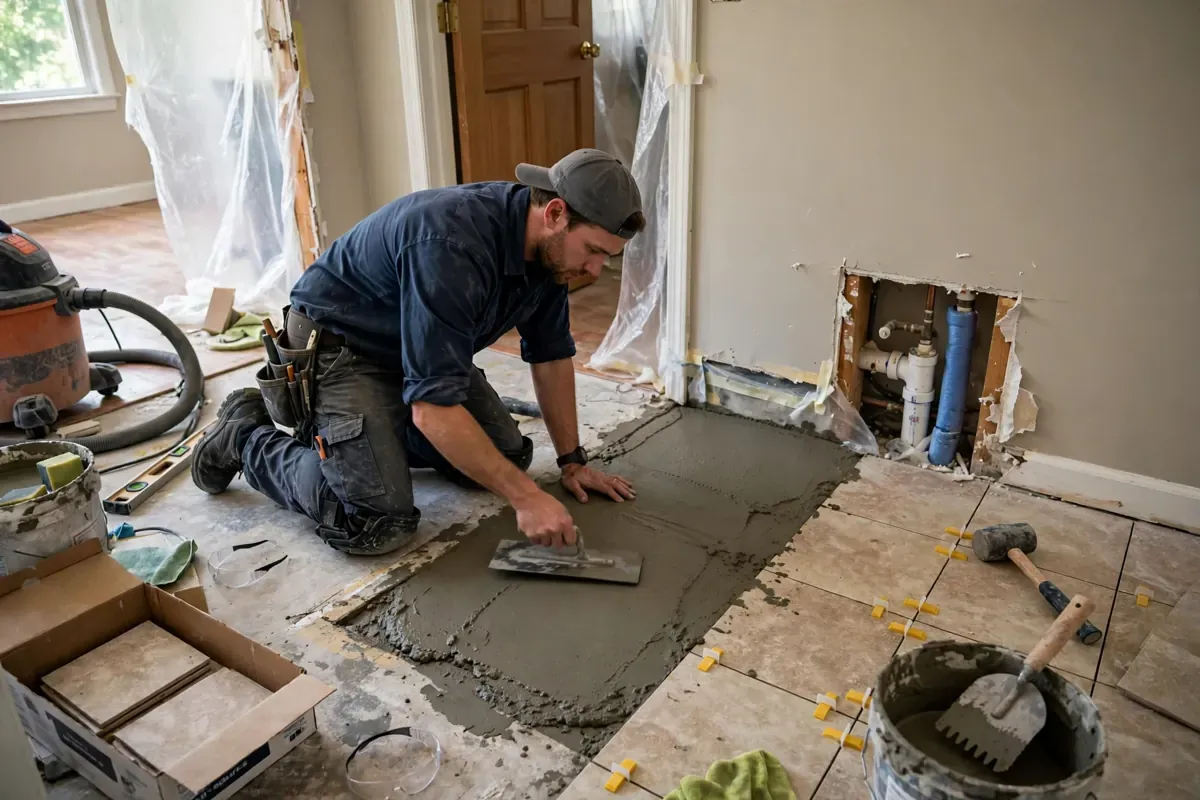
The images on this page are generic illustrations — a slab-and-pipe diagram and a floor-restoration photo — not photos of this business's own work or of a specific home. Call us at (770) 520-8128 if you are unsure what you are seeing.
The short answer: the pipe's owner pays — and the declaration says who that is
There is no single rule for who pays for a slab leak in a condo, and anyone who gives you one without asking three questions is guessing. The three questions are: where exactly is the leaking pipe, what does your condo's declaration say about that location, and what do the two insurance policies cover. A pipe that serves the whole building is usually the association's. A pipe that serves only your unit is usually yours — even when it runs under the slab, outside your walls. And the pipe repair and the water damage it caused can land on different parties, so the answer to "who fixes the pipe" and the answer to "who fixes my floor" are often different. The homeowners insurance guide covers how a slab leak is treated by a single-family policy; this guide is the condo version, where a second owner — the association — shares the building.
That is why detection comes before the argument. Until the leak is pinpointed to a specific pipe, nobody can say whose pipe it is, and the association and the owner can argue for weeks over a leak that detection would have placed in an afternoon. The water meter leak test guide walks through the meter check, and the detection methods guide maps each method to the question it answers. This page is general information about how the responsibility is usually divided in Georgia, not legal advice for your situation — the declaration for your building controls, and a Georgia attorney is the right call for a dispute.
The three buckets: common, unit-only, and the grey zone
Condo declarations typically divide a building into three categories, and the leaking pipe falls into one of them. The first is the common elements: the foundation, the slab, the exterior walls, the structural supports, and the shared systems — including a main water line or riser that feeds more than one unit. A pipe embedded in the foundation that feeds several units is almost certainly a common element, and the association is responsible for repairing it. The second is the unit: everything inside your boundaries, from the drywall inward, including the fixtures and any system that serves only your unit. A supply line that branches off the main and serves only your unit is typically yours, even though it sits under the slab outside your walls.
The third bucket is where most disputes live: the limited common elements. These are parts of the common area reserved for one unit's use — and a pipe that serves only your unit but runs through common area often lands here. Owners assume anything outside their unit belongs to the association; the association assumes anything serving one unit belongs to that owner. Both can be wrong, because the declaration draws the line, and declarations differ from building to building. Two identical leaks in two Lawrenceville condo buildings can land on different parties for no reason other than the wording of each building's documents. That is the single most important fact in this guide: the declaration decides, and nobody can answer the question without reading it.
What Georgia law actually says
Georgia condominiums are governed by the Georgia Condominium Act, O.C.G.A. Section 44-3-70 and the sections that follow it, and the Act sets the defaults that a declaration can then shift. Section 44-3-105, on upkeep, provides the basic split: except as the condominium instruments otherwise provide, maintenance, repair, renovation, restoration and replacement of the common elements — other than limited common elements — belong to the association, and the same duties for a unit and its appurtenant limited common elements belong to the individual unit owner. In plain terms, the association looks after what is shared, and the owner looks after what is theirs, unless the declaration says otherwise.
Section 44-3-107(a) requires the association to maintain insurance for the common and structural elements against fire and extended coverage perils. Water damage is not among the perils the Act requires the association to insure against — so an association is not automatically carrying water-damage cover, and many do buy it voluntarily, which is why the master policy itself has to be checked rather than assumed. Section 44-3-94 deals with damage and restoration, and it allows the association to allocate a reasonable insurance deductible between the association and the affected unit owners, up to $2,500 per casualty loss covered by insurance the association is required to maintain. The numbers in this section come from the Act as reported in Georgia legal writing on condo water damage; they are the framework, not a verdict on your building. If your declaration is vague, the association's board typically interprets it, sometimes with the association's attorney — and if you disagree with that reading, a Georgia attorney is the next step, not a second argument with the board.
Fixing the pipe is one bill; repairing the damage is another
Here is the distinction that catches most condo owners off guard: the party responsible for fixing the pipe is not always the party responsible for repairing the damage the leak caused inside your unit. Even when the association is obligated to fix a leaking common-area pipe, the water damage to your flooring, cabinets, and drywall is typically your responsibility to repair. Your unit's interior, from the walls in, is your domain regardless of where the water came from. The pattern plays out the same way again and again: the association fixes the pipe and walks away, leaving the owner with the floor and wall damage — and the declaration almost always supports that outcome, because it assigns interior maintenance to the unit owner regardless of fault.
Two insurance policies come into play, and neither one changes who is responsible for ordering the repair — they determine who pays. The association's master policy covers the common elements and the structure; your individual condo policy, called an HO-6, covers your unit's interior, your belongings, and usually the gap between what the master policy covers and what your unit needs. The insurance claim process guide walks through documenting a claim, and the denied claim guide covers what to do when a claim is refused. Keep every receipt and photograph, and keep the detection report: it is the document that says which pipe leaked, and that is the fact the whole argument turns on. A leak left running while the argument goes on also feeds mold and water damage, and the longer it runs, the larger the interior bill that lands on the owner.
What to do, step by step, when you suspect a slab leak in your condo
First, confirm the loss. Do the meter test: turn off every tap and appliance in your unit and watch your meter — if your building has an individual meter per unit. Some condo buildings share one meter for the whole building, and then the test cannot isolate your unit; ask the association whether your unit has its own meter before you draw a conclusion from it. The meter test post explains how to read the result. Second, shut off your unit's water at your unit shut-off valve and check whether the signs stop: a warm spot cooling, the sound of running water going quiet, the meter settling. The shut-off valve guide shows where to look.
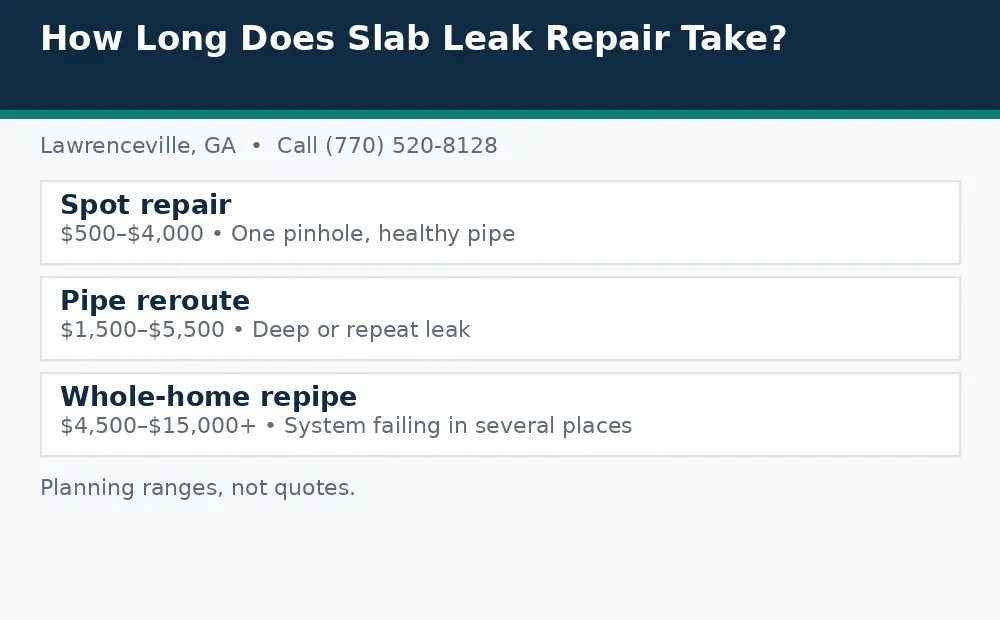
Third, tell the association in writing the same day — an email or a message through the association's portal, with photographs and the date, so there is a record of when you reported it. Do not wait for the next board meeting: a leak under a slab does not pause for a meeting, and delay is the one thing both sides can blame on you. Fourth, get detection done. Acoustic listening and thermal imaging pinpoint the leaking pipe without opening the floor, and the detection report is the fact the declaration is applied to — it says which pipe, serving which units, in which part of the building. Commercial detection covers multi-unit buildings, and the detection methods guide explains the sequence. Fifth, keep the paper trail: the meter readings, the photographs, the association's reply, the detection report, and every receipt. Whatever the declaration says about who pays, the repair routes are the same — detection $300-$600, spot repair $500-$4,000, lining $800-$3,000, reroute $1,500-$5,500, and whole-home repipe $4,500-$15,000 or more, all published planning ranges only — and the concrete and floor restoration service page covers putting the surface back after a repair.
What to tell us when you call
When you call, tell us it is a condo or townhome, which floor you are on, whether your unit has its own water meter, what the association has said so far, and your ZIP code. That short list tells us whose pipe we are likely looking for, and what the detection report will need to show.
Call (770) 520-8128 and describe your situation in plain words. We will talk through detection first, then a repair plan that fits your home.
Call Us Today
Fast local slab leak detection and repair in Lawrenceville, GA, ZIPs 30043–30046.
Call Now to Speak to a SpecialistFrequently asked questions
Who pays for a slab leak in a condo?
Whoever owns the leaking pipe pays, and the condo's declaration says who that is. A pipe that serves the whole building, such as a shared main under the slab, is usually a common element and the association's responsibility. A line that serves only your unit is usually yours, even under the slab. Detection has to find the pipe first, because the pipe's location is the fact the declaration is applied to.
Does the HOA have to fix a slab leak under my unit?
Only if the leaking pipe is a common element. A main or riser feeding several units is almost certainly the association's. A branch line serving only your unit is typically yours, even though it runs under the slab outside your walls. Lines in the grey zone — serving one unit but running through common area — depend on the declaration's exact wording, which differs from building to building.
If the HOA fixes the pipe, does it repair my floors too?
Usually not. The party that fixes the pipe is not always the party that repairs the damage inside your unit. Your unit's interior — flooring, cabinets, drywall — is typically your responsibility regardless of where the water came from, and the declaration almost always supports that outcome. Your HO-6 condo policy is the cover for the interior; the association's master policy covers the common elements and the structure.
Does condo insurance cover a slab leak?
Two policies come into play: the association's master policy and your individual HO-6 condo policy. Under the Georgia Condominium Act, O.C.G.A. Section 44-3-107(a), the association must insure the common and structural elements for fire and extended coverage — water damage is not among the required perils, though many associations buy water cover voluntarily. Check the master policy and your HO-6 rather than assuming either covers the loss.
What should I do first when I suspect a slab leak in my condo?
Do the meter test if your unit has its own meter, shut off your unit's water, and tell the association in writing the same day, with photographs and the date. Do not wait for the next board meeting. Then get detection done: acoustic listening and thermal imaging pinpoint the leaking pipe without opening the floor, and the detection report is the document that says which pipe leaked — the fact the whole responsibility question turns on.