 Lawrenceville Slab Leak Detectors
Slab Leak Insurance Claim Denied in Lawrenceville, GA?
A denied slab leak insurance claim in Lawrenceville, GA, is not the end of the claim — it is the insurer's first answer. Read the denial letter, gather dated photos, meter readings, and a detection report, then appeal in writing from ZIPs 30043 to 30046, Downtown to Collins Hill.
What this looks like in a Lawrenceville home
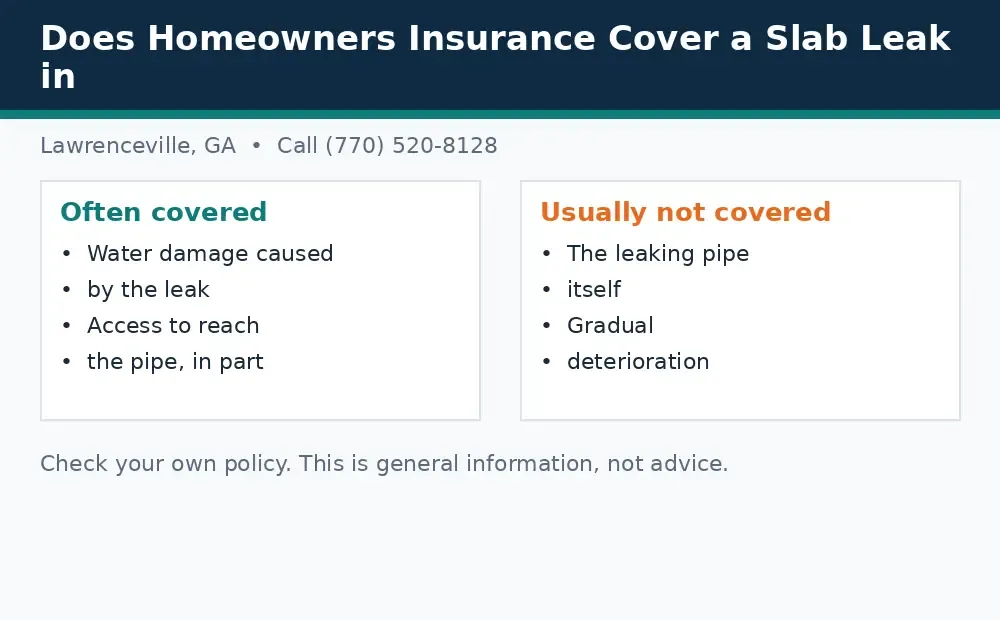
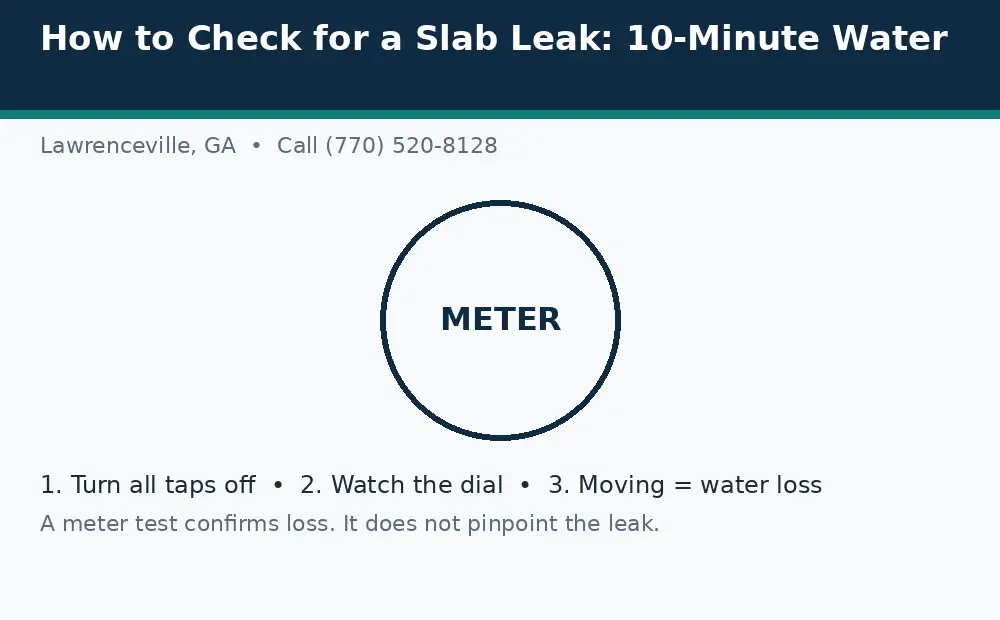
The images on this page are illustrative diagrams, not photos of a specific job at a specific address, and they are not presented as this business's own work. Call us at (770) 520-8128 if you are unsure what you are seeing.
The short answer: a denial is a starting position, not a verdict
A denied slab leak insurance claim is not the end of the claim. It is the insurer's first answer, and that answer is often based on the file as it stood when the adjuster reviewed it — which may be thin, incomplete, or missing the one document that changes the picture. Denials are more common than most homeowners expect, and many of them turn on documentation rather than on whether the damage is real. The single biggest lever in an appeal is evidence the adjuster cannot wave away: dated photographs, meter readings, water bills that show the jump, and a detection report that locates the leak and describes it in plain terms. The homeowners insurance guide explains what insurance usually does and does not cover, and the insurance claim process guide covers how a claim is documented from the start.
None of this is legal advice, and nothing here promises a different outcome. Whether a claim is covered depends on your policy, not on this guide. What this guide does is walk through the steps homeowners take after a denial, in order, so you can decide what to do next with a clear head instead of accepting the first letter as final. Do not let a running leak wait while the paperwork moves: a supply leak runs 24 hours a day. Fix the leak first, keep the evidence, and handle the claim on a dry floor.
Why slab leak claims get denied
Most denials cite one of a handful of reasons, and knowing which one yours cites is the whole point of reading the letter carefully. The most common reason for a slab leak is the gradual-versus-sudden distinction: insurance generally covers sudden and accidental damage, while a slow, long-running leak is often treated as a maintenance issue. A pinhole leak that wept for months before anyone noticed it is an easy target for that argument, even when the damage it caused appeared suddenly. A second common reason is wear and tear or corrosion: the insurer argues the pipe failed because it was old and worn, not because of a covered event. A third is that the pipe itself is not covered — many policies cover the water damage a leak causes but not the cost of repairing or replacing the failed pipe. A fourth is the deductible: if the repair cost is below your deductible, there is nothing left for insurance to pay, and the claim is denied on the numbers alone.
Other denials are about timing and paperwork rather than the leak itself. A claim reported long after the damage appeared can be denied for late reporting, and a claim with thin documentation — no photos, no meter readings, no detection report — gives the adjuster little to work with. Sometimes the denial is about scope: the insurer accepts part of the damage and denies the rest. Each of these is a different problem with a different answer, which is why the first step is always to find out exactly which reason your letter gives, rather than guessing.
Step one: read the denial letter line by line
Start with the letter itself. An insurer that denies a claim usually has to tell you why in writing, and that reason is your roadmap. Look for the exact exclusion or policy language the letter cites, and the specific facts it relies on — "gradual leak", "wear and tear", "below deductible", "reported late". Write down the reason in your own words, and check it against what you know: when did you first notice the damage, what did the meter do, what did detection find. If the letter says the leak was gradual and your detection report shows a sudden break, that gap is the core of your appeal. If the letter says the damage is below your deductible, check the numbers against the published planning ranges — detection $300-$600, spot repair $500-$4,000, lining $800-$3,000, reroute $1,500-$5,500, repipe $4,500-$15,000+ — and against the itemised estimate for your home.
Check the letter for deadlines as well. Check your policy or the denial letter for any appeal deadline, because timelines vary and missing one can leave you with little recourse. Keep the letter itself — it is the document everything else refers back to. If anything in the letter is unclear, call your agent or the claims department and ask for the specific policy language and the specific facts behind the decision, in writing. A phone call alone is not a record; ask for the answer in writing, and keep a log of every call, with the date, the name of the person you spoke to, and what they said.
Step two: build the file the insurer did not have
Most appeals that succeed do so on documentation, not on argument. Build the file the adjuster did not have when the denial was written. Dated photographs and video of the damage, from several angles, taken before any repair begins, are the foundation — photograph the cracks, the flooring, the baseboards, the damp patches, and the meter, with dates. Keep the water bills that show the jump, and record the meter reading with everything off: turn off every tap and appliance and watch the dial for 15 to 30 minutes. The water meter leak test guide walks through the check, and the meter test post explains how to read the result.
The document that carries the most weight is a detection report that locates the leak and describes it: where the break is, whether it is hot or cold, supply or drain, and what the meter and pressure results showed. A report that identifies a sudden break in a supply line under the slab is a different file from a report that finds a slow drain seep — and the difference is exactly what a denial about "gradual" damage turns on. Add an itemised estimate for the repair and the restoration, so the insurer is looking at the same job you are. Keep every receipt, every invoice, and a log of every call and letter, with dates. If the leak has already been repaired, the photographs and the detection report still matter — they are the record of what was there before the floor was opened.
Step three: put the appeal in writing
Call your adjuster, but do not stop there — insurers respond to paper. A written appeal should reference your policy and claim numbers, quote the specific denial reason, and answer it point by point, attaching your evidence as numbered exhibits: the photographs, the meter readings, the bills, the detection report, the itemised estimate. State plainly what you are asking for — reconsideration, a re-inspection, or a specific payment — and ask for a written response. Keep a copy of everything you send. If the insurer offers a re-inspection, take it, and be present for it with your file in hand; a second look with the evidence on the table is a different conversation from the first one.
If the appeal stalls, you have further options, and they are worth knowing about before you need them. Many policies include an appraisal clause that lets each side hire an independent appraiser, with a neutral umpire settling disagreements over the amount of damage and the cost of repair — appraisal generally addresses the amount, not whether the damage is covered at all. You can also file a complaint with your state's department of insurance, which triggers a review of how the claim was handled. A licensed public adjuster works on your behalf, not the insurer's, and can help negotiate the claim — consider one when the amount is significant or the claim has already been denied once. None of these steps guarantees a different result: read your policy first, and ask your agent what it actually says.
The deductible question: when you pay out of pocket anyway
One denial reason deserves its own section, because it is not really a dispute at all: the deductible. Your deductible is the amount you pay before coverage starts, and if the repair costs less than your deductible, there is nothing left for insurance to pay. That is a numbers question, not a coverage question, and the way to answer it is to compare the real cost of the job against your deductible. The published planning ranges are detection $300-$600, spot repair $500-$4,000, lining $800-$3,000, reroute $1,500-$5,500, repipe $4,500-$15,000+ — the repair cost estimator gives a planning figure from those ranges once detection has found the break. A small spot repair may sit below a high deductible, while a reroute or a repipe almost certainly does not. The spot repair versus reroute versus repipe guide compares the routes, and the questions before approving a repair guide lists what to ask before any work starts.
Even when the numbers say insurance will not pay, the detection report is still worth having, because it is the document that proves what the problem was and what it cost to fix. And if the denial was about the pipe itself rather than the damage, remember the distinction: many policies cover the water damage a leak causes, such as drying and flooring, but not the pipe repair. An appeal that asks for the pipe to be covered when the policy excludes it will not move, while an appeal that asks for the damage the pipe caused may. Read the policy, read the letter, and appeal the part that is actually in dispute.
What to tell us when you call
When you call, tell us what the denial letter said — the exact reason, in the letter's words — and what detection has already found, if anything. Mention your ZIP code, whether the leak is still running, and whether any repair work has already started. That short list lets us plan detection around your claim file, not around a guess.
Call (770) 520-8128 and describe your situation in plain words. We will talk through detection first, then a repair plan that fits your home.
Call Us Today
Fast local slab leak detection and repair in Lawrenceville, GA, ZIPs 30043–30046.
Call Now to Speak to a SpecialistFrequently asked questions
Can I appeal a denied slab leak insurance claim?
Yes. Start by reading the denial letter for the exact reason and the policy language it cites, then gather the evidence the adjuster did not have — dated photos, meter readings, water bills, a detection report, and an itemised estimate — and put the appeal in writing, referencing your policy and claim numbers and asking for reconsideration, a re-inspection, or a specific payment. Check the letter or your policy for any appeal deadline, because timelines vary.
Why do insurers deny slab leak claims?
The most common reasons are that the leak is treated as gradual rather than sudden, that the pipe failed from wear and tear or corrosion, that the pipe itself is not covered even though the water damage is, that the repair cost is below the deductible, that the claim was reported late, or that the documentation was thin. Each reason has a different answer, which is why the first step is always to find out which reason your letter gives.
What evidence helps overturn a denied slab leak claim?
Dated photographs and video of the damage from several angles, water bills showing the jump, meter readings proving water was lost with everything off, and a detection report that locates the leak and describes it — where the break is, hot or cold, supply or drain — plus an itemised estimate for the repair and restoration. Appeals usually succeed on documentation, not on argument, so build the file before you write the appeal.
Does a denied claim mean I pay for everything myself?
Not necessarily. A denial may cover only part of the claim — for example, the insurer may pay for drying but not for flooring, or for the water damage but not the pipe. And if the denial is about the deductible, it is a numbers question: compare the cost of the job against your deductible, using the published planning ranges. A small spot repair may sit below a high deductible, while a reroute or a repipe almost certainly does not.
Can a leak detection report help with an insurance appeal?
Yes — it is often the document that carries the most weight. A detection report locates the break and describes it in plain terms: where it is, whether it is hot or cold, supply or drain, and what the meter and pressure results showed. That description is exactly what a denial about gradual damage turns on, because a report showing a sudden break in a supply line is a different file from one showing a slow drain seep.