 Lawrenceville Slab Leak Detectors
Can Tree Roots Cause a Slab Leak in Lawrenceville, GA?
Tree roots can help cause a slab leak in Lawrenceville, GA, but rarely by breaking a sound pipe. In ZIP 30044, near Sugarloaf, the real damage is indirect: thirsty roots dry out Georgia red clay, the ground settles unevenly, and the joints under the slab take the strain.
What this looks like in a Lawrenceville home
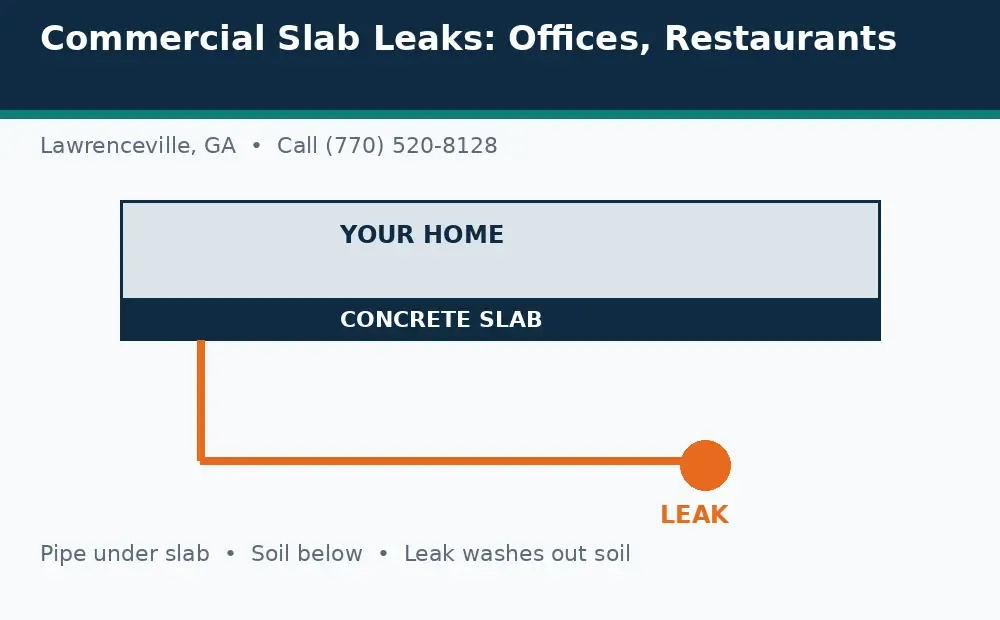
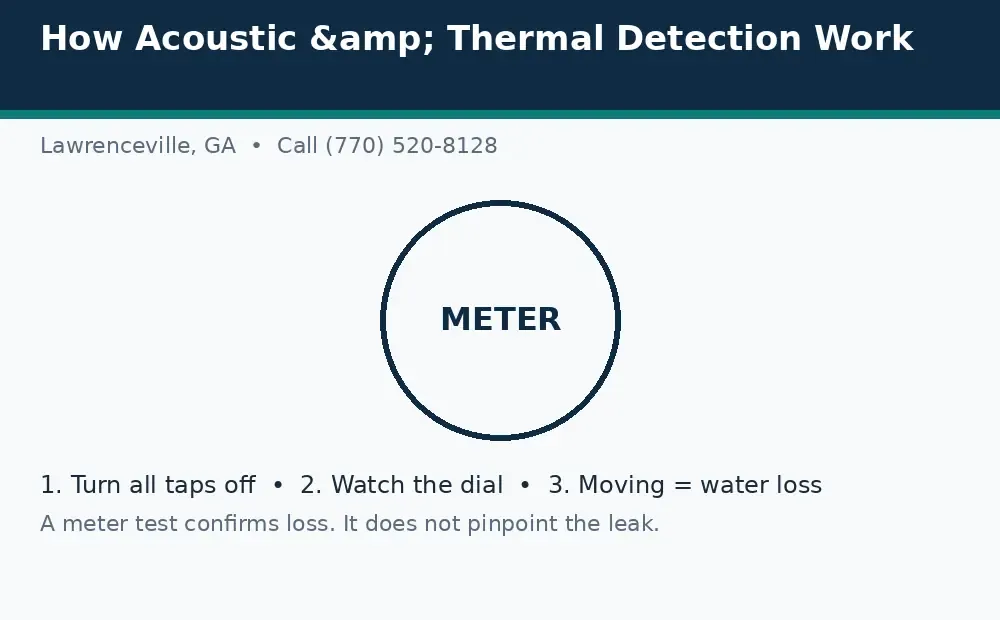
The images on this page are generic diagrams — a house on a slab with a pipe underneath, and a water meter leak test — not photos of this business's own work or of a specific home. Call us at (770) 520-8128 if you are unsure what you are seeing.
The short answer: roots rarely break a sound pipe — but they do move the ground
A big tree near the house gets blamed for a lot of pipe trouble, and the truth is narrower than the reputation. A healthy root does not punch through a sound pressurized water pipe under a slab. Copper and PEX under concrete are hard, smooth, and under pressure, and a root tip cannot force its way through them. What roots do, and what matters in Lawrenceville, is move the ground the pipe sits in. A mature tree drinks a lot of water, and it drinks it from one side of the house — the side the tree stands on. When that water leaves the soil, the soil shrinks, and the slab above it settles a little on that side. A slab that settles unevenly pulls at the joints where pipes enter and leave it, and a joint that was already tight can start to weep. That is the first mechanism, and it is the one that matters most for supply lines. The Georgia red clay guide explains why this hits Lawrenceville harder than most places: red clay swells when it is wet and shrinks when it dries, so a thirsty tree on one side of a house can open a moisture gap between the wet side and the dry side, and the slab rides that gap. The second mechanism is different, and it belongs to the drain side, not the supply side. A sewer or drain line under a slab is not pressurized, and its joints can loosen with age. A fine root hair follows moisture to a joint that is already leaking a little, slips inside, and then thickens into a mat that blocks the line and widens the opening. The root did not make the crack — it found it, fed on it, and made it worse. The sewer leak versus supply leak guide explains how the two kinds of leak behave differently, and that difference is the key to reading the signs below.
Which trees, and how close, actually matter
Distance matters more than species. A small ornamental tree planted ten feet from the foundation is not the same risk as a mature oak or pine standing close enough that its canopy hangs over the roof. The roots of a large tree spread at least as far as its branches reach, and often further, so a tree whose branches overhang the house has roots under the house. That is the first thing to check: stand at the trunk, look up at the canopy, and picture the same shape underground. The second thing is the soil. Lawrenceville's red clay is the amplifier. In sandy soil a tree drinks and the ground barely moves; in clay the same tree dries a pocket of soil that shrinks and pulls away from the slab, and the next wet spell swells it back. That cycle, repeated over dry summers and wet winters, is what stresses pipe joints over years. The what causes slab leaks guide lists soil movement alongside corrosion and age, and roots are one of the forces behind that movement. The third thing is the age of the plumbing. A new PEX system with tight joints can ride out a season of soil movement; an older copper system, or a drain line with joints that have already loosened, has less give. The older-homes guide covers the materials that fail first. None of this means every large tree is a problem. Plenty of Lawrenceville homes in ZIPs 30043 to 30046 have big trees and sound pipes. The risk is the combination: a large tree, close to the house, on clay soil, with older pipe joints underneath. One of those alone is a note; all four together is a reason to test.
The signs that point toward a tree
A slab leak caused or helped by roots does not announce itself as a tree problem. It shows up as the usual slab-leak signs, plus a few details that point outside. Start with the usual cluster, the same one in the signs guide: a warm patch on the floor over a hot-water line, a water bill that jumped with no change in the household, the sound of running water when every tap is off, damp flooring, or a musty smell near a baseboard. Any one of those is weak evidence on its own, and two or three together are a reason to test. Then look for the tree details. Cracks in a wall or floor that run toward the side of the house where the big tree stands, rather than spreading evenly, point to one-sided settling. A door or window on the tree side that sticks in the dry season and frees up in the wet season points the same way. A slab, driveway, or patio that has lifted in a hump near a tree is a root pushing up from below, which is a different problem from a leak but the same tree, and worth noting. On the drain side, the signs are different: a drain that slows again a few weeks after it was cleared, gurgling when the washing machine drains, or a sewer smell that appears after showers or laundry all point to a drain line, and the sewer smell guide explains how to read those. A lush green strip of lawn above a buried line, or a wet patch that stays green through a dry spell, can mean water is feeding the grass — and the roots — from below. The yard leak guide covers those outdoor signs. No single sign proves roots. The pattern that matters is slab-leak signs plus a large tree on the same side of the house, with the signs tracking the dry season.
What detection shows — and what it cannot
Detection answers a narrower question than homeowners expect: it finds the leak, not the tree. Start with the meter test, because it costs nothing and it separates the two kinds of leak in minutes. Turn off every tap and appliance, watch the meter, and if the dial moves, water is leaving a pressurized supply line somewhere. The water meter leak test guide walks through the check step by step, and the slab leak symptom checker runs through the signs one by one. If the meter is still, the leak is not on a supply line, and the next step is a camera inspection of the drain and sewer lines — the sewer camera guide explains what the camera can and cannot see, and a root mat inside a cracked joint is one of the clearest things it shows. For a supply leak, acoustic listening follows the sound of escaping water through the slab, and thermal imaging looks for the warm patch a hot-water leak leaves behind; the acoustic and thermal detection guide explains both. What none of these tests can do is prove a tree caused the leak. Detection can show that the leak sits on the tree side of the house, at a joint, under soil that has dried and settled — and that is as close as anyone gets to a cause. A root found inside a sewer line is direct evidence on the drain side; on the supply side, the evidence is circumstantial, and an honest report says so. That matters because the fix for a supply leak is a repair to the pipe, not a war on the tree, and a report that claims certainty about the tree is overselling what the tools can show.
What to do about the tree — and the repair routes
Do not cut a tree down on a guess. A mature tree is worth more standing than the price of a repair, and cutting it can make the ground swell back unevenly, which stresses the slab again in the other direction. The right order is detection first, tree decisions second. If detection finds a supply-line leak, the repair routes are the ones in the comparison guide: a spot repair opens the slab at the marked leak and replaces the damaged section, a reroute abandons the old line and runs a new one through the walls or the attic, trenchless lining seals the pipe from the inside, and a whole-home repipe replaces the system overhead. The spot repair versus reroute versus repipe guide compares them, and the repair cost guide carries the published planning ranges: detection $300–$600, spot repair $500–$4,000, lining $800–$3,000, reroute $1,500–$5,500, and whole-home repipe $4,500–$15,000 or more, with a written price following inspection. If the camera finds a root mat in a sewer or drain line, the line is cleared and the joint is repaired or lined, and the tree question goes to an arborist, not a plumber — an arborist can say whether a root barrier, selective root pruning, or removal is right for that tree, and a landscaper can advise on planting distance for anything new. The prevention guide covers the habits that help either way: steady watering around the slab in dry spells so the clay does not shrink on one side, a yearly pressure check, and noting any new cracks with a date and a photo. If you are weighing a repair, the questions before approving a repair guide lists what to ask before anyone opens a floor. After the repair, the concrete and the floor need putting back, and the concrete and floor restoration page covers what that looks like.
What to tell us when you call
When you call, tell us where the big trees stand relative to the house, which signs you have seen and when they started, whether the meter moves with every tap off, and whether drains slow down or smell after showers or laundry, plus your ZIP code. That short list tells us whether we are looking at a supply line, a drain line, or both, and what the detection should show first.
Call (770) 520-8128 and describe what you are seeing in plain words. We will talk through the meter test first, then detection if the test points that way.
Call Us Today
Fast local slab leak detection and repair in Lawrenceville, GA, ZIPs 30043–30046.
Call Now to Speak to a SpecialistFrequently asked questions
Can tree roots cause a slab leak?
Yes, but usually indirectly. A healthy root rarely punches through a sound pressurized water pipe. The real damage is that thirsty roots dry out the clay soil on one side of the house, the ground settles unevenly, and the joints under the slab take the strain. On the drain side, roots exploit a joint that is already cracked or loose, grow inside it, and block and widen the opening.
Can tree roots break a water pipe under a slab?
Almost never on their own. Copper and PEX under concrete are hard and smooth, and a root tip cannot force its way through a sound pipe. Roots break pipes by moving the ground: drying out clay soil so it shrinks and settles, or pushing against a pipe that is already weakened. If a pipe fails near a tree, the cause is usually the soil movement, not the root touching the pipe.
Which trees are the worst for slab leaks in Lawrenceville?
Distance matters more than species. Any large, mature tree planted close to the house is a bigger risk than a small ornamental one further away, because its roots spread at least as far as its branches reach. Large oaks and pines are the common examples around Lawrenceville. The risk is the combination: a big tree, close to the house, on red clay, with older pipe joints underneath.
How do I know if roots caused my slab leak?
You cannot prove it from the signs alone. Look for the pattern: slab-leak signs plus a large tree on the same side of the house, cracks that run toward the tree, and signs that track the dry season. Detection can show the leak sits on the tree side at a joint, and a camera can show a root mat inside a sewer line. On the supply side, that is as close as anyone gets to a cause.
Should I cut down a tree near my house to stop slab leaks?
Not on a guess. Get detection first: find the leak, fix the pipe, and then ask an arborist about the tree. Cutting a mature tree can make the ground swell back unevenly and stress the slab again in the other direction. An arborist can advise on a root barrier, selective root pruning, or removal for that specific tree, and on planting distance for anything new.