 Lawrenceville Slab Leak Detectors
Void Under Slab After a Slab Leak in Lawrenceville, GA
A void under the slab after a slab leak is the space left where water washed soil from under the concrete. In Lawrenceville, near Sugarloaf in ZIP 30044, a hollow-sounding floor or a dipping tile is the clue — and the leak must be fixed before the void is filled.
What this looks like in a Lawrenceville home
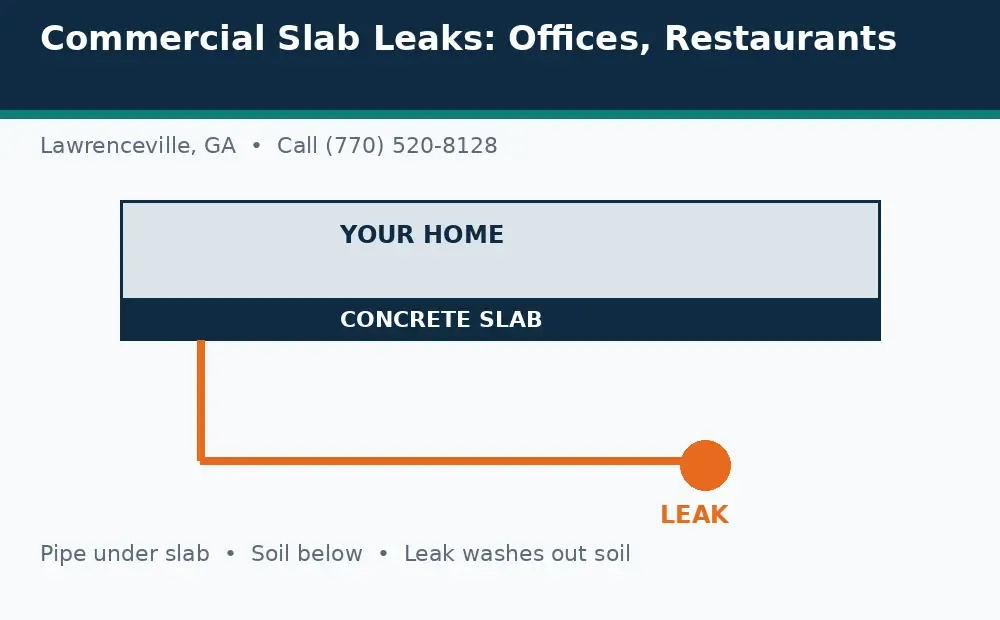
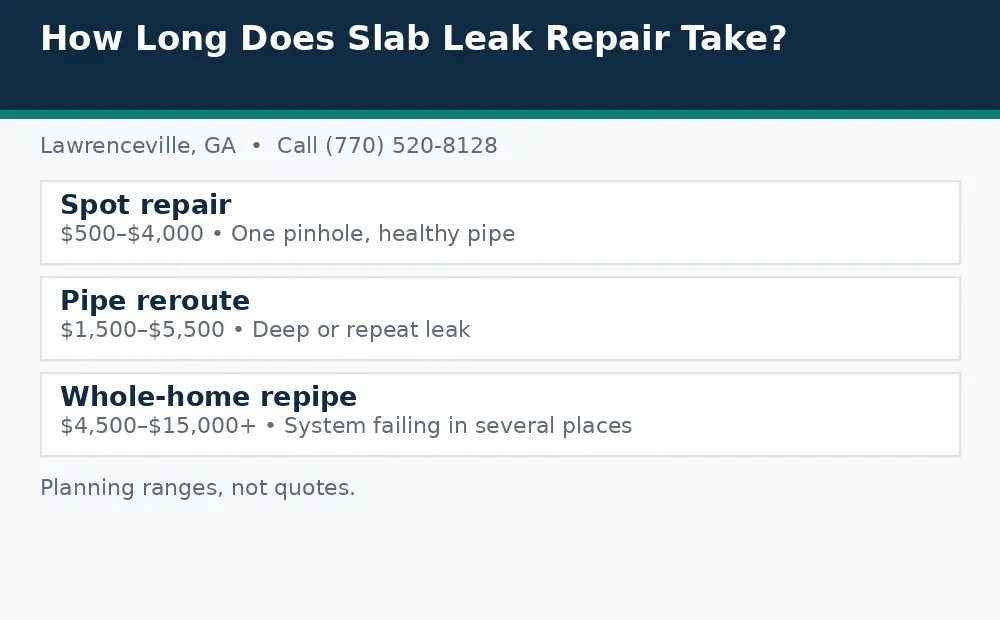
The images on this page are generic diagrams — a house on a slab with a pipe underneath, and slab leak repair options — not photos of this business's own work or of a specific home. Call us at (770) 520-8128 if you are unsure what you are seeing.
What a void under the slab actually is
A void under the slab is an empty space where the soil that used to support the concrete is gone. It forms when water from a leaking pipe under the slab carries the fine soil particles away, a little at a time, until there is a cavity under the concrete where solid ground used to be. Concrete is stiff, so it bridges a small void, which is why a void can sit under a floor for months without any visible sign. In Lawrenceville the soil under most slabs is red clay, and that matters twice over. The Georgia red clay guide explains how clay swells when it is wet and shrinks when it dries, so the ground under a slab is always moving a little; a leak adds running water to that movement, washing the finest particles out first and leaving the coarser ground behind. A void is not the same thing as a sinkhole, although the two get confused. A sinkhole is a sudden collapse, usually of a much larger cavity, and it is rare under a house slab. A void is a slow, quiet loss of support, and it is the ordinary consequence of a leak that ran for a long time before anyone found it. The slab leak versus foundation problem guide draws the line: a slab leak is a pipe failure under concrete, and a foundation problem is movement of the slab itself. A void sits between the two, and only detection separates them, which is why the order of the work matters more than any single fix.
The signs of a void under your floor
The first sign is usually sound. Walk across the suspect area and tap the floor with your knuckles, or tap it with the end of a broom handle, and listen. A floor with solid ground under it gives a short, dull thud. A floor over a void sounds hollow, higher-pitched, and emptier, and the difference is clearest when you compare the suspect spot with a spot a few feet away that you know is sound. The second sign is movement. A tile that has started to dip in one corner, a tile that has cracked in a line with no impact to explain it, or a floor that feels springy or uneven underfoot in one place all point the same way: the ground under that spot is no longer carrying the slab evenly. Gaps can open at the baseboards where the floor has dropped away from the wall, and a door can start to stick, although a sticking door on its own proves nothing, because seasonal clay movement does the same thing. The third sign is timing. If the hollow sound or the dipping tile appeared after a leak was found, or after a water bill jumped and then came back down, the void is very likely the leak's leftover. The high water bill guide walks through the comparison that gives the leak away, and the signs guide lists the full cluster to watch for alongside it. A musty smell near a baseboard, or grout that never dries, is a leak sign rather than a void sign: the water may still be running, which changes the order of the work entirely. None of these signs on its own is proof. A hollow sound can come from a floor laid over a hollow core, and a cracked tile can come from a bad bond. Two or three together, in the same spot, in a house with a known leak history, are a reason to check rather than to keep watching.
Three checks before you call anyone
Start with the tap test, because it needs no tools and it maps the area. Tap the floor in a grid over the suspect spot and a few feet around it, listening for where the hollow sound starts and stops, and mark the boundary with painter's tape. A small, tight hollow spot is a different problem from a broad hollow area, and the map tells the person you call where to look first. Second, check for level. Lay a long straightedge or a four-foot level across the suspect area and look for a gap under it, then check the same straightedge in a spot you trust. A small gap on its own is not alarming, because few slabs are perfectly flat, but a gap that lines up exactly with the hollow sound is. Photograph the gap with a coin for scale; it is worth more than a description when you call. Third, run the meter test, because it answers the question the other two cannot: is water still leaving the system? Turn off every tap and appliance, watch the meter dial, and if it moves, a pressurized supply line is still losing water, which means the leak is live and the void is still growing. The water meter leak test guide walks through the check step by step, and the slab leak symptom checker runs through the signs one by one. If the dial holds still, the leak has either been fixed already or was never a supply leak, and the void is a leftover to deal with rather than an active problem. Do not drill a hole in the floor to look inside, and do not break the slab open to see how big the void is: opening the floor before the leak is found only gives the water a new path out.
The order that works: leak first, void second
The order is simple, and getting it backwards is the most common mistake. First, find the leak and fix the pipe. Detection comes before any filling, because filling a void while water is still running is pointless: the water keeps washing soil out from under the fill, and the void comes back. Acoustic listening follows the sound of escaping water through the slab, and thermal imaging looks for the warm patch a hot-water leak leaves behind; the acoustic and thermal detection guide explains both, and the detection methods guide covers the full set, including the water meter leak test. Once the leak is found, the repair routes are spot repair, which opens the slab at the marked leak and replaces the damaged section; a reroute, which abandons the old line and runs a new one through the walls or the attic; trenchless lining, which seals the pipe from the inside; and a whole-home repipe. The spot repair versus reroute versus repipe guide compares them, and the repair cost guide carries the published planning ranges: detection $300–$600, spot repair $500–$4,000, lining $800–$3,000, reroute $1,500–$5,500, and whole-home repipe $4,500–$15,000 or more, with a written price following inspection. Second, let the ground dry and settle: a void filled while the soil is still saturated can reopen as the ground settles. Third, fill the void. That step belongs to a concrete-lifting specialist, not to us: the usual methods are foam injection, which fills the space with an expanding material, and mudjacking or slabjacking, which pumps a cement-based mix under the slab. We do not offer void filling or slab lifting, and we do not quote prices for it, because it is a different trade with its own pricing; get a written quote from the lifting contractor once the leak is fixed and the soil has dried. Fourth, put the floor back. After the pipe is repaired and the void is filled, the concrete and the floor need restoring, and the concrete and floor restoration page covers what that looks like. If the slab was opened for a spot repair, the jackhammer guide explains what the opening involves and what the patch looks like afterwards. The sequence is the whole point: leak, dry, fill, restore. Skip a step and you pay for the later ones twice.
What happens if you leave a void alone
A small void under a slab that is still level can sit for a long time without doing much, but it does not get better on its own. The slab above it is carrying a load it was not designed to carry across a gap, and every season of clay movement works on it a little more. Tiles over the void crack first, because tile has no give, and then the slab itself can crack along the edge of the unsupported area. The longer the void sits, the bigger the repair gets: a small fill becomes a large fill, and a large fill with a cracked slab becomes a structural question. The what causes slab leaks guide lists pressure, corrosion, and soil movement side by side, because in a real house they arrive together, and the older-homes guide covers the materials that fail first. There is one case that is urgent rather than slow. If the floor drops suddenly, if a section of floor sinks visibly over days rather than months, or if the ground outside collapses, keep clear of the area and call promptly. That is not an ordinary void any more, and it is urgent regardless of cause. Otherwise, the right pace is steady: confirm whether the leak is still running, get the pipe fixed, let the ground dry, and then get the void filled. A void found early is a contained repair; found late, after the slab has cracked, it is a bigger job.
What to tell us when you call
When you call, tell us where the floor sounds hollow and how big the hollow area is, whether the leak has already been found and fixed or is still running, what the meter dial did with every tap off, and whether any tile has cracked or dipped, plus your ZIP code. That short list tells us whether we are looking at an active leak, a leftover void, or both, and what the detection should show first.
Call (770) 520-8128 and describe what you are seeing in plain words. We will talk through the tap test and the meter test first, then detection if the test points that way.
Call Us Today
Fast local slab leak detection and repair in Lawrenceville, GA, ZIPs 30043–30046.
Call Now to Speak to a SpecialistFrequently asked questions
Can a slab leak leave a void under the slab?
Yes. Water escaping from a pipe under the slab carries the fine soil particles away, and over months that leaves a cavity where solid ground used to be. The slab bridges a small void, so the floor above it can look fine for a long time. The void is the leak's leftover, which is why the leak has to be found and fixed before the void is filled, or the water will wash the fill out too.
How do I know if there is a void under my slab?
Tap the floor with your knuckles or a broom handle and compare the sound with a spot you know is sound: a floor over a void sounds hollow and higher-pitched, while a supported floor gives a short, dull thud. A tile that dips or cracks, a floor that feels springy or uneven in one spot, and gaps at the baseboards all point the same way. Two or three of these together, in the same spot, are a reason to check.
Should the void be filled before the leak is fixed?
No. The leak comes first, always. Filling a void while water is still running is pointless, because the water keeps washing soil out from under the fill and the void comes back. Find the leak with detection, repair the pipe, let the ground dry and settle, and only then have the void filled. Skipping the order means paying for the later steps twice, and it hides the evidence the detection needs.
Who fills a void under a slab?
A concrete-lifting specialist. The usual methods are foam injection, which fills the space with an expanding material, and mudjacking or slabjacking, which pumps a cement-based mix under the slab. We do not offer void filling or slab lifting, so that step goes to a lifting contractor once the leak is fixed and the soil has dried. Our part is finding and repairing the leak, and restoring the concrete and floor afterwards.
Is a void under the slab dangerous?
Usually it is slow rather than dangerous: a small void under a slab that is still level can sit for a long time, and the first damage is cracked tile and a floor that feels uneven. It becomes urgent if the floor drops suddenly, a section sinks visibly over days, or the ground outside collapses. In that case keep clear of the area and call promptly, because a sudden collapse is urgent regardless of what caused it.