 Lawrenceville Slab Leak Detectors
Slab Leak Pipe Materials Guide: Copper, Galvanized, Polybutylene, and PEX
Slab leak risk in a Lawrenceville home depends on its under-slab pipe material: copper can pinhole with age, galvanized steel corrodes and narrows, polybutylene-era pipe has a failure history, and PEX is the replacement. Homeowners in Downtown Lawrenceville and Collins Hill, ZIPs 30046 and 30043, should identify their material first.
Key takeaways
- Copper: long-serving but prone to pinhole corrosion thinning with age and water conditions.
- Galvanized steel: corrodes from the inside, narrowing flow and weakening walls over decades.
- Polybutylene: an era material with a documented failure pattern — its presence alone changes the conversation.
- PEX: flexible modern replacement material used in repipes and reroutes; it does not make existing old pipe sound.
What this looks like in a Lawrenceville home
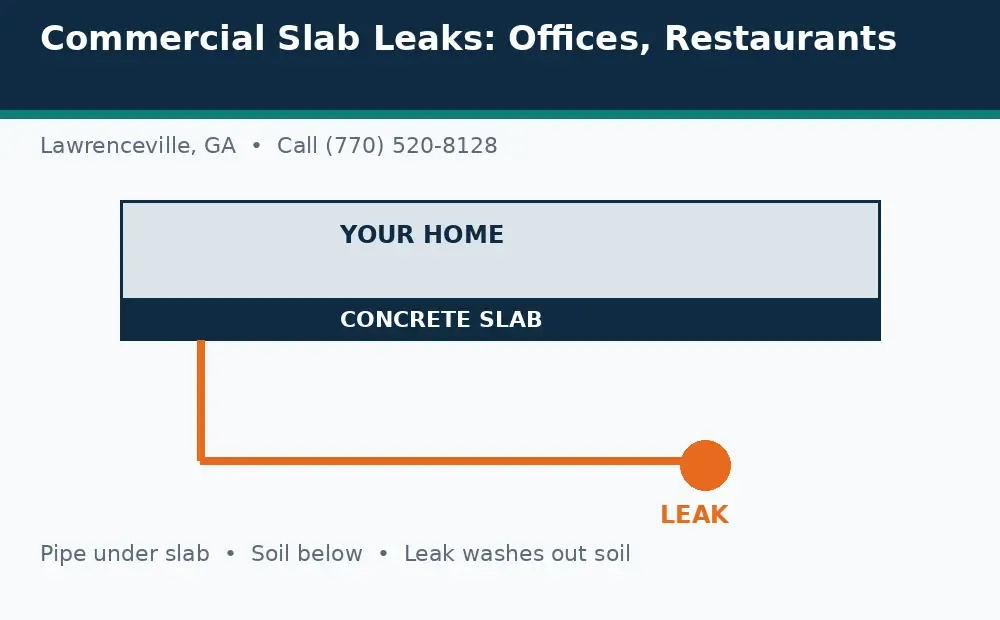
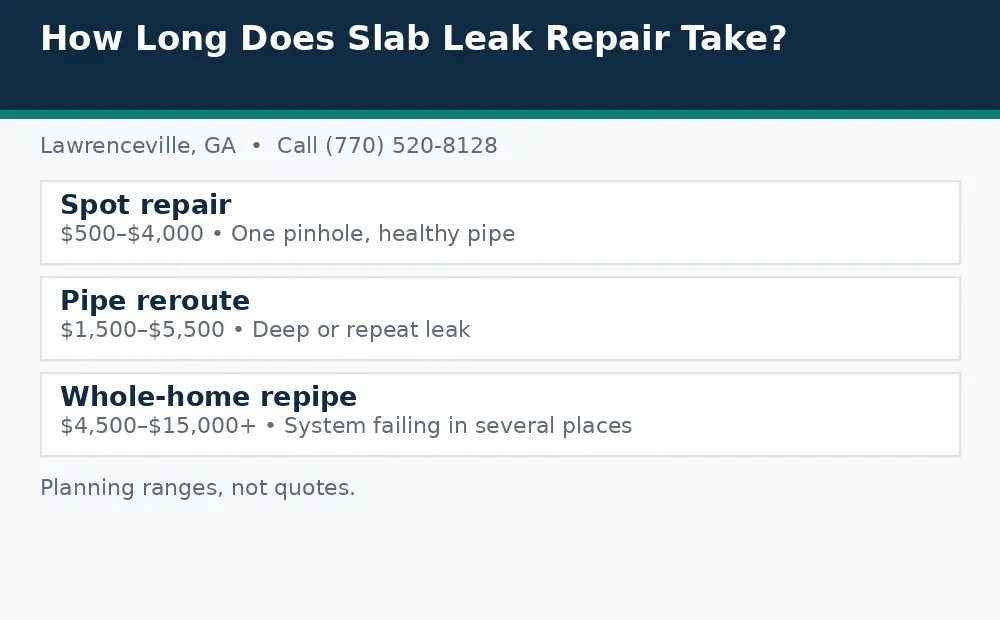
The working photo on this page is an illustrative working photo, not a photo of a specific job at a specific address. The diagrams are schematics, not to scale, made to explain the signs, process, options, or costs on this page in plain words. Call us at (770) 520-8128 if you are unsure what you are seeing.
How do I find out what material my pipes are?
Start where pipes are visible: at the water heater, at the main shut-off, under sinks, and in any utility area where a supply line enters the wall. Copper shows as a reddish-brown metal, often with greenish discolouration at joints where corrosion has touched it. Galvanized steel shows as a dull grey metal, heavier and rougher, often with rust staining at joints. Polybutylene, where it appears in visible sections, is a flexible grey plastic pipe, usually with plastic or metal fittings that differ from modern PEX fittings — but visible sections do not prove what runs under the slab, because homes can mix materials across eras and renovations.
The honest limit is that visible pipe is only a clue to buried pipe. A home replumbed in part may show PEX at the heater and copper under the slab, or vice versa. Previous repair invoices, inspection reports, and the technician's assessment during detection are what turn a clue into a material picture, and a camera or an opened section during a repair is what confirms it. Do not assume the whole system matches the one visible length you found, and do not order material-specific advice online based on a single photograph. If you are unsure, note what you saw and where, and let the detection visit complete the picture — the detection visit guide in this batch explains what to gather before that visit.
What goes wrong with copper under a slab?
Copper's failure mode under a slab is usually pinhole corrosion: the wall thins unevenly from the inside over years until one spot gives way. The pipe can look and feel sound a foot away from the hole, which is why a single pinhole raises the run question rather than answering it. Water conditions, pipe age, and installation details all influence how fast thinning proceeds, and no web page can rate a specific Lawrenceville home's copper from those factors alone. What can be said is that copper pinholes are the classic slow slab leak: a creeping bill, a returning damp patch, a meter that moves — the pattern covered in full on the copper pinhole guide in this batch.
The repair implication follows the pattern logic. One pinhole in a run that otherwise tests sound is a spot repair candidate. Pinholes appearing on the same run, or a run whose opened section shows general thinning, point toward rerouting that run or repiping, because the remaining wall is the same age and condition as the failed spot. No specific lifespan is stated here for copper, because lifespans depend on conditions no page can verify for an individual home, and any number offered without that verification would be invented. The decision rests on the run's own evidence: where holes appeared, what the opened pipe looked like, and what pressure testing says about the rest.
What about galvanized steel and polybutylene?
Galvanized steel fails differently from copper: it corrodes from the inside, building up rough deposits that narrow the pipe while simultaneously weakening its wall. Homeowners often notice galvanized trouble first as flow rather than leakage — pressure that fades at distant fixtures, discoloured water after the system sits idle — and then as leaks where the wall has thinned enough to give way. A galvanized run under a slab therefore carries two problems at once: reduced flow and rising leak risk, both worsening with age. When galvanized appears in a Lawrenceville home, the conversation usually moves faster toward reroute or repipe than it does for a single copper pinhole, because the deterioration is systemic rather than local.
Polybutylene deserves its own paragraph because its history is distinct. It is a flexible plastic pipe installed in a particular era, and it developed a documented pattern of failures at joints and along runs that led to its withdrawal from the market. A home with polybutylene under the slab is not automatically leaking, but its presence changes every conversation: a single leak is read against a material history, not as an isolated event, and reroute or repipe enters the discussion far earlier than it would for copper or PEX. This post makes no claim about any specific Lawrenceville subdivision's pipe history — era framing only, never a neighbourhood-level assertion without evidence — and any homeowner who finds polybutylene should treat the material identification itself as the finding to bring to a technician, via the whole-home repiping page for the replacement side of the conversation.
Where does PEX fit, and does it solve old-pipe problems?
PEX — cross-linked polyethylene — is the flexible plastic pipe most modern repipes and reroutes use. Its advantages for replacement work are practical: it bends around obstacles without a joint at every turn, it resists the corrosion mechanisms that thin copper and galvanized steel, and it can be routed through walls and ceilings in a reroute without the slab work an old-pipe repair might need. Those advantages belong to new work, and they do not transfer backwards: installing PEX in one run does not improve the copper or galvanized runs left in place, and a home that is part-PEX, part-old-material still carries the old material's risks wherever it remains.
PEX also has its own honest limits, though they are less relevant to this post than the old materials' failures. Fittings, installation quality, and protection from damage matter as much as the pipe itself, and a poorly joined PEX run fails like any poorly joined run. The point for a homeowner is not to collect material trivia but to understand the decision the material picture forces: a sound modern material in the replaced runs, and a judgement — run by run — about what remains. That judgement, priced in writing after inspection against the planning ranges on this site (spot $500–$4,000, reroute $1,500–$5,500, repipe $4,500–$15,000+, all planning ranges, not quotes), is what turns a material guide into a repair plan.
What should I do once I know my pipe material?
First, record it: material, where you saw it, and any documents that confirm it, kept with your bills and meter notes. Second, match your monitoring to the material: copper and galvanized homes benefit most from yearly meter tests and bill comparisons, because their failures arrive slowly; polybutylene homes benefit from an earlier professional conversation even without a current leak, because the material history itself is the warning. Third, bring the material picture to any detection or repair conversation, because it changes the method discussion — a camera finding, a pressure result, and a material identity together are what justify spot repair versus reroute versus repipe.
Finally, resist two opposite errors. Do not panic on material identity alone — a material is a risk factor, not a leak, and many homes with older materials run for years without incident. And do not dismiss material identity because nothing has leaked yet — a run's condition is evidence about the future, not just the past, and the cheapest time to reroute or repipe a failing run is as a planned job, not as the next emergency. For homes in Downtown Lawrenceville and Collins Hill, the material question is best answered house by house, and the repair cost estimator lets you walk the planning ranges for each route once you know which routes your material picture makes relevant.
Materials at a glance
| Material | Typical failure | Early clues | Decision it pushes toward |
|---|---|---|---|
| Copper | Pinhole corrosion thinning | Creeping bill, returning damp | Spot repair if isolated; reroute if patterned |
| Galvanized steel | Internal corrosion + narrowing | Fading pressure, discoloured water | Reroute or repipe sooner |
| Polybutylene | Documented joint and run failures | Material identity itself | Early reroute/repipe conversation |
| PEX (new work) | Fitting/installation dependent | — | Standard replacement material |
No lifespans are stated here: material life depends on conditions no page can verify for an individual home. Judge the run's own evidence.
What to tell us when you call
When you call, tell us what you noticed, when it started, and where in the house it shows. Mention your ZIP code, whether the water meter moves with everything off, and whether the sign is on a hot-water or cold-water line if you know. That short list helps the technician bring the right equipment and plan the visit. You do not need to know the cause before you call — that is what detection is for.
Call (770) 520-8128 and describe what you are seeing in plain words. We will talk through the next step and arrange a detection visit.
Call Us Today
Fast local slab leak detection and repair in Lawrenceville, GA, ZIPs 30043–30046.
Call Us: (770) 520-8128Frequently asked questions
How can I tell copper from galvanized pipe?
Copper is reddish-brown metal, often with greenish joint discolouration; galvanized steel is dull grey, heavier, and rougher, often with rust staining at joints. Visible sections are clues only — buried pipe may differ where eras or renovations mixed materials.
Does finding polybutylene mean I must repipe immediately?
No, but it changes the conversation: the material's documented failure history means a single leak is read as a pattern warning, and reroute or repipe enters discussion far earlier than for other materials. Bring the identification to a technician.
Can PEX be used to line or repair an old pipe?
PEX is a replacement material for reroutes and repipes, not a liner for an existing pipe. Lining is a separate method with its own eligibility rules, decided by camera inspection.
Do material lifespans exist that I can compare?
Published lifespans vary so widely with water, installation, and soil conditions that no single number is meaningful for an individual home. Judge the run's own evidence: leak history, opened-pipe condition, and pressure results.
My home mixes materials. What does that mean?
Judge run by run. A replaced PEX run does not improve the old runs left in place, and each old run carries its own material risk. Record what is where, and bring that map to any detection visit.