 Lawrenceville Slab Leak Detectors
How Much Water Does a Slab Leak Waste in Lawrenceville?
A slab leak wastes water because a pressurized supply line never rests, so a small leak adds up across days and billing cycles. Sugarloaf and Gwinnett Place homes, ZIPs 30044 and 30045, can estimate the loss with a water meter test, then call for detection before the bill climbs.
What this looks like in a Lawrenceville home
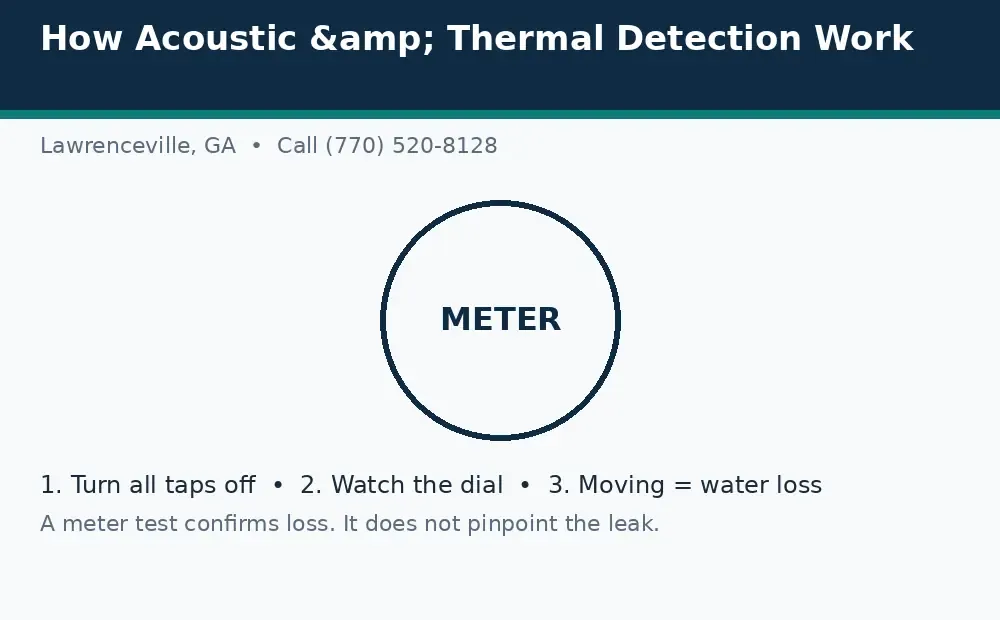
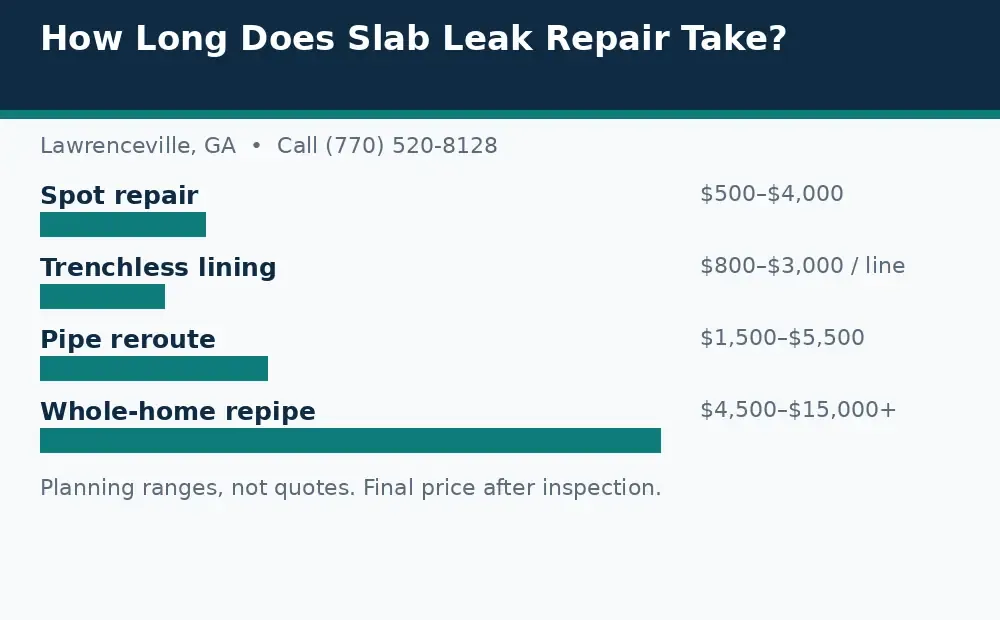
The images on this page are illustrative diagrams, not photos of a specific job at a specific address, and they are not presented as this business's own work. Call us at (770) 520-8128 if you are unsure what you are seeing.
Why a slab leak wastes water around the clock
Most household water use stops when you stop using it. A tap closes, a toilet refills and stops, a washing machine finishes its cycle. A slab leak does none of that. A supply line under the slab is pressurized all day and all night, so a crack or pinhole in it releases water continuously — while you sleep, while you are at work, and while you are on holiday. That continuity is what makes the waste so large, and it is also what makes it so easy to miss: there is no puddle to step in, no tap left running to notice, just water leaving the pipe into the soil beneath your home, hour after hour. The signs guide lists the clues that betray it — a bill that climbs without a change in habits, a warm patch on the floor, the sound of running water when everything is off — but the waste itself starts long before any of those clues appear.
The distinction that matters here is between supply leaks and drain leaks. A supply leak moves water under pressure, so it wastes water continuously and moves the meter. A drain leak, covered in the sewer versus supply guide, only leaks when water is flowing through the drain, so it wastes far less water and usually leaves the meter still. That is why a meter test is the first estimator of waste: a meter that moves with everything off is measuring a supply-side loss in real time, while a still meter points the investigation toward drains, fixtures, or a toilet that runs silently. Either way, the waste question is answered by measurement, not by guessing at the size of a hole nobody can see.
The arithmetic: small rates, large totals
The waste from any continuous leak follows one simple multiplication: flow rate, multiplied by hours, multiplied by days. That is why a rate that sounds trivial becomes a large total so quickly, and why the table below is labelled as arithmetic examples rather than measurements of your leak. Nobody can state your leak's rate without testing it, but anyone can see what a given rate would total if it ran uninterrupted. Read the table as "if it leaked this fast, this is what a month would hold", and use your own meter reading to replace the "if" with a number.
| If the leak runs at | Per day | Per 30 days | Per year |
|---|---|---|---|
| 1 gallon per hour | 24 gallons | 720 gallons | 8,760 gallons |
| 1 gallon every 10 minutes | 144 gallons | 4,320 gallons | 52,560 gallons |
| 1 gallon per minute | 1,440 gallons | 43,200 gallons | 525,600 gallons |
Those totals are pure multiplication, and they are the reason a bill can jump by an amount that looks impossible for a hole you cannot see. For scale, the US Environmental Protection Agency's WaterSense program reports that household leaks overall can waste nearly 10,000 gallons of water per year in an average home, and that a share of homes have leaks wasting at least 90 gallons a day. Your slab leak is one specific leak, not that average, and its rate can sit anywhere in the table above or beyond it — the point of the comparison is that continuous flow, not hole size, is what drives the total. A pinhole under pressure, running for a billing cycle, is a different quantity from a pinhole that drips for an hour.
How to estimate your own leak's waste
Start with the meter, not with the table. The water meter leak test guide walks through the method: turn off every tap and appliance, note the meter reading, wait without using water, and read it again. The difference across that window is your loss rate for that window, and multiplying it out gives a daily and monthly estimate grounded in your home rather than in an example. A two-hour window with no water use is a practical test length, and it is worth doing twice — once in the evening and once overnight — because a leak that only shows under certain conditions, such as a hot-water line that cycles with the heater, may not show the same rate both times. Write both readings down with their times, because a technician will want the numbers, not just the conclusion.
Then cross-check with the bill. Compare the current billing period against the same period last year and against your household's normal range, and note whether usage rose while habits did not. A bill jump on its own does not prove a slab leak — a running toilet, a new appliance, extra guests, or a changed irrigation schedule can all move a bill — which is why the high water bill guide walks through the rule-outs first. But a bill jump plus a moving meter, with no fixture explanation, is a strong pair of signals, and together they turn "how much is it wasting" from a guess into a measured rate. The hidden water cost calculator tool can then turn that rate into a running total for your own planning, without anyone having to guess at a price for your repair.
Hot-water leaks waste energy as well as water
A hot-water line leak under the slab wastes more than water. Every gallon that escapes is a gallon your water heater warmed first, so the heater cycles more often to replace it, and the energy used to heat water that never reaches a tap is spent for nothing. Homeowners sometimes notice this side first: a water heater that runs constantly, or a gas or electricity bill that climbs alongside the water bill, as the water heater guide explains. The floor clue points the same way — a warm patch on the floor above a hot-water line is heat escaping with the water — and the warm spot guide covers how to read that sign without overclaiming it. A cold-water leak wastes water alone; a hot-water leak wastes water plus the energy that heated it, which is one more reason a warm floor plus a climbing bill deserves a prompt meter test rather than a wait-and-see month.
The same logic explains why a leak's bill effect can lag behind the leak itself. Water lost into soil does not arrive as a line item the day it starts; it arrives when the meter is read, when the billing period closes, and when the total is compared against a previous period. A leak that started mid-cycle may only show half its rate on the first bill, then its full rate on the next, which can make the second bill look like a sudden jump when the leak itself has been steady all along. Reading the meter yourself, between bills, removes that lag: you see the loss this week, not at the next billing date, and you can act on it before another cycle of waste accumulates.
What the waste means for the fix
Knowing the waste rate changes the repair conversation in two practical ways. First, it sets urgency honestly: a measured loss of hundreds of gallons a day is a stronger reason to book detection this week than a vague worry, while a barely moving meter suggests a slower investigation is reasonable. Detection itself carries a published planning range of $300-$600, and the detection-cost guide explains what that covers, so the cost of finding the leak can be weighed against the water it is wasting while it runs. Second, the rate helps choose between repair routes once detection confirms the location: the spot repair versus reroute versus repipe guide compares the options, and the repair-cost guide gives their planning ranges — spot repair $500-$4,000, lining $800-$3,000, reroute $1,500-$5,500, repipe $4,500-$15,000+ — all as planning ranges, never as a computed quote for your home.
What the waste rate should never do is rush you past detection. A large estimated loss justifies prompt detection, not a repair approved on the strength of a bill alone, because the repair must aim at a located leak, not at a symptom. The detection methods guide explains how acoustic listening and thermal imaging narrow the location before anything is opened, and the water loss visualizer tool can make the running total concrete while you wait for the visit. Measure first, locate second, repair third: that order keeps the waste estimate honest and the repair aimed at the right pipe.
What to tell us when you call
When you call, tell us your meter test result — the two readings and the time between them — plus whether the bill jumped, whether any floor feels warm, and whether the sound of running water appears with everything off. Mention your ZIP code and whether the leak signs point to a hot-water or cold-water line. That short list turns a waste estimate into a detection plan.
Call (770) 520-8128 and describe what your meter showed in plain words. We will talk through the next step and arrange a detection visit.
Call Us Today
Fast local slab leak detection and repair in Lawrenceville, GA, ZIPs 30043–30046.
Call Us: (770) 520-8128Frequently asked questions
How do I measure how much water my slab leak wastes?
Run a water meter test: turn off every tap and appliance, note the meter reading, wait without using water, and read it again. The difference across that window is your loss rate, and multiplying it out gives a daily and monthly estimate. Test twice, such as evening and overnight, and write both readings down with their times for the technician.
Can a tiny pinhole leak really waste a lot of water?
Yes, because it runs continuously. A leak of just one gallon per hour totals 24 gallons a day and 720 gallons in 30 days, purely by multiplication. A pressurized supply line never rests, so even a small opening accumulates a large total across a billing cycle. The rate, not the hole size alone, is what drives the total.
Does a sewer leak under the slab waste water the same way?
No. A drain or sewer leak only releases water when fixtures drain through it, so it wastes far less water and usually leaves the meter still. A supply leak runs under pressure around the clock and moves the meter. That difference is why a meter test separates the two: a moving meter points to supply, a still meter points elsewhere.
Why did my bill jump suddenly if the leak was steady?
Billing lag explains it. Water lost into soil shows up only when the meter is read and the period closes, so a leak that started mid-cycle may show half its rate on the first bill and its full rate on the next. Reading the meter yourself between bills removes that lag and shows the loss this week, not at the next billing date.
Should I fix the leak or keep paying the higher bill?
Fixing it starts with detection, not with a repair guessed from the bill. Detection carries a published planning range of $300-$600, and a written repair price follows inspection. Weigh that against your measured waste rate: hundreds of gallons a day makes prompt detection the clear choice, while any repair should still wait for a located leak.