 Lawrenceville Slab Leak Detectors
Frozen Pipes in Lawrenceville, GA: First Freeze Weekend Guide
Freezing temperatures reach Lawrenceville, GA, this weekend, and the pipes most at risk are the ones in crawl spaces, garages, and along exterior walls. In ZIPs 30043 and 30044, from Collins Hill to Downtown Lawrenceville, a Friday checklist beats a Saturday burst — call (770) 520-8128 if a pipe freezes.
What this looks like in a Lawrenceville home
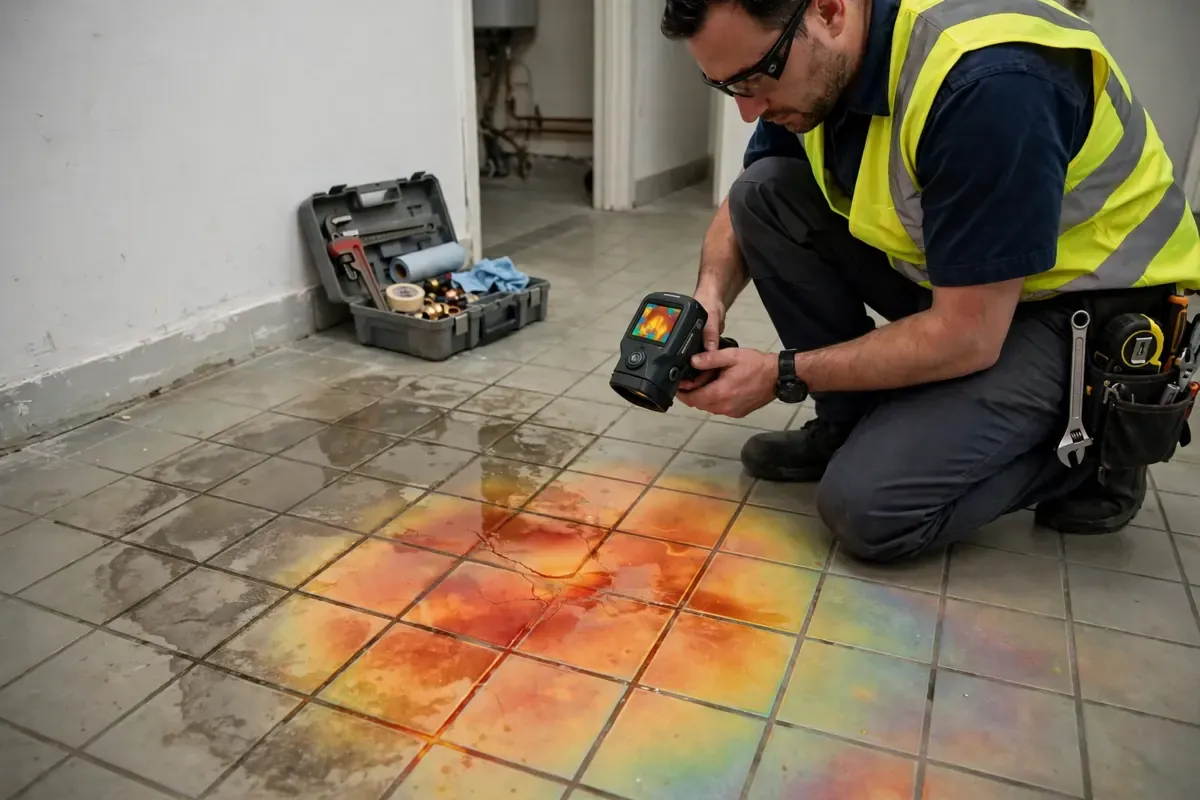
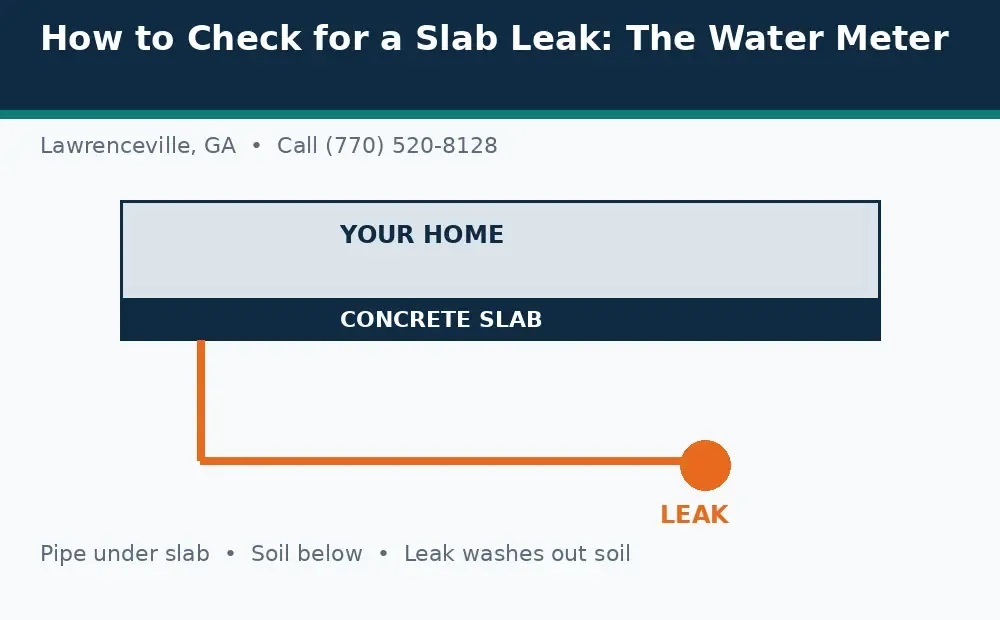
The images on this page are generic illustrations — a thermal-imaging photo and a water-meter-check diagram — not photos of this business's own work or of a specific home. Call us at (770) 520-8128 if you are unsure what you are seeing.
The short answer: this weekend is the first real test
Freezing temperatures reach Lawrenceville this weekend, and the forecast is the reason to act on Friday rather than on Saturday night. Atlanta News First's First Alert forecast (November 10, 2026) calls for lows near freezing on Saturday and Sunday in metro Atlanta, with a freeze expected north of the metro, highs only in the 50s, and wind chills likely below freezing. FOX 5 Atlanta's forecast the same day puts morning lows in the 20s and 30s across north Georgia, with frost and freezes likely and no snow in metro Atlanta. Lawrenceville sits in metro Atlanta's north metro, so the metro-Atlanta forecast applies here, and the first freeze of the season is the one that catches homes unprepared — the pipes that burst this weekend are usually the ones nobody insulated in the autumn.
Georgia has had reminders that a mild-winter state still freezes hard enough to burst pipes: the late-January 2026 ice storm and the December 2022 arctic blast both burst pipes across the state. Federal forecasters expect a wetter-than-average winter across the South (NOAA's 2026-2027 winter outlook, October 15, 2026), and a strong El Niño is likely to continue through early 2027 (NOAA's El Niño Advisory, October 8, 2026) — which makes this winter harder to predict, not milder. None of that means a hard freeze is certain every week; it means the first freeze weekend is worth an hour of preparation, because a burst pipe floods a home in minutes and the damage is often not obvious until the thaw.
Why a Georgia freeze bursts pipes
When water freezes, it expands. Inside a pipe, that expansion has nowhere to go, so pressure builds between the ice blockage and the nearest closed faucet — and the pipe often splits at a point away from the ice itself, not at the frozen section. That is why a burst can be hard to find: the ice forms in one place and the split opens in another, sometimes in a wall or under a floor where nothing is visible. A single split supply line can release a large volume of water before the main valve is closed, which is why knowing where the valve is matters more than any other preparation.
The damage is often not obvious until the thaw. While the pipe is frozen, the ice itself plugs the split, so nothing leaks. When temperatures rise and the ice melts, the split suddenly gushes — sometimes hours after the coldest night, when nobody is watching. That is the pattern to plan for: a pipe that survived the freeze night can still flood the house on Sunday afternoon. After any freeze, the checks in this guide matter as much as the preparation before it. The water meter leak test guide walks through that check.
Which pipes are at risk in a Lawrenceville home
In colder states, pipes are routed deep inside insulated walls. In metro Atlanta, builders often run pipes through uninsulated crawl spaces, exterior walls, garages, and attics, because hard freezes are rare — and when a sharp freeze does hit, that exposed pipe is the vulnerable one. The pipes most at risk in a Lawrenceville home are the ones in crawl spaces, attics, and along exterior walls, plus outdoor pipes: the hose bibs on the outside of the house, the lines to outdoor taps, and the water service line where it comes up out of the ground. Homes with pipes in unheated spaces are at risk even when temperatures do not drop far below freezing, and the risk rises sharply when temperatures stay below 20°F for hours, especially during an extended cold snap.
The pipes buried under the slab are the exception, not the rule. Earth and concrete insulate them, so a slab pipe is far less likely to freeze than an exposed pipe in a crawl space or a garage. That distinction matters after a freeze: if water appears after the thaw, the break is more likely in an exposed run or in the shallow service line outside than under the slab — but it can still be under the slab, and only detection tells you which. A burst service line outside can look exactly like a slab leak from inside the house — a wet patch, a high bill, a meter that keeps moving. Do not assume a post-freeze leak is under the slab, and do not assume it is not; the meter test and detection decide.
Before the freeze: the Friday checklist
Do this before Saturday night, while the weather is still mild. Disconnect every garden hose from its outdoor spigot and drain the spigot — water left in a connected hose can freeze, expand, and back the ice up into the pipe inside the house. Cover outdoor faucets with insulated faucet covers, or shut off and drain them if they have their own valve. Insulate exposed pipes in crawl spaces, garages, attics, and along exterior walls with foam pipe sleeves; heat tape is the stronger option for pipes that are particularly exposed or hard to insulate. Seal gaps and openings where cold air can reach plumbing, including around crawl space vents and wall penetrations.
Inside the house, open the cabinet doors under sinks on exterior walls so warmer indoor air can reach the pipes behind them. During freezing nights, let a pencil-thin trickle of water run from the most exposed faucets — moving water is harder to freeze than still water, and the trickle relieves the pressure that splits a pipe. Keep the heat on at a consistent temperature day and night, even when you are away; the American Red Cross recommends keeping heat set no lower than 55°F when leaving home during cold weather. For extended travel during a forecast freeze, consider shutting off the main water supply and draining the lines. And make sure every adult in the household knows where the main water shut-off valve is and that it opens and closes — a valve that has not moved in years can seize, and the time to find that out is Friday, not during a flood.
How to tell a pipe has frozen
The clearest sign is a faucet that gives no water, or much less water than usual, on a freezing morning. Check the other taps: if one faucet is dry and the rest flow normally, the frozen section is on that faucet's line; if nothing flows anywhere, the freeze is in a main or shared line. Look at visible pipes in the crawl space, garage, or attic for frost on the outside of the pipe — a white, crusty coating on a section of pipe is ice forming on the surface. Listen for gurgling or unusual sounds when a tap is opened, and watch for damp drywall or a musty smell near an exterior wall, which can mean a split has already opened behind it.
After the thaw, watch the meter. Turn off every tap and appliance, including irrigation and the ice maker, and watch the dial for 15 to 30 minutes. A dial that moves means water is escaping from a pressurised line — a split that opened during the freeze. A bill that jumps in the next cycle tells the same story after the fact. If you find a frozen line, shutting off the main before it warms can prevent a flood — the ice is plugging the split, and closing the main takes the pressure off before the thaw releases it.
What to do if a pipe is frozen — and what never to do
If a pipe is frozen but has not burst, thaw it gently. A hair dryer, a heating pad, or warm towels on the frozen section all work; start from the faucet end and work back toward the frozen section so the melting water has somewhere to go. Never thaw a frozen pipe with an open flame or a torch — a flame on a pipe in a wall or under a floor is a fire risk, and it can damage the pipe itself. If you cannot locate the frozen section, or if the pipe has already burst, shut off the main water supply immediately and call a professional. If a pipe has burst, close the main shutoff, open a low faucet to relieve pressure, and call — every minute the main stays open is water on the floor.
If water appears after the thaw and you cannot see where it is coming from, that is a detection job, not a guessing job. Acoustic listening follows the sound of escaping water through concrete and walls, thermal imaging maps warm areas for a hot-water leak, and the meter test confirms the loss — the same methods used for a slab leak, applied to a freeze break. The published planning range for detection is $300-$600, a planning range only, with a written price following inspection. Repair follows the same routes as any other pipe failure: a spot repair for a single split, a reroute or a lining where the pipe has failed before or the run is hard to reach, and the spot repair versus reroute versus repipe guide compares them. The repair cost estimator gives a planning figure from those ranges once detection has found the break.
What to tell us when you call
When you call, tell us which taps are dry or weak, whether you can see frost on any exposed pipe, what the meter did with everything off, and your ZIP code. If a pipe has burst, say so first — shutting off the main comes before anything else. That short list lets us plan the visit around your freeze, not around a guess.
Call (770) 520-8128 and describe your situation in plain words. We will talk through detection first, then a repair plan that fits your home.
Call Us Today
Fast local slab leak detection and repair in Lawrenceville, GA, ZIPs 30043–30046.
Call Now to Speak to a SpecialistFrequently asked questions
When will pipes freeze in Lawrenceville this weekend?
Atlanta News First's First Alert forecast (November 10, 2026) calls for lows near freezing on Saturday and Sunday in metro Atlanta, with a freeze expected north of the metro, highs only in the 50s, and wind chills likely below freezing. FOX 5 Atlanta puts morning lows in the 20s and 30s across north Georgia. No snow is expected in metro Atlanta. The risk is highest on Saturday and Sunday nights, when temperatures stay below freezing for hours.
Which pipes freeze first in a Georgia home?
The exposed ones: pipes in crawl spaces, attics, and garages, pipes along exterior walls, and outdoor taps and hose bibs. Metro Atlanta builders often run pipes through uninsulated spaces because hard freezes are rare, and those runs freeze first. Pipes buried under the slab are protected by the earth and the concrete, so they are far less likely to freeze than an exposed pipe in a crawl space or garage.
Should I let my faucets drip during the freeze?
Yes, for the most exposed faucets. Let a pencil-thin trickle run overnight from faucets on exterior walls — moving water is harder to freeze than still water, and the trickle relieves the pressure that splits a pipe. Open the cabinet doors under sinks on exterior walls so warm indoor air reaches the pipes. Keep the heat on at a consistent temperature, and no lower than 55°F if you leave the house.
What should I do if a pipe has already frozen?
Thaw it gently with a hair dryer, a heating pad, or warm towels, starting from the faucet end so melting water has somewhere to go. Never use an open flame or a torch — it is a fire risk and can damage the pipe. If you cannot find the frozen section, or the pipe has already burst, shut off the main water supply immediately and call a professional. If a pipe has burst, open a low faucet to relieve pressure.
Can a freeze cause a slab leak?
A freeze can burst a shallow service line, and a burst outside can look like a slab leak inside — a wet patch, a high bill, a meter that keeps moving. Pipes under the slab are protected by earth and concrete, so a slab pipe is less likely to freeze than an exposed one. If water appears after the thaw, the meter test confirms the loss, and detection pinpoints whether the break is under the slab or outside it.