 Lawrenceville Slab Leak Detectors
Epoxy Pipe Lining for a Slab Leak in Lawrenceville, GA
Epoxy pipe lining seals a slab leak in Lawrenceville, GA — a resin-coated liner is pulled through, inflated, and cured in place, so the floor stays closed. In ZIPs 30043 and 30044, from Collins Hill to Sugarloaf, it suits a sound pipe with a small leak, not a collapsed one.
What this looks like in a Lawrenceville home
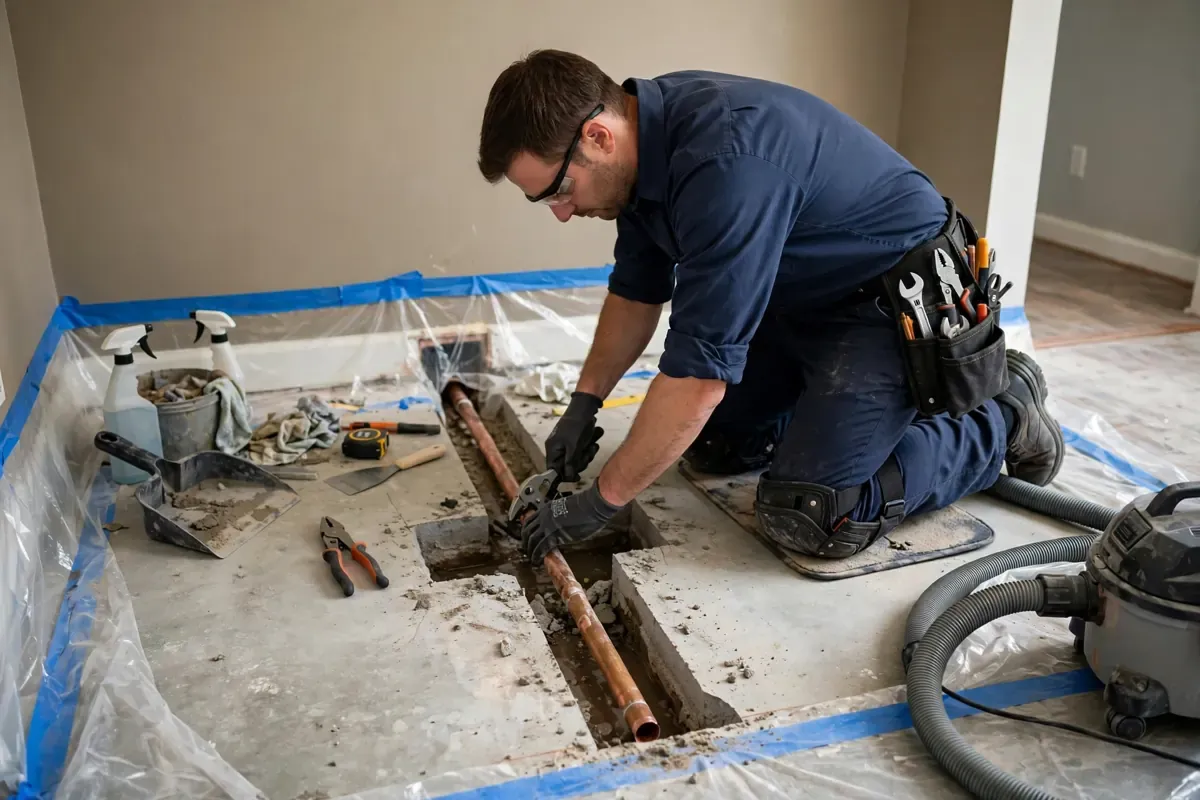
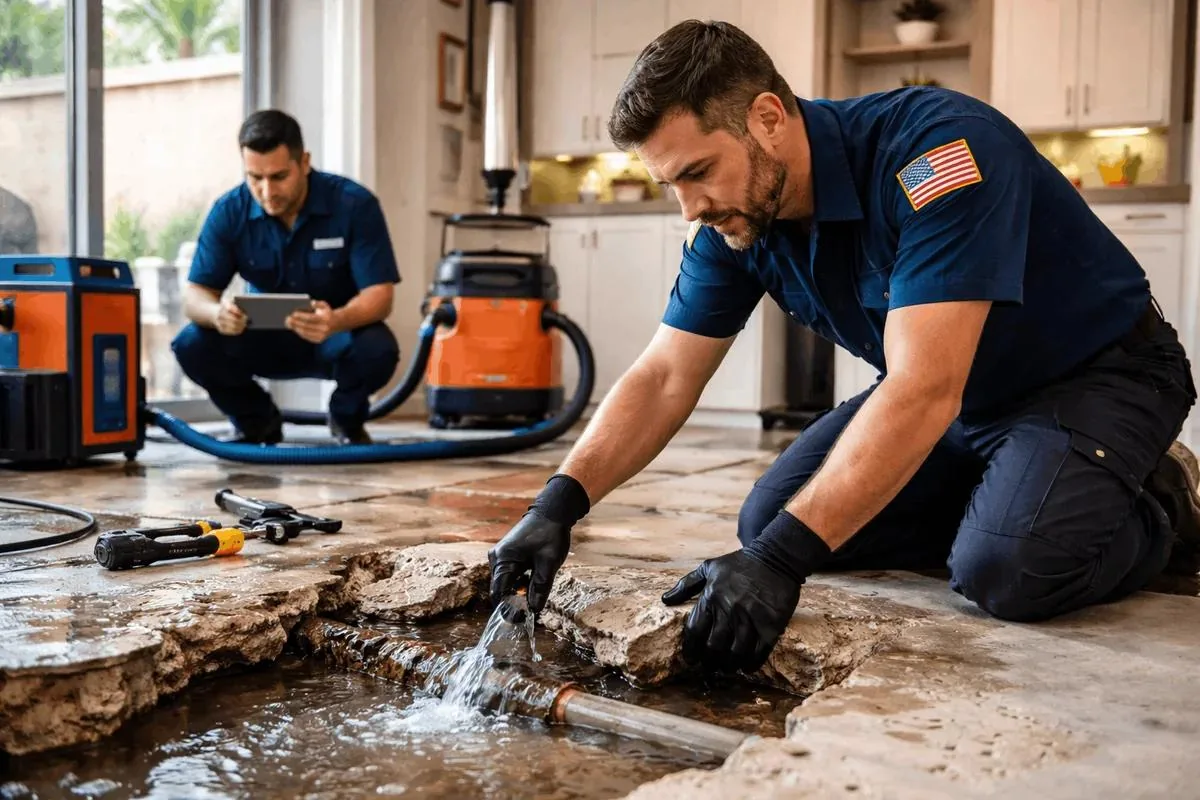
The images on this page are generic illustrations — a pipe-under-slab diagram and a spot-repair photo — not photos of this business's own work or of a specific home. Call us at (770) 520-8128 if you are unsure what you are seeing.
The short answer: a new pipe inside the old one
Epoxy pipe lining is the trenchless way to fix a slab leak: instead of opening the floor to reach the pipe, a technician works from inside it. A flexible liner coated with epoxy resin is pulled through the leaking section of pipe from an access point, inflated so it presses against the pipe walls, and cured in place. The cured liner forms a smooth, jointless pipe inside the old one, sealing the crack or pinhole from the inside. The floor above never opens. It is also called cured-in-place pipe, or CIPP, and it is the same idea used to line drain and sewer lines without digging. Trenchless pipe lining is an offered service, and the spot repair versus reroute versus repipe guide compares it with the other repair routes.
Lining is not the answer to every slab leak, and the honest version of this guide is mostly about where it stops working. It needs a pipe that is still sound enough to hold a liner: a pipe that has collapsed, rusted through, or shifted out of line at a joint cannot support one. It suits straight runs and small leaks far better than bends, branches, and breaks. And it costs more up front than a single spot repair, because the equipment and the resin are specialised. What follows is the process, the cases where lining is the right call, the cases where it is not, and what it costs in Lawrenceville — using only this site's published planning ranges. Detection still comes first: the water meter leak test guide walks through the check that confirms water is actually being lost before any repair is priced.
How the lining process works, step by step
The job starts the same way every slab leak repair starts: with detection. The meter test and a pressure test confirm the loss and narrow it to a line, then acoustic listening and, for a hot-water leak, thermal imaging pinpoint the break. Lining is never priced from a damp patch alone, because the liner has to cover the leak, and a liner placed on a guess covers the wrong stretch of pipe. The detection methods guide maps each method to the question it answers, and the acoustic and thermal detection guide explains the listening and imaging steps.
Once the leak is located, a camera goes into the pipe first. The camera shows what the outside of the pipe cannot: whether the pipe is sound, where the leak sits, whether there are bends or branches in the way, and whether the pipe has sagged or shifted. The sewer camera inspection guide covers what the camera sees and why it matters. If the camera says the pipe can hold a liner, the pipe is cleaned — usually with compressed air and an abrasive pass — so the resin can bond to a clean surface. A liner is then measured and cut to the length of the damaged section, saturated with epoxy resin, and pulled or pushed through the pipe from an access point, often a cleanout or an exposed section where the pipe enters the slab.
The liner is inflated with air or water so it presses against the pipe walls along its whole length, and held there while the epoxy cures — typically several hours, with hot water or UV light speeding the cure. While it cures, the treated pipe cannot be used, so the water stays off for that line until the cure is finished. A second camera pass checks the finished liner: it should sit tight against the pipe wall, with no folds or gaps, and the leak sealed. The whole job is usually done within a day, with the curing time as the longest single step. What you get at the end is not a patched pipe but a new inner surface running the length of the lined section, with no joints for water to find.
When lining is the right call
Lining earns its price in four situations. The first is a straight run of pipe with a small leak, or several pinholes spread along one run: a spot repair would fix one pinhole and leave the next, while a liner treats the whole run in one pass. The second is a floor you cannot disturb — expensive tile, hardwood, or a room finished over the leak — where opening the slab would cost more in restoration than the lining itself. The fix a slab leak without breaking the floor guide compares the no-dig options side by side, and the concrete and floor restoration service page covers what putting a floor back involves when a repair does open it.
The third is a leak in a hard-to-reach section: under a patio, under a room with no easy access, or in a line that runs beneath a structural element where cutting is not practical. The fourth is specific to Lawrenceville's housing stock: a post-tension slab. Lining works inside the pipe, so it never cuts near the steel tendons running through the slab — the tendons that make spot repair risky and electromagnetic locating unreliable. The post-tension slab leak detection guide explains why acoustic listening becomes the primary method under those slabs, and the same logic applies to the repair: a method that never touches the concrete never touches a tendon. Lining is also a strong fit for drain lines, where the slight loss of inside diameter from the liner thickness matters less, because drain flow does not depend on pressure the way a supply line does.
When lining does not work — and what happens instead
The limits are straightforward, and a contractor who skips them is selling a liner, not a repair. A collapsed pipe cannot hold a liner: the liner needs a stable pipe shell to bond to, and a pipe that has caved in has no shell left. Severe corrosion is the same problem — a pipe that is ready to collapse cannot support the lining, and lining it only hides the failure for a while. Joints that have shifted out of line are another no: the liner cannot bridge a step in the pipe, and water will find the gap. Heavy bends and branches complicate the run too, because the liner has to follow the pipe's shape, and a run with many turns or a branch in the middle may not take one cleanly.
The liner itself costs about a quarter of an inch of inside diameter, because the cured resin has thickness. On a drain line that rarely matters. On a small supply line it can matter, especially where water pressure is already low — the low water pressure guide covers how a slab leak shows up as a pressure drop, and a lining that narrows the line further is the wrong trade. A drain that has lost its slope is another case lining cannot fix: a sagging or bellied drain holds water regardless of what coats its inside, and the slope has to be corrected, not lined. And a hot-water supply line needs a liner rated for the temperature it will carry — the check is the pipe's condition and the liner's rating, not the water temperature alone.
When lining is ruled out, the routes are the ones in the comparison guide: a spot repair opens the slab at the marked leak and replaces the damaged section, a reroute abandons the old line and runs a new one through walls or the attic, and a whole-home repipe replaces the system overhead. None of these is a failure of the job — each is the right answer for a different pipe. What a careful repair never does is line a pipe the camera has already condemned, or cut a floor before detection has marked the spot.
What epoxy lining costs in Lawrenceville
The published planning range for lining on this site is $800-$3,000, a planning range only, with a written price following inspection. That range covers the lined section; what moves the price inside it is the length of the run, the pipe's diameter, how the liner is reached, and the pipe's condition — a long run with difficult access costs more than a short, straight one, and a pipe that needs heavy cleaning before the liner can bond adds time. The detection that comes first carries its own published planning range, $300-$600, and the repair price is written after inspection, once detection has found the break.
For comparison, the site's other published planning ranges are spot repair $500-$4,000, reroute $1,500-$5,500, and whole-home repipe $4,500-$15,000 or more. Lining sits between spot repair and reroute on price, and its value is not in being the cheapest option but in being the one that leaves the floor untouched — which is worth the most when the floor above the leak is the expensive part of the job. The repair cost guide carries all five ranges together. A permit may be needed depending on the scope of the work. Whatever route is chosen, ask for the written price before work starts, and ask what it covers: detection, the repair itself, and putting the surface back.
What to tell us when you call
When you call, tell us what you have seen — a warm spot, a high bill, a spinning meter — and what kind of pipe and floor you have, if you know: copper or plastic, tile or hardwood over the leak, and your ZIP code. That short list tells us whether lining is even on the table, instead of starting from a guess.
Call (770) 520-8128 and describe your situation in plain words. We will talk through detection first, then a repair plan that fits your home.
Call Us Today
Fast local slab leak detection and repair in Lawrenceville, GA, ZIPs 30043–30046.
Call Now to Speak to a SpecialistFrequently asked questions
What is epoxy pipe lining, exactly?
It is a trenchless repair: a flexible liner coated with epoxy resin is pulled through the leaking section of pipe from an access point, inflated so it presses against the pipe walls, and cured in place. The cured liner forms a smooth, jointless pipe inside the old one, sealing the crack or pinhole from the inside. It is also called cured-in-place pipe, or CIPP, and it leaves the floor above the leak unopened.
Does epoxy lining work on a hot-water line?
It is used on supply lines, including hot-water lines, and on drain sections where the pipe is sound. The deciding factors are the pipe's condition and the liner's temperature rating, not the water temperature alone. A hot-water leak is still found the same way first — the meter test, acoustic listening, and thermal imaging — and the camera check decides whether the pipe can hold a liner.
How long does an epoxy lining job take?
Usually within a day. The steps are detection, a camera inspection, cleaning the pipe, pulling the liner through, inflating it, and curing — the cure takes several hours, with hot water or UV light speeding it, and the treated pipe cannot be used while it cures. A second camera pass checks the finished liner. The curing time is the longest single step, so the water stays off for that line until it is finished.
When can't a slab leak be fixed with lining?
When the pipe cannot support a liner: a collapsed pipe, severe corrosion, or joints that have shifted out of line. Heavy bends and branches can also rule it out. A drain that has lost its slope cannot be fixed by lining either — the slope has to be corrected. And on a small supply line, the liner's thickness costs about a quarter of an inch of diameter, which matters where pressure is already low.
How much does epoxy pipe lining cost in Lawrenceville?
The published planning range for lining is $800-$3,000, a planning range only, with a written price following inspection. The price moves with the length of the run, the pipe's diameter, access, and condition. For comparison, spot repair is $500-$4,000, reroute $1,500-$5,500, and whole-home repipe $4,500-$15,000 or more. Detection is $300-$600, priced before the repair is chosen.