 Lawrenceville Slab Leak Detectors
Post-Tension Slab Leak Detection in Lawrenceville, GA
A post-tension slab leak in Lawrenceville, GA, needs detection that works around steel cables tensioned through the concrete. In ZIPs 30043 and 30044, from Collins Hill to Sugarloaf, acoustic listening finds the leak so no tendon is cut blind — call (770) 520-8128 before anyone opens the slab.
What this looks like in a Lawrenceville home

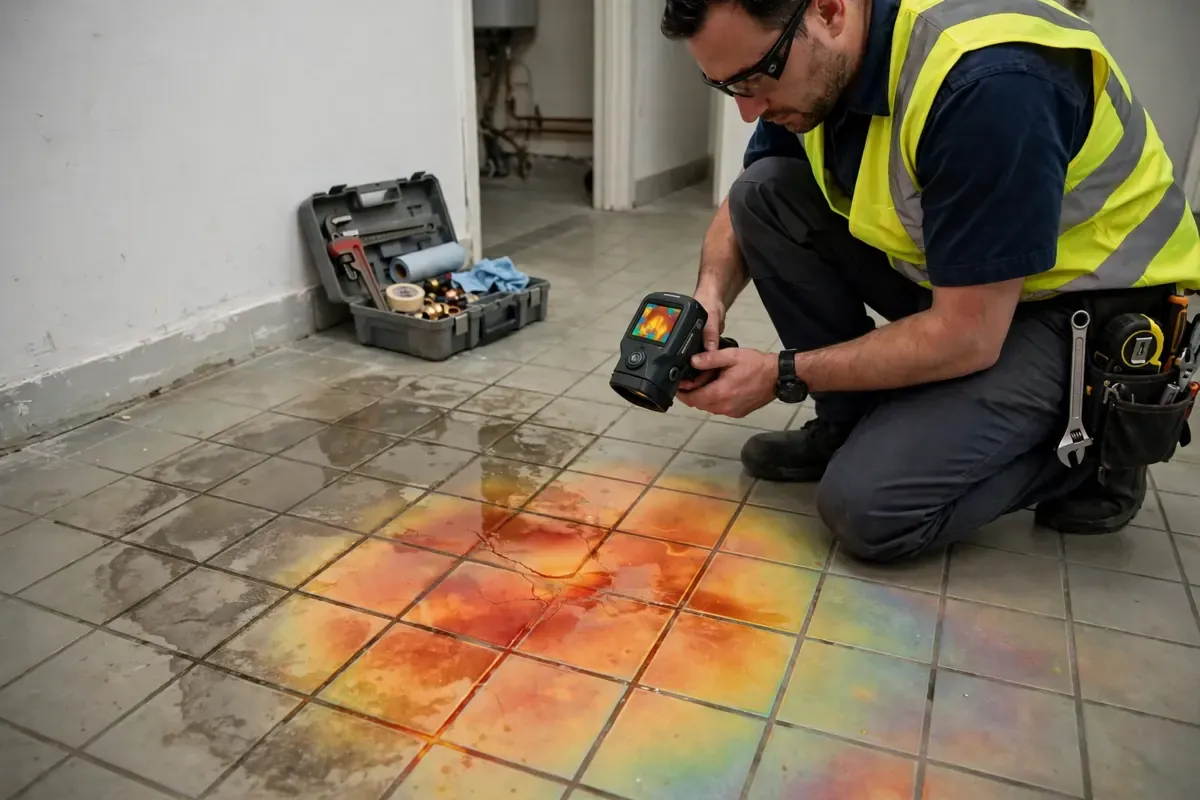
The images on this page are generic illustrations — an acoustic-listening photo and a thermal-imaging photo — not photos of this business's own work or of a specific home. Call us at (770) 520-8128 if you are unsure what you are seeing.
The short answer: the cables change the detection, not the signs
A post-tension slab leak behaves like any other slab leak from the homeowner's side: a warm spot on the floor, a water bill that jumps, a meter that keeps moving with everything off, the sound of running water when every tap is closed. What changes is what happens after the signs point under the slab. A post-tension slab is reinforced with steel cables, called tendons, that run through the concrete and are pulled tight after it cures. Those cables are under high tension, and a tendon cut during a repair loses its pull and can snap back with force, weakening the slab it was holding together. So the first rule of a post-tension slab leak is simple: nothing is cut until the tendons are located and the leak is pinpointed. Detection is not a formality here; it is the step that keeps a plumbing repair from becoming a foundation repair.
The good news is that a post-tension slab does not make a leak harder to find — it makes the wrong method unreliable, and the right method is one the business already offers. Acoustic listening, which follows the sound of escaping water through the concrete, is the primary method under a post-tension slab, because it does not depend on the electromagnetic signals the steel cables disturb. Thermal imaging still works for a hot-water leak, and the meter test still confirms the loss before any equipment comes out. The published planning range for detection is $300-$600, a planning range only, with a written price following inspection.
What a post-tension slab is, in plain words
Most older Lawrenceville homes sit on a conventional slab: concrete poured over steel rebar, with the water pipes buried in the ground beneath it. A post-tension slab works differently. Before the concrete is poured, steel cables are laid in sleeves through the slab area, in a grid. After the concrete cures, the cables are pulled tight with a hydraulic jack and anchored at the slab's edges, squeezing the whole slab into compression. Concrete is strong when squeezed and weak when pulled apart, so the tensioned cables let the slab resist the cracking that Georgia's red clay soil causes as it swells and shrinks with the seasons.
Post-tension construction is used in newer subdivisions across metro Atlanta, including Gwinnett County, and it appears in Georgia slab-leak guidance for homes built from the 1990s onward. It is not the only slab type in Lawrenceville — many homes here are conventional slab or pier-and-beam — and the type matters only when work under the slab is planned. A conventional slab can be opened anywhere the leak is marked; a post-tension slab must be opened only where the tendons are not. That single difference is why the detection method, the repair route, and the crew's preparation all change, even though the leak itself is the same kind of pipe failure.
How to tell whether your home has a post-tension slab
The reliable record is the original building plans. If you bought the home new, the plans may be in your closing documents; if not, the builder or the county permit file may hold them. Plans for a post-tension slab show the tendon layout — the cable runs, their spacing, and the anchor points at the slab edges. A foundation specialist can also confirm the slab type from the plans or from the anchors visible at the slab edge, usually in the garage, where the cable ends sit in small pockets that were filled after tensioning. Do not guess from the home's age alone: age suggests the possibility, but only the plans or a specialist confirm it, and a wrong guess in either direction costs money — assuming a conventional slab and cutting a tendon, or assuming post-tension and paying for precautions a conventional slab does not need.
If you are selling or buying, the question comes up in the inspection. When you call us, tell us if the plans show post-tension construction, or if you are unsure — "unsure" is a useful answer, because it tells us to confirm the slab type before planning any opening. What matters is that the question is asked before the concrete is cut, not after.
Why electronic detection struggles under a post-tension slab
Electronic leak detection uses electromagnetic pipe locators and ground microphones to trace a pipe's route and triangulate the sound of a leak, and on a conventional slab with copper or PEX pipe it is often the first-line method. Under a post-tension slab, the steel tendons create electromagnetic interference that the locator reads as noise. The locator can misread the pipe's route, place the leak in the wrong spot, or fail to give a usable reading at all. That is not a fault in the equipment; it is the wrong tool for a slab full of tensioned steel. The same interference is why acoustic detection becomes the primary method: sound does not care about electromagnetic noise. A ground microphone pressed to the floor hears the hiss of pressurised water escaping, and sensors placed at several points triangulate the loudest point. Georgia's red clay dampens sound, so the sensors sit closer together than they would in sandy soil, but the method still pinpoints the leak without breaking concrete.
Thermal imaging keeps its role for a hot-water leak: a warm patch on the floor shows where hot water is moving under the slab. A pressure test and the water meter test still do the confirming work first: the meter test post explains how to read the result, and the water meter leak test guide walks through the check step by step. For a stubborn leak that acoustic listening cannot pin down, a technician may use tracer gas — a harmless gas pumped into the line that escapes at the leak point, where a detector picks it up. Tracer gas is mentioned here only as a method a technician may use, not as a service on its own. Line tracing still comes first, so the search starts on the pipe's route and the tendon layout, not on a guess.
Repair routes that protect the slab
Whether concrete has to come up depends on the repair route, and on a post-tension slab the route is chosen around the tendons. A single leak in otherwise healthy pipe is usually a spot repair: the tendons are located first, then a small, targeted opening is made at the marked leak point, clear of the cables, the pipe is fixed, and the concrete is put back. That opening takes out only the section directly over the break, and the tendon layout decides exactly where it goes. A line that has failed before, or pipe worn along its length, may suit a reroute, where a new line runs above the slab — through walls or the attic — and bypasses the bad under-slab section entirely, or a lining, where a new pipe is formed inside the old one without breaking the concrete. Both routes avoid cutting the slab at all, which is why they are often the preferred answer for a post-tension home. Whether a line can be lined is decided by camera inspection, and a collapsed or offset pipe does not qualify.
The published planning ranges are detection $300-$600, spot repair $500-$4,000, lining $800-$3,000, reroute $1,500-$5,500, and whole-home repipe $4,500-$15,000 or more — the repair cost guide carries the full table. A permit may be needed depending on the scope; the technician confirms what applies after inspection. Whatever route is chosen, the concrete and flooring need putting back properly, and the concrete and floor restoration service page covers what that step includes. A leak that keeps coming back in different places points at the pipe itself rather than one bad joint.
What not to do with a post-tension slab
Do not let anyone cut the slab without locating the tendons first. A contractor who treats a post-tension slab like a conventional one is the single biggest risk in this repair, and it is worth asking the question directly before work starts: how will the tendons be located, and where are they relative to the planned opening? Do not dig on a guess, inside or outside the house — the pipe's route and the tendon layout are not visible from the surface, and a shovel can turn a leak into a break. Do not ignore a warm spot on the floor or a bill that stays high across two billing periods; the leak is not waiting for a convenient time, and the water washing soil from under the slab is the same whether the slab is post-tension or conventional.
Do not assume the repair must be a spot repair. On a post-tension slab, a reroute or a lining that avoids the slab entirely is often the better answer, and the choice is made from what detection finds — the leak's position relative to the tendons, the pipe's condition, and whether the pipe has failed before. And do not skip the written price: detection first, a marked leak point, a tendon-aware repair plan, and a written price after inspection, in that order.
What to tell us when you call
When you call, tell us whether your building plans show a post-tension slab, or that you are unsure, plus the signs you have seen — a warm spot, a high bill, a spinning meter, the sound of running water — and your ZIP code. That short list lets us plan acoustic detection around your slab type, not around a guess.
Call (770) 520-8128 and describe your situation in plain words. We will talk through detection first, then a repair plan that fits your home and your slab.
Call Us Today
Fast local slab leak detection and repair in Lawrenceville, GA, ZIPs 30043–30046.
Call Now to Speak to a SpecialistFrequently asked questions
How do I know if my home has a post-tension slab?
The original building plans are the reliable record — they show the tendon layout, the cable runs, and the anchor points at the slab edges. If you do not have the plans, the builder or the county permit file may hold them, and a foundation specialist can confirm the slab type. Age alone is not proof: post-tension construction appears in newer metro Atlanta subdivisions, but only the plans or a specialist confirm it for your home.
Why can't electronic detection find a leak under a post-tension slab?
Electronic locators use electromagnetic signals to trace a pipe's route, and the steel tendons running through a post-tension slab create electromagnetic interference that the locator reads as noise. The reading can misplace the pipe, misplace the leak, or fail outright. Acoustic detection does not depend on those signals — it listens for the sound of escaping water — so it becomes the primary method under a post-tension slab.
Is it dangerous to cut into a post-tension slab?
It is risky if the tendons are not located first. The steel cables are under high tension, and a cut tendon loses its pull and can snap back with force, weakening the slab it was holding together. That is why nothing is cut until the tendons are located and the leak is pinpointed, and why reroute and lining — which avoid cutting the slab at all — are often the preferred routes for a post-tension home.
Can a slab leak under a post-tension slab be fixed without breaking the floor?
Often, yes. A reroute runs a new line above the slab, through walls or the attic, and bypasses the bad under-slab section. A lining forms a new pipe inside the old one without breaking concrete, though a collapsed or offset pipe does not qualify and the decision is made by camera inspection. A spot repair is the third route, and it needs the tendons located first so the opening is made clear of the cables.
Does a post-tension slab leak cost more to find and fix?
Detection uses the same published planning range, $300-$600, a planning range only. The repair price depends on the route, not the slab type: spot repair $500-$4,000, lining $800-$3,000, reroute $1,500-$5,500, and whole-home repipe $4,500-$15,000 or more. A reroute or lining can cost less in restoration because no slab is opened. The written price comes after inspection, once detection has found the break.