 Lawrenceville Slab Leak Detectors
DIY vs Professional Slab Leak Repair: What You Can and Cannot Do
A Lawrenceville homeowner can do slab leak detective work — meter tests, bill comparisons, symptom notes, and shut-off — but not the repair, because the pipe sits under concrete. Homeowners in Downtown Lawrenceville and Collins Hill, ZIPs 30046 and 30043, should use DIY for finding, and professionals for repair.
Key takeaways
- DIY territory: meter tests, bill comparison, symptom notes, photos, shut-off, and mimic rule-outs.
- Professional territory: pressure testing, acoustic and thermal location, floor opening, pipe repair, and restoration.
- Opening concrete without a located leak risks the wrong place, damaged pipes, and a larger restoration bill.
- The cheapest DIY is the one that prevents a wasted professional visit — good notes and a meter result.
What this looks like in a Lawrenceville home
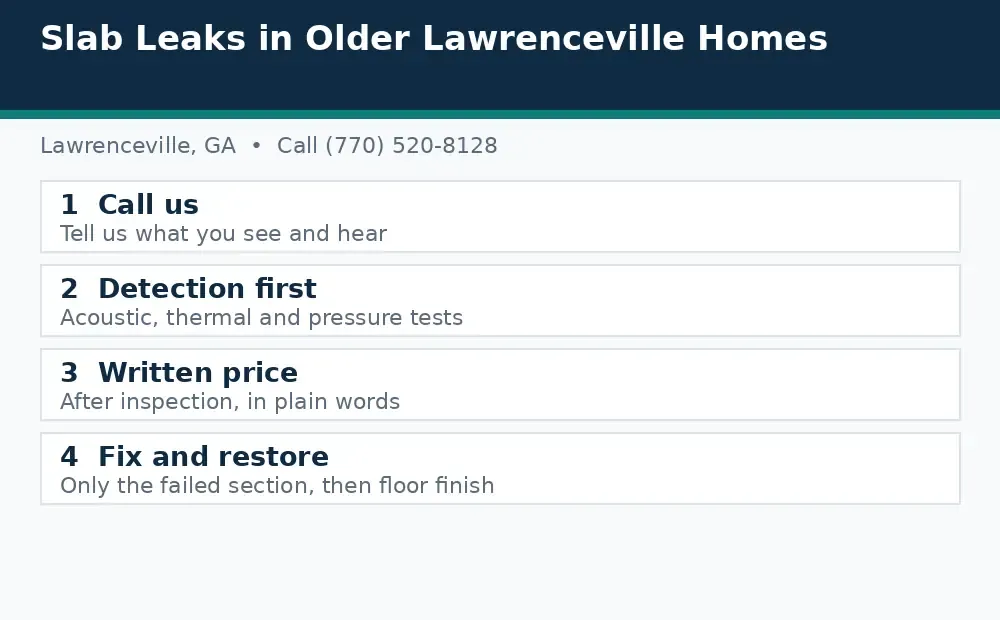
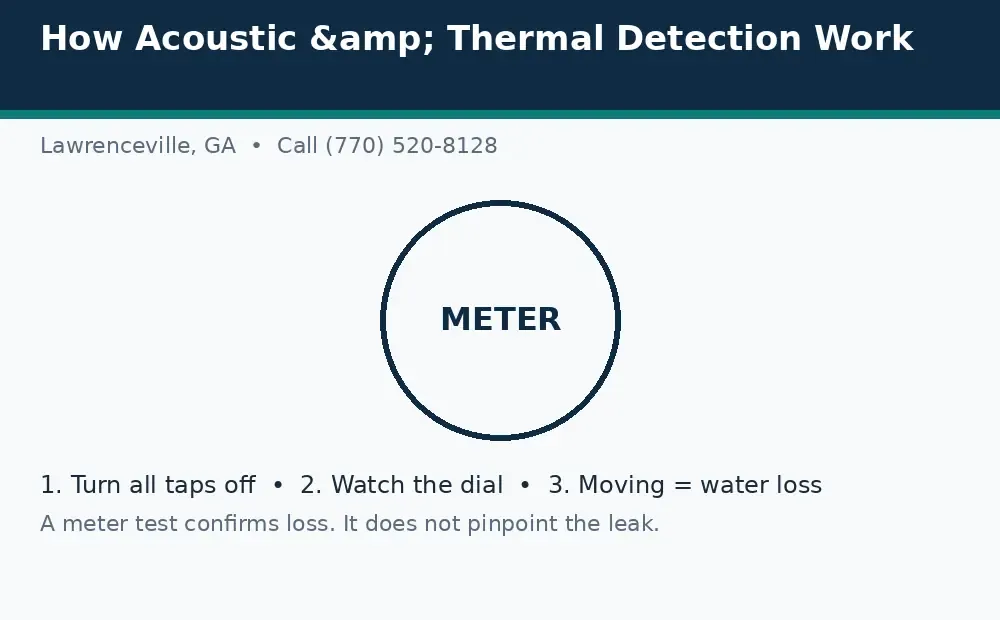
The working photo on this page is an illustrative working photo, not a photo of a specific job at a specific address. The diagrams are schematics, not to scale, made to explain the signs, process, options, or costs on this page in plain words. Call us at (770) 520-8128 if you are unsure what you are seeing.
Why is slab leak repair different from other DIY plumbing?
Most DIY plumbing works on visible, accessible pipes: a trap under a sink, a supply line to a toilet, a tap washer. The work is visible, the failure is visible, and a mistake shows itself immediately as a drip you can see and fix. Slab work inverts all three: the pipe is invisible under concrete, the failure is invisible until its effects surface rooms away, and a mistake — a wrong opening, a damaged neighbouring line, a poorly joined repair buried under concrete — hides until it fails again, by which time the floor has been restored over it. That inversion is why slab repair belongs to a different category from ordinary DIY plumbing, even for a capable homeowner.
The second difference is consequence scale. A mistake on a visible trap costs a towel and a second attempt. A mistake under a slab costs a second floor opening, a second restoration, and potentially a weakened slab section. The stakes do not make homeowners helpless — far from it, as the next section shows — but they do draw a clear line between the investigation a homeowner can do brilliantly and the repair that needs located, licensed work. Knowing that line is not a lack of ambition; it is the skill that keeps a manageable problem manageable.
What can a homeowner safely do themselves?
A homeowner can do the entire detective phase, and doing it well genuinely helps. Run the meter test with everything off and write both readings down. Compare bills with the same period last year and note the first period that breaks the pattern. Walk the house for signs — warm patches, damp spots, sounds, cracks — and photograph and date each one. Rule out the mimics: isolate toilet supplies, close bibs, shut the irrigation main, one at a time, watching the meter after each. Note the main shut-off's location and make sure everyone in the house knows it. Every one of those actions is safe, free, and useful, and together they form the evidence bundle a technician starts from.
A homeowner can also do the protective phase: shut the supply off if a leak is active and it is safe to do so, move valuables out of water's path, photograph damage before cleanup, and keep every bill, reading, and photo in one folder. Those actions limit damage while professional help is arranged, and they matter for any insurance file. What a homeowner should not do is the subject of the next section — and the line between the two lists is the whole point of this post. If you want a structured way to run the detective phase, the symptom checker and the mimics guide in this batch walk it step by step.
What should a homeowner never attempt on a slab leak?
Never open concrete to look for a leak. Without a located, marked point from pressure testing and listening or imaging, an opening is a guess, and a guessed opening can miss the leak entirely, damage a sound pipe, sever a neighbouring line, or weaken the slab — all while the real leak keeps running. Never attempt to repair a buried pipe by excavation without location work, for the same reason, plus the risks of buried utilities and unstable digging. Never repressurise a system after a burst or a major failure to 'see if it holds' without a located repair plan, because repressurising a failed section restarts the flooding and can widen the failure.
Also avoid the chemical and sealant shortcuts sometimes marketed for slab leaks. Products poured into a system cannot be steered to a leak under concrete, cannot be verified as having sealed anything, and can complicate the professional repair that follows by coating the pipe interior a camera or liner would otherwise read clearly. The same caution applies to partial DIY reroutes improvised without pressure testing: a new route that is not tested and not properly joined becomes a second leak risk buried in a wall. The professional steps that must not be improvised are covered on the detection page and the repair page — location first, written price after inspection, then repair and restoration, in that order.
How do DIY and professional work fit together best?
The best outcome is a handoff, not a contest: homeowner evidence in, professional location and repair out. A homeowner who arrives at a detection visit with a dated symptom list, meter readings, bill comparisons, ruled-out mimics, and dated photos has already done the slowest part of the job — the history-taking — and the technician can spend the visit testing and locating rather than reconstructing. That handoff also produces better decisions: a homeowner who understands the evidence can follow the method reasoning in the questions before approving guide and approve a repair on its merits rather than on trust alone.
The handoff works in reverse too. A professional who explains the findings in plain words — which line, where marked, what the evidence was, what the options are with their planning ranges — leaves the homeowner able to monitor afterwards: scheduled meter tests, bill comparisons, and prompt calls if a sign returns. That monitoring is DIY again, and it is the part that catches a future leak early. The division is therefore not 'homeowner versus professional' but 'homeowner before and after, professional in the middle' — and homes in Downtown Lawrenceville and Collins Hill benefit from that division exactly as homes anywhere in ZIPs 30043–30046 do.
What does DIY cost versus professional, honestly?
DIY detective work costs nothing but time, and it can save a wasted professional visit when the cause turns out to be a toilet or an irrigation fault. Professional detection is published on this site as a planning range of $300–$600, and repair ranges run from spot repair $500–$4,000 through lining $800–$3,000 and reroute $1,500–$5,500 to repipe $4,500–$15,000+, all planning ranges, not quotes, with a written price after inspection. Those figures frame the decision honestly: the professional cost is real, but so is the cost of a wrong DIY opening — a second opening, a second restoration, and a leak still running underneath.
The false economy to avoid is the DIY repair that saves the detection fee and spends the restoration budget twice. A homeowner who opens concrete on a guess and misses pays for the opening, the restoration of the wrong area, and then the professional location and repair anyway — with the floor already disturbed. By contrast, a homeowner who spends the detective phase well and then approves a located, written repair pays once, for the right scope, with restoration agreed in advance. That comparison, not any claim about skill or courage, is why this post draws the line where it does, and why the repair cost estimator is offered as a planning aid before any approval, not as a substitute for a written price.
DIY vs professional: the line
| Task | Homeowner (DIY) | Professional |
|---|---|---|
| Meter test, bill comparison | Yes — do it, write it down | Confirms and extends it |
| Symptom notes, photos | Yes — dated, wide and close | Uses them as the starting map |
| Mimic rule-outs | Yes — isolate one at a time | Verifies the ruled-out list |
| Shut-off, protect valuables | Yes — if safe | Advises on isolation |
| Pressure testing, listening, imaging | No | Yes — location work |
| Opening concrete | Never | Yes — only at a marked location |
| Pipe repair, reroute, repipe | No | Yes — licensed work, written price |
| Restoration | Monitoring afterwards | Yes — concrete and flooring |
The line is not about ability; it is about visibility. Visible work can be DIY work. Buried work under concrete cannot.
Detect yourself Meter, bills, symptoms, photos, mimics — the full detective phase.
Hand off Bring the evidence bundle to the detection visit.
Approve on evidence Method, opening, restoration, and written price — before work.
Monitor after Meter tests and bill comparisons catch the next leak early.
What to tell us when you call
When you call, tell us what you noticed, when it started, and where in the house it shows. Mention your ZIP code, whether the water meter moves with everything off, and whether the sign is on a hot-water or cold-water line if you know. That short list helps the technician bring the right equipment and plan the visit. You do not need to know the cause before you call — that is what detection is for.
Call (770) 520-8128 and describe what you are seeing in plain words. We will talk through the next step and arrange a detection visit.
Call Us Today
Fast local slab leak detection and repair in Lawrenceville, GA, ZIPs 30043–30046.
Call Us: (770) 520-8128Frequently asked questions
Can I find a slab leak myself with a rented listening device?
You can hear more, but hearing is not locating: professional location combines pressure testing, listening, imaging, and pipe-route knowledge, and a marked location from that combination is what a repair is based on. A rented device without the rest of the sequence risks a confident wrong mark.
Is it safe to break concrete to check for a leak?
No. Without a located point, an opening can miss the leak, damage sound pipes or utilities, and weaken the slab — while the real leak keeps running. Floor opening belongs after detection, at a marked point.
What DIY checks should I do before calling?
Meter test with everything off, bill comparison vs the same period last year, symptom notes with dated photos, and mimic isolations (toilets, bibs, irrigation). Bring all of it to the visit.
Are leak-sealing chemicals a DIY option for slab leaks?
No. They cannot be steered to an under-slab leak, cannot be verified as sealing anything, and can complicate the professional repair and camera work that follows.
Can I do the restoration myself after a professional repair?
Restoration scope should be agreed in writing with the repair. Some finishing work can be homeowner-done where agreed, but concrete refill and flooring restoration are normally part of the professional scope — confirm before approval, not after.